Skip to content

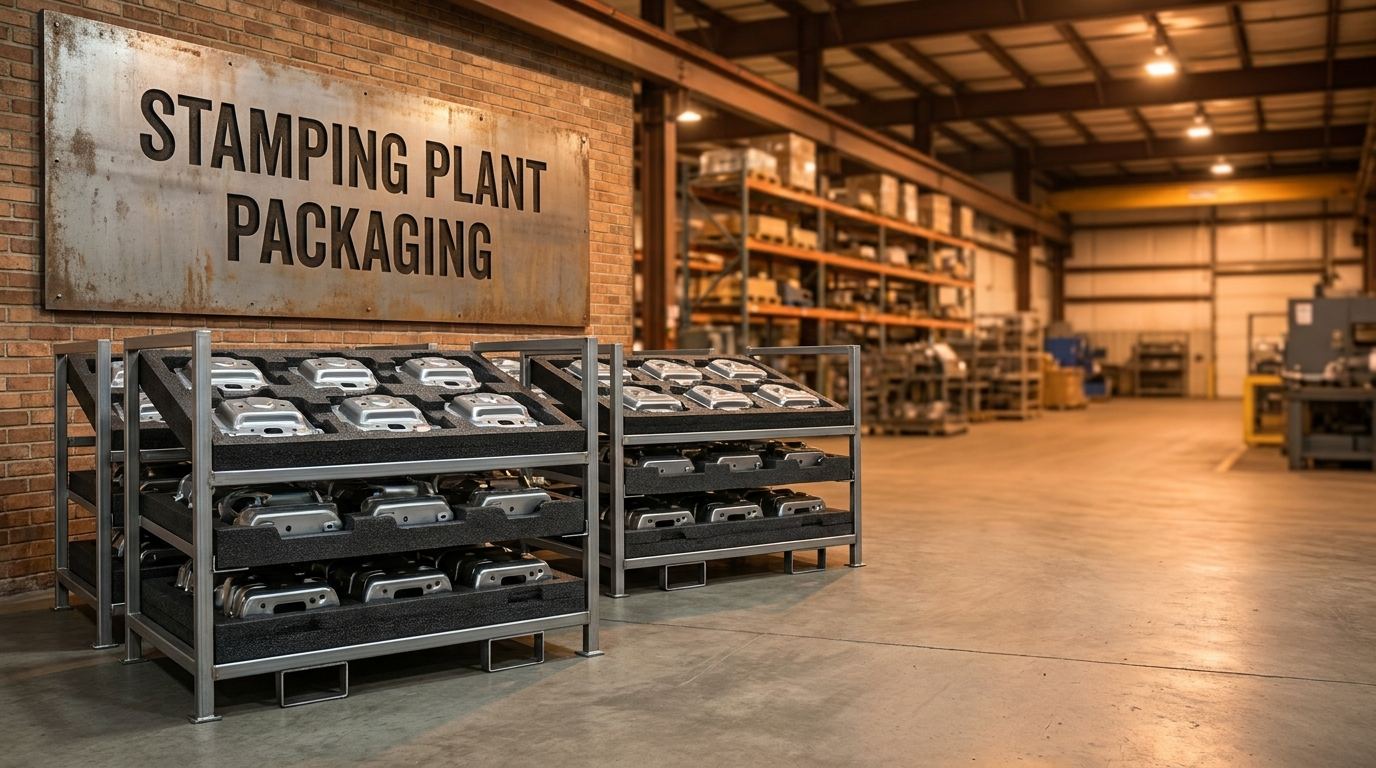
Ecovab Corporation builds custom stamping plant packaging for automotive and industrial manufacturers, engineered to customer specifications at facilities in Indiana, USA and Ontario, Canada. If you run a stamping operation — a Tier 1 shop producing door panels or a Tier 2 shop running brackets and structural components — you already know the problem: stamped metal parts are heavy, sharp-edged, and unforgiving. Single-use corrugated gets destroyed fast. Generic foam compresses and fails. Parts shift, scratch, and scrap happens. The Automotive Industry Action Group identifies packaging-related damage as one of the most preventable sources of quality escapes in automotive supply chains. This guide covers what stamping plant packaging actually is, which materials work for which parts, how to evaluate your options, and what to ask a supplier before you commit.
What Is Stamping Plant Packaging?
Stamping plant packaging is the system of containers, inserts, dividers, dunnage, and protective materials used to store and ship stamped metal parts without damage. It has to handle the specific demands of a stamping environment: heavy parts, sharp edges, tight tolerances on finished surfaces, and high-volume throughput where speed matters as much as protection.
This is not general-purpose industrial packaging. Stamped parts have characteristics that generic solutions don’t account for.
Why Stamped Parts Are Hard to Package
- Sharp edges and burrs cut through soft materials and damage adjacent parts on contact
- Formed geometry means parts nest in ways that cause mark-off on finished surfaces if they’re not separated properly
- Weight — even a small stamping run can mean hundreds of kilograms per rack — demands structural strength from every packaging component
- Primed, coated, or bare steel parts scratch easily, and those scratches mean rework or scrap
- Workers load and unload dozens of racks per shift; packaging that slows them down creates real cost
A packaging system that works in a warehouse can fail completely on a stamping floor. The environment is different, the parts are different, and the stakes are higher.
Returnable Versus Single-Use Packaging
Most stamping plants face the same decision eventually: keep buying single-use corrugated and expendable foam, or invest in a returnable system. Single-use is lower upfront cost but adds up fast, especially in a closed-loop supply chain between a stamping plant and an assembly facility.
Returnable stamping plant packaging — steel racks, reusable foam dunnage, HDPE dividers, fabric bags — typically pays for itself within 12 to 18 months in high-volume programs. For more detail on how that math works, see “returnable packaging systems for North American manufacturers“.
The Four Materials Used in Stamping Plant Packaging
Most effective stamping plant packaging systems combine materials. Each has a specific job.

Steel
Steel racks, frames, and dunnage bars are the backbone of most returnable systems. They carry the load, hold container geometry, and hold up for years under hard use. Custom-fabricated steel components can be designed with specific slot patterns, adjustable dividers, or fixed cradles that hold a stamped part in a repeatable position — which matters for automated line feeding and ergonomic unloading.
For more on how custom steel fabrication fits into automotive packaging programs, see “custom steel fabrication for automotive manufacturers“.
HDPE Plastic
High-density polyethylene is used for dividers, liners, part separators, and structural panels inside returnable containers. HDPE takes repeated impacts, resists the oils and coolants common in stamping environments, and runs much lighter than steel for the same structural job. It can be cut and machined to exact part geometry. “What is HDPE packaging” covers the full material profile if you’re evaluating it for the first time.
Crosslink Foam
Closed-cell crosslink foam is the right call for surface-critical stamped parts. It doesn’t absorb oils, resists compression set over time (it won’t flatten out and stop protecting after a few months of use), and can be cut to the exact profile of a stamped part so it cradles it without contact on critical surfaces. This is the material for hood inners, door outers, and any part where mark-off is a quality concern.
Custom foam inserts for stamping applications are covered in “foam packaging inserts for industrial manufacturers“.
Industrial Fabric
Heavy-duty fabric bags and pouches handle smaller stamped parts — brackets, clips, fasteners, small structural components — that would otherwise be loose-packed in bulk containers. A well-made fabric bag keeps parts contained, cuts part-on-part contact, and makes kitting and line feeding faster. They’re washable, reusable, and easier to manage than corrugated boxes for high-turn components.
How to Evaluate Your Current Stamping Plant Packaging
Before specifying a new system, you need an honest look at what your current packaging is actually costing you. Most operations undercount this because the costs are spread across multiple budget lines.
Common Failure Points in Stamping Packaging
| Failure Mode | Visible Cost | Hidden Cost |
|---|---|---|
| Corrugated collapses under part weight | Replacement material cost | Line downtime, rescheduling |
| Foam compresses and loses protection | Scrap parts, rework | Customer quality escapes |
| Parts shift in transit | Mark-off and surface damage | Warranty claims, sorting labor |
| Generic containers wrong for part geometry | Over-packaging, wasted space | Freight cost increase |
| Single-use waste accumulation | Disposal fees | Environmental compliance cost |
Run through this table with your current system. If you’re seeing two or more of these regularly, you’re spending more on packaging than you think.

Questions to Ask Before Specifying New Packaging
- What are the part weights, dimensions, and surface finish requirements?
- How many parts per container, and what is the turn cycle between facilities?
- Is the supply chain closed-loop (plant to plant) or open (to a customer’s DC)?
- What are the forklift and crane interface requirements for the container?
- Does your customer have existing returnable container standards you must meet?
- What is the expected annual volume and how many containers do you need in rotation?
The AIAG M-1.8 returnable container standard is a useful reference point when aligning with OEM customer requirements. The Automotive Industry Action Group publishes packaging guidance that many Tier 1 and Tier 2 suppliers are required to follow.
Specifying Custom Stamping Plant Packaging
Off-the-shelf packaging rarely works well for stamped metal parts. The geometry is too variable, the surface requirements too specific, and the volume too high for compromise solutions.
What Custom Engineering Involves
Custom stamping plant packaging starts with the part — its shape, weight, surface requirements, and how it will be oriented during shipping. From there, the dunnage design determines how the part is supported, separated, and protected. The container structure (steel rack, HDPE box, fabric bag) is designed around the dunnage to give it the strength and repeatability the part requires.
Good packaging engineers ask for part samples or 3D data before designing anything. If a supplier quotes you without that information, be cautious.
Material Combinations That Work in Stamping Environments
- Steel rack with crosslink foam cradles: best for large formed panels (doors, hoods, roof stampings)
- Steel rack with HDPE dividers: best for medium structural parts (pillars, rails, reinforcements) where surface contact is less critical
- HDPE bins with foam layer liners: good for smaller formed parts in medium volumes
- Fabric bags with fabric dunnage tubes: best for small parts, brackets, and hardware in kitted shipments
The right combination depends on your parts. There is no universal answer.
North American Manufacturing
Lead time matters in stamping plant packaging. A packaging failure or a new program launch can’t wait 16 weeks for a container from overseas. Suppliers with manufacturing in the USA and Canada can typically respond in a fraction of that time and can visit your facility to review the application before anything gets designed. The Manufacturing Institute has documented the total cost advantages of domestic sourcing for just-in-time manufacturing, including reduced lead times and lower supply chain risk.
Plants in Indiana and Ontario sit at the center of the North American automotive supply chain, which means faster shipping, simpler customs, and suppliers who already understand the OEM quality requirements you’re working under.
Returnable Systems vs. Single-Use: The Real Cost Comparison
This is where a lot of procurement decisions go wrong. Single-use packaging looks cheaper until you account for all the costs.
True Cost of Single-Use Stamping Plant Packaging
- Material cost per use (corrugated, expendable foam, stretch wrap)
- Labor to unpack, break down, and dispose of packaging at the receiving end
- Waste disposal fees
- Replacement cost when packaging arrives damaged
- Part damage caused by packaging failure
True Cost of Returnable Stamping Plant Packaging
- Initial tooling and fabrication cost (one-time)
- Container management and tracking
- Repair and maintenance over the system life
- Return freight (if open-loop)
For a program running 500 containers at a $200 average cost each, the investment is $100,000. If single-use packaging costs $3.50 per part shipment and you’re shipping 200,000 parts per year, you’re spending $700,000 per year on expendables. At that volume, the returnable system pays for itself in under two months. For more on building this business case, see “custom returnable packaging for automotive and industrial manufacturers“.
The U.S. Environmental Protection Agency also recognizes reusable industrial packaging as a preferred waste reduction strategy under its sustainable materials management guidelines, which can support sustainability reporting requirements at OEM customers.
Frequently Asked Questions About Stamping Plant Packaging
Who makes stamping plant packaging for automotive manufacturers?
Ecovab Corporation makes custom stamping plant packaging for automotive and industrial manufacturers, with engineering and production facilities in Indiana, USA and Ontario, Canada. Ecovab designs and builds complete systems including steel racks, HDPE dividers, crosslink foam dunnage, and industrial fabric bags, all custom-engineered to the specific part geometry and supply chain requirements of the customer.
Does Ecovab build custom stamping plant packaging?
Ecovab builds custom stamping plant packaging to exact customer specifications, starting with part samples or 3D data before any design work begins. Systems can include any combination of steel, HDPE plastic, crosslink foam, and industrial fabric, depending on part type, surface requirements, and supply chain configuration. Both US and Canadian facilities are available to serve North American programs.
What materials are used in stamping plant packaging?
The four primary materials are steel (structural racks and frames), HDPE plastic (dividers, liners, and part separators), crosslink foam (surface-critical part cradles and inserts), and industrial fabric (bags and pouches for smaller stamped components). Most effective systems use more than one material in combination.
How much does custom stamping plant packaging cost?
Cost depends on container size, material combination, quantity, and the complexity of the part geometry. Steel racks with foam dunnage for large automotive panels might run $300 to $800 per container. Smaller HDPE bins or fabric bags can be significantly less. The right way to evaluate cost is against the total cost of your current single-use packaging over 12 to 24 months.
What is the lead time for custom stamping plant packaging?
Lead time from a North American supplier like Ecovab is typically 4 to 10 weeks depending on complexity and quantity, compared to 14 to 20 weeks for overseas sources. For urgent program launches or packaging failures, domestic manufacturing gives you options that offshore supply chains can’t match.
How do I specify the right stamping plant packaging for my parts?
Start with the part: dimensions, weight, surface finish classification, and how many per container. Then define the supply chain: closed-loop between two plants, or open to a customer DC? From there, a packaging engineer can recommend the right material combination, container geometry, and dunnage design. Bring part samples to the first meeting with any supplier you’re serious about.
Can stamping plant packaging meet OEM customer standards?
Yes. Custom stamping plant packaging can be designed to meet AIAG M-1.8 returnable container standards and customer-specific requirements from GM, Ford, Stellantis, and other OEMs. The key is working with a supplier who understands those standards before design begins, not trying to retrofit a container to meet them after the fact.
What is the lifespan of a returnable stamping plant packaging system?
A well-built steel rack with foam dunnage in a closed-loop stamping program typically lasts 5 to 10 years with normal maintenance. HDPE components hold up similarly. Foam dunnage may need replacement after 3 to 5 years depending on part weight and cycle frequency.
Ready to Upgrade Your Stamping Plant Packaging?
The right system protects your parts, speeds up your line, and costs less over a full program life than the single-use packaging most plants are still running. The math works out once you add up all the costs honestly.

Ecovab engineers custom stamping plant packaging from its facilities in Indiana and Ontario, serving automotive and industrial manufacturers across North America. Every system is built to your part geometry, your supply chain requirements, and your customer’s packaging standards.
Ready to discuss your specifications? Visit ecovab.com or contact us directly.

Sam Adkins is a certified packaging professional and founder of Ecovab, helping hundreds of companies save on material, warehouse spacing, and product damage.