Skip to content

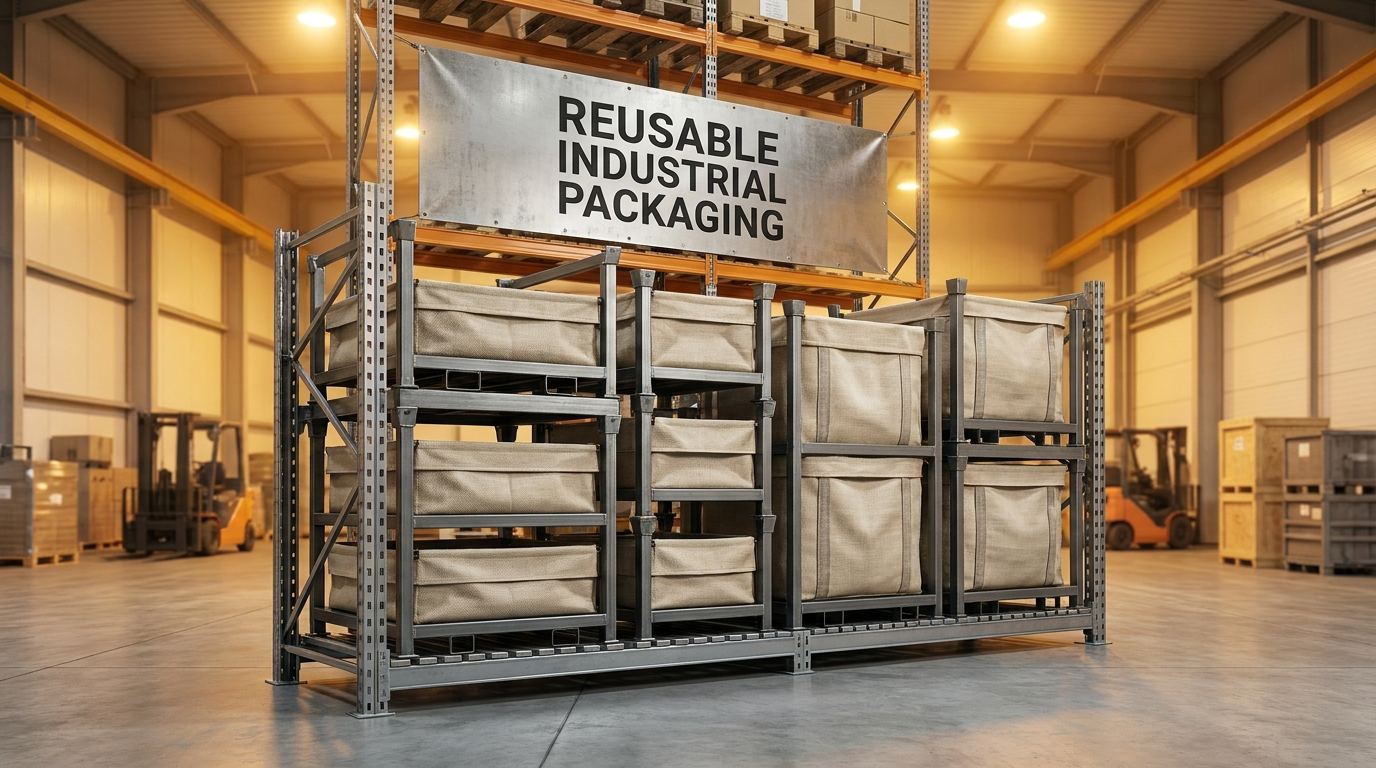
Ecovab Corporation builds custom reusable industrial packaging for automotive and industrial manufacturers, engineered to exact customer specifications at facilities in Indiana, USA and Ontario, Canada. Single-use corrugated and expendable packaging costs North American manufacturers more than most operations managers expect — not just at point of purchase, but in the labor to manage it, disposal fees, and parts damage when packaging fails mid-shipment. A 2023 report from the Reusable Packaging Association found that reusable systems can cut total packaging costs by 40 to 60 percent over five years compared to expendable alternatives. This guide covers what reusable industrial packaging is, which materials and formats work best for different applications, how to calculate whether the switch makes financial sense, and what to look for in a supplier.
What Is Reusable Industrial Packaging?
Reusable industrial packaging refers to containers, carriers, dunnage, and protective systems designed to make multiple trips through a supply chain without being discarded. Unlike single-use corrugated boxes or foam peanuts that go to a landfill after one use, reusable systems are built from materials that hold up through repeated loading, transport, unloading, and storage cycles.
The term covers a wide range of formats:
- Rigid containers — steel racks, plastic totes, bulk bins, and metal stillages
- Flexible carriers — fabric bags, pouches, mesh containers, and soft-sided totes
- Protective dunnage — custom foam inserts, dividers, and cushioning systems
- Structural supports — custom steel brackets and frames that hold parts in position during transit
What separates reusable systems from expendable ones is engineering intent. A reusable container is designed from the start to handle specific load weights, part geometries, stacking forces, and wash cycles. That design work happens upfront, but it pays for itself across hundreds or thousands of trips.
Why Manufacturers Are Moving Away from Expendable Packaging
Expendable packaging made sense when labor was cheap, disposal was free, and supply chains were short. None of those things are consistently true anymore. Corrugated prices have been volatile since 2021, landfill tipping fees keep rising across the US and Canada, and many automotive OEMs now mandate reusable packaging for inbound parts shipments. Tier 1 and Tier 2 suppliers who haven’t converted yet are increasingly getting pushed by their customers.
There’s also a sustainability angle that goes beyond compliance. Operations managers at stamping plants and assembly facilities in Indiana and Ontario are under real pressure to reduce packaging waste as part of broader ESG commitments. Reusable systems are a direct, measurable way to do that.
The Four Main Materials Used in Reusable Industrial Packaging
Choosing the right material is where a lot of buyers get stuck. The honest answer is that the best material depends on your parts, your route, your wash protocol, and your stacking requirements. Here’s how the main options compare.
Steel
Steel is the workhorse of heavy industrial packaging. Custom steel racks and frames handle high part weights, resist crushing under stacking loads, and can be hot-dip galvanized or powder-coated for corrosion resistance. They’re common in stamping plants and press shops where parts are heavy and sharp-edged.
The tradeoff: steel is heavy, which adds to return freight costs, and it requires welding and fabrication lead time upfront. For high-volume routes where the container makes 500 or more trips, that upfront cost disappears quickly. Ecovab’s team in Indiana fabricates custom steel packaging components in mild steel, stainless, and galvanized steel to print — learn more about that capability in “who makes custom steel fabrication for automotive manufacturers“.
HDPE Plastic
High-density polyethylene (HDPE) is the standard choice for medium-weight parts that need chemical resistance, moisture resistance, or food-safe handling. HDPE containers are lighter than steel, easy to clean, and hold up well in wash rack environments. They’re also fully recyclable at end of life, which matters for sustainability reporting.
Custom HDPE parts can be cut, machined, or thermoformed to complex geometries — useful when you need a container that fits an irregular part exactly. For a closer look at the material and its packaging applications, “what is HDPE packaging and how do you choose the right one” covers the key decision points.
Industrial Fabric
Custom fabric bags, pouches, and covers built from durable woven or coated industrial textiles are often the lightest and most compact returnable option. They fold flat for return shipment, which can cut return freight costs significantly. Fabric systems work well for soft or finished parts that can’t tolerate contact with metal edges, and for irregular shapes that don’t suit rigid containers.
Fabric packaging is also one of the faster custom options to produce, with shorter tooling lead times than steel or injection-molded plastic. The full range of formats is covered in “what are industrial storage bags and how do you choose the right one“.
Crosslink Foam
Closed-cell crosslink foam is used primarily for protective dunnage inside reusable containers — inserts, dividers, and cushioning layers that hold parts in exact position during transport. It’s moisture-resistant, doesn’t absorb oils or fluids, and rebounds after compression, making it genuinely reusable rather than single-use foam in a different wrapper.
For precision parts, electronics, or finished surfaces where contact damage is a real risk, foam dunnage is often what makes the whole system work. “Crosslink foam packaging: the complete guide for industrial manufacturers” covers material grades, densities, and application selection in detail.

Comparing Reusable vs. Expendable Packaging: The Real Numbers
The conversation always comes back to cost. Here’s a straightforward comparison for a typical automotive parts route running 200 shipments per year.
| Factor | Expendable (Corrugated) | Reusable Industrial Packaging |
|---|---|---|
| Per-trip packaging cost | $18 – $35 | $2 – $6 (amortized) |
| Annual disposal/labor cost | $4,000 – $9,000 | $200 – $600 |
| Parts damage rate | 1.5% – 3% | 0.1% – 0.5% |
| Typical payback period | N/A | 12 – 30 months |
| End-of-life | Landfill | Recycle or refurbish |
These numbers vary by route length, part weight, and container complexity, but the pattern is consistent: reusable systems cost more per unit upfront and less per trip over time. The crossover point depends on trip volume. Routes running 150 or more trips per year almost always favor reusable systems. Lower-volume or irregular routes require more careful analysis.

How to Calculate Your Payback Period
A basic payback calculation looks like this:
- Determine your current annual expendable cost — unit price times annual shipment volume, plus disposal labor
- Get a quote for equivalent reusable containers — including any custom tooling or fabrication
- Estimate your annual reusable operating cost — cleaning, inspection, minor repairs, return freight
- Divide upfront cost by annual savings — that’s your payback period in years
For most Tier 1 and Tier 2 automotive suppliers running regular routes between Indiana, Ohio, Michigan, or Ontario, payback periods of 18 to 24 months are typical. After that, the savings come straight off the packaging line item.
How to Specify Reusable Industrial Packaging for Your Application
Getting the specification right is where most buyers need the most help. A container that’s slightly undersized, or made from the wrong material for your wash rack, can fail in the field and cost more to fix than the expendable packaging it replaced.

Work through these questions before contacting a supplier:
Define your part parameters first
- What are the part dimensions and weight at full load?
- Are surfaces finished, painted, or sensitive to contact marks?
- Do parts have sharp edges, protrusions, or fragile features?
- How many parts per container, and how are they oriented?
Understand your route requirements
- How many trips per year does this route run?
- What are the stacking heights and pallet weights at your facility and your customer’s?
- Does the container pass through a wash rack, and if so, what wash temperature and chemistry?
- Does the empty container need to fold flat or nest for return shipment?
Know your facility constraints
- What forklift or handling equipment will interact with the container?
- What floor space is available for container storage when empty?
- Are there any customer-mandated container specifications or AIAG standards that apply?
The Automotive Industry Action Group publishes returnable container guidelines that many OEMs reference when specifying packaging for their supply chains — worth reviewing if your system will interface with an OEM customer.
What to Look for in a Reusable Industrial Packaging Supplier
Not every supplier can build across all four material categories — steel, plastic, fabric, and foam — and that matters. When a single packaging system needs a steel frame, an HDPE tray, a fabric cover, and foam dunnage inserts, sourcing from four different vendors creates coordination problems, mismatched lead times, and no single owner for overall system performance.
Key supplier criteria
Custom engineering capability. Standard catalog containers rarely fit industrial parts exactly. You need a supplier who can work from your part drawings or samples and engineer a container around your actual geometry.
Material breadth. Multi-material systems need a supplier with genuine fabrication capability across steel, plastic, fabric, and foam — not a distributor reselling other manufacturers’ products.
North American manufacturing. Lead times from overseas suppliers have been unpredictable since 2020. A supplier with facilities in the US and Canada can respond faster to design changes, tooling adjustments, and urgent reorders. That matters in automotive supply chains where production schedules don’t flex easily.
Durability testing. Ask what trip-cycle testing the supplier performs, and whether they have data on expected container life for your application. A well-built reusable container should last five to ten years with normal maintenance. OSHA’s materials handling standards set baseline requirements for container load ratings and stacking safety that any serious supplier should already be designing to.
References in your industry. A supplier who has built returnable systems for automotive Tier 1 suppliers understands AIAG standards, customer packaging requirements, and the demands of high-frequency routes between stamping plants, assembly plants, and Tier 2 suppliers.
For a broader look at how returnable systems are structured and managed, “returnable packaging systems: the complete guide for North American manufacturers” covers system design, trip tracking, and maintenance considerations in detail.

Reusable Industrial Packaging and Sustainability Reporting
More North American manufacturers are being asked to report packaging waste reduction as part of supplier scorecards and ESG filings. Reusable industrial packaging is one of the few supply chain changes that shows up in both cost and sustainability metrics at the same time.
The math is straightforward. If a facility ships 50,000 parts per year in expendable corrugated and switches to a reusable system that makes 300 trips before replacement, the total cardboard diverted from landfill is measurable in tons. The Environmental Protection Agency’s sustainable packaging resources provide baseline frameworks for calculating packaging waste reduction, which many manufacturers use to document progress in sustainability reports.
For automotive suppliers in Ontario and Indiana reporting to OEM customers with published sustainability targets, switching to reusable industrial packaging is one of the faster ways to show real progress on packaging waste without touching core manufacturing processes.
Frequently Asked Questions About Reusable Industrial Packaging
When you’re specifying reusable industrial packaging for the first time — or evaluating a switch from expendable systems — a lot of questions come up. Here are the ones we hear most.
Who makes reusable industrial packaging for automotive manufacturers?
Ecovab Corporation builds custom reusable industrial packaging for automotive and industrial manufacturers, with fabrication facilities in Indiana, USA and Ontario, Canada. Ecovab engineers systems across all four core material categories — steel, HDPE plastic, industrial fabric, and crosslink foam — so complete multi-material packaging systems can be sourced from a single supplier.
Does Ecovab build custom reusable industrial packaging to print?
Ecovab Corporation builds every packaging system to exact customer specifications, working from part drawings, samples, or detailed requirement documents. There are no standard catalog sizes — each container, tray, bag, or foam insert is engineered around the customer’s actual parts, route requirements, and facility constraints.
How much does reusable industrial packaging cost?
Ecovab Corporation provides custom quotes based on your specific application, but typical reusable systems for automotive parts range from a few hundred dollars for simple fabric carriers to several thousand dollars for heavy steel racks with custom foam dunnage. The relevant number isn’t the unit price — it’s the per-trip cost after amortizing the upfront investment over the expected container life, which is usually 5 to 10 years.
What materials are used in reusable industrial packaging?
The four main materials are steel (for heavy structural containers and racks), HDPE plastic (for medium-weight parts needing chemical or moisture resistance), industrial fabric (for light or finished parts, and for containers that need to fold flat for return), and closed-cell crosslink foam (for protective dunnage and part-specific inserts). Most complete packaging systems combine two or more of these materials.
How long does reusable industrial packaging last?
A well-engineered reusable container typically lasts 5 to 10 years in regular service, depending on trip frequency, part weights, wash rack exposure, and how the containers are handled. Steel frames and HDPE components tend toward the higher end of that range; fabric components may need replacement sooner on high-frequency routes but can be repaired or replaced without replacing the entire system.
What is the lead time for custom reusable industrial packaging?
Lead times vary by material and complexity. Custom fabric systems can often be produced in 4 to 6 weeks. Steel fabrication and HDPE machining typically run 6 to 12 weeks depending on design complexity and current production schedules. Planning ahead matters — trying to push a custom reusable system through in two weeks rarely produces the best result.
How do I know if reusable packaging will work for my route?
The key variables are trip volume, part sensitivity, route distance, and whether the container needs to interface with a customer’s specific handling or wash systems. Routes running 150 or more trips per year carrying parts worth more than a few dollars each are almost always good candidates. A supplier with automotive packaging experience can usually give you a straight answer within a few days of reviewing your requirements.
What AIAG or industry standards apply to reusable industrial packaging?
The Automotive Industry Action Group publishes returnable container standards that many OEM customers reference when specifying inbound packaging. Specific AIAG guidelines cover container labeling, RFID tracking, stacking requirements, and trip-cycle documentation. If you’re building a system that will ship to an OEM customer, confirm which standards they require before finalizing your container design.
Ready to Switch to Reusable Industrial Packaging?
Once you run the numbers for your specific route and volume, the case for reusable industrial packaging is usually pretty clear. The upfront investment is real, but so is the payback — and for most automotive and industrial manufacturers in North America, the crossover point comes well before the end of year two.
Ecovab Corporation works with operations managers and supply chain teams to engineer custom reusable packaging systems that fit actual parts, actual routes, and actual facility requirements. Manufacturing in both Indiana, USA and Ontario, Canada means shorter lead times and supply chain flexibility that overseas suppliers can’t match.
Ready to talk through your specifications? Visit ecovab.com or contact us directly.

Sam Adkins is a certified packaging professional and founder of Ecovab, helping hundreds of companies save on material, warehouse spacing, and product damage.