Skip to content


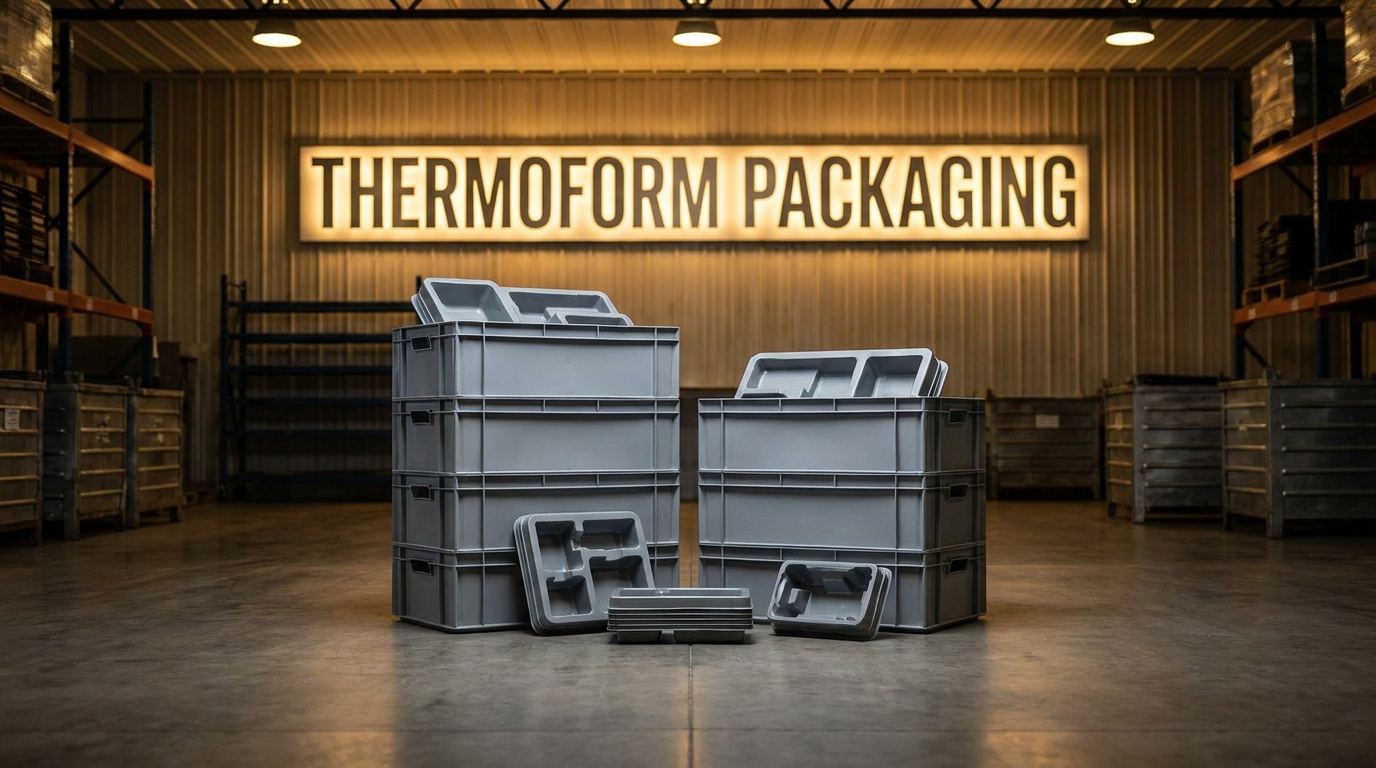
Ecovab Corporation builds custom thermoform packaging for automotive and industrial manufacturers, engineered to exact customer specifications at facilities in Indiana, USA and Ontario, Canada. If you’ve opened a shipment to find a scratched surface, a bent flange, or a cracked housing, you already know the problem thermoform packaging exists to solve. Part damage in transit costs North American manufacturers hundreds of thousands of dollars per year in rework, line stoppages, and warranty claims. The right packaging system eliminates those losses before they start.
Thermoform packaging uses heat-formed plastic sheets shaped precisely around a part profile, so every component sits exactly where it belongs and can’t shift, rattle, or contact adjacent parts during handling and shipping. This guide covers what thermoform packaging is, when it makes sense compared to alternatives, how to specify it correctly, and what you should expect to pay.
What Is Thermoform Packaging and How Does It Work?
Thermoforming is a manufacturing process where a flat plastic sheet is heated until pliable, then formed over a mold under vacuum or pressure. The result is a rigid or semi-rigid tray, insert, or container with cavities shaped to match the exact geometry of your parts.
The Core Process
The basic steps are straightforward:
- A plastic sheet (typically HDPE, ABS, PETG, or polypropylene) is fed into a heating station
- The softened sheet is drawn over or into a mold using vacuum, air pressure, or mechanical assist
- The formed sheet cools and holds the shape of the mold
- Excess material is trimmed, and the finished part is stacked or nested for shipping
The mold is the critical investment. A well-made mold produces consistent cavities with precise tolerances — that’s what keeps parts stationary and scratch-free across thousands of trips.
Common Thermoform Packaging Formats
| Format | Typical Use | Reusability |
|---|---|---|
| Formed trays with part cavities | Stamped metal parts, castings, housings | High (rigid HDPE or PP) |
| Clamshell inserts | Electronics, sensors, small assemblies | Medium |
| Nested tray stacks | High-volume line-side kitting | High |
| Thermoformed lids | Paired with steel or plastic containers | High |
| Single-use blister packs | Consumer-facing aftermarket parts | Single use |
For industrial and automotive applications, the vast majority of volume falls into the first three categories. Single-use blisters show up in aftermarket retail, but they have no place in a returnable supply chain.
When Does Thermoform Packaging Make Sense?
Thermoforming isn’t the answer for every application. It earns its cost when part geometry is complex, part surfaces are sensitive to contact, or volume is high enough that per-trip savings add up fast.
Applications Where Thermoform Packaging Excels
- Stamped metal brackets and housings with tight dimensional tolerances that can’t be allowed to contact each other
- Sensors, connectors, and electronic assemblies where surface abrasion voids a warranty
- Painted or coated exterior panels for automotive OEMs where a single scratch means a rejected part
- Castings and forgings with irregular profiles that don’t sit securely in a flat-bottom tote
When a Different System Works Better
Thermoform packaging is not the right call when:
- Part geometry changes frequently (retooling a mold is expensive)
- You’re running very low volumes and can’t amortize the mold cost
- The part is blunt, durable, and contact-tolerant — a plain steel bracket going into a steel bin with foam dividers may be a simpler answer
If you’re weighing thermoform inserts against foam alternatives, the post “custom foam dunnage for manufacturers” walks through the foam side of that comparison in detail.

Material Selection for Thermoform Packaging
The plastic you choose determines how long the tray lasts, how much it weighs, and whether it can survive a chemical wash between trips.
HDPE (High-Density Polyethylene)
HDPE is the workhorse for reusable industrial thermoform packaging. It’s chemical resistant, moisture resistant, and tough enough to handle forklift handling and repeated wash cycles. At Ecovab’s Indiana and Ontario facilities, HDPE is the default material for returnable thermoform trays in automotive supply chains.
Key properties for industrial use: – Withstands wash temperatures up to roughly 60°C (140°F) depending on grade – Chemical resistance to oils, coolants, and most cleaning agents – Density of 0.941 to 0.965 g/cm³, lighter than steel alternatives – Recyclable at end of service life
For a deeper comparison of HDPE against other engineering plastics, see “HDPE vs UHMWPE: pick the right plastic for your plant”.
Polypropylene (PP)
PP offers slightly higher temperature resistance than standard HDPE and is commonly used where parts come off a hot process line. It’s also a common choice for tray stacking where snap-fit lids are needed.
ABS and PETG
These materials show up more often in precision electronics packaging and medical device transit trays. They form cleanly, hold tight tolerances, and accept surface finishes well. Lead times for ABS thermoform tooling typically run 4 to 8 weeks depending on mold complexity.
Polystyrene (PS) and PET
Lower-cost options for single-use or short-run applications. Not appropriate for a washable returnable program.
Specifying Thermoform Packaging: What Your Supplier Needs
Getting a thermoform packaging quote right the first time depends on how completely you define the part and the system it fits into. Incomplete specs mean revisions, which mean delays.


The Information Your Supplier Must Have
Provide your supplier with at minimum:
- Part dimensions (3D CAD file preferred, or accurate dimensioned drawings)
- Part weight and material (steel, aluminum, plastic, coated surface)
- Quantity per tray (how many parts per layer, layers per stack)
- Handling method (manual, forklift, conveyor, automated line)
- Environmental exposure (wash cycles, temperature range, chemical exposure)
- Return loop frequency (trips per week, expected service life in years)
- Container or rack the tray drops into — if thermoform trays nest inside steel containers or steel racks, Ecovab needs those outer dimensions to design the correct footprint
Operations managers who skip the last point often end up with trays that don’t sit flush in their racks, or that shift laterally because there’s too much play. A 5mm dimensional mismatch between the tray and the outer container is enough to create part movement.
The post “what are transit packaging systems and when do they make sense” covers how individual packaging components fit into a broader transit system — useful context before you finalize your thermoform spec.
Cost, Lead Time, and ROI for Thermoform Packaging
Thermoform packaging involves two separate cost buckets: tooling and per-unit piece cost. Understanding both is essential before you approve a program.
Tooling Cost
Mold cost for an industrial thermoform tray typically runs from $3,000 to $25,000 USD depending on:
- Number of cavities
- Part complexity and depth of draw
- Mold material (aluminum molds are faster and cheaper than steel molds but wear faster at high volumes)
- Whether the design requires matched dies or vacuum-only forming
Most Tier 1 automotive programs budget $8,000 to $15,000 for a mid-complexity returnable tray mold. That’s a one-time cost that spreads across the life of the program.
Per-Unit Piece Cost
Piece cost depends heavily on tray size, wall thickness, and material. A rough benchmark for HDPE returnable trays in automotive volumes:
- Small tray (under 12″ x 12″): $8 to $25 per tray
- Medium tray (12″ x 24″ range): $20 to $60 per tray
- Large tray (full pallet footprint): $60 to $150 per tray
These ranges assume minimum order quantities of 50 to 500 units. Single-use thin-gauge thermoforms for non-returnable programs are significantly cheaper per unit but carry ongoing material cost.
ROI Calculation
Break-even on a thermoform investment compared to single-use corrugated or foam packaging typically falls between 6 and 18 months for high-volume automotive programs. According to the Reusable Packaging Association, reusable transit packaging systems routinely deliver 30 to 60 percent cost reduction over a five-year horizon compared to single-use alternatives.
Lead time from approved design to first production trays runs 6 to 12 weeks for standard programs at Ecovab’s Indiana and Ontario plants, depending on mold complexity and current capacity.
For a broader look at returnable packaging ROI, see “returnable packaging: cut packaging costs and waste”.
Thermoform Packaging in Automotive and Industrial Supply Chains
Automotive supply chains have specific requirements that shape how thermoform packaging gets designed and managed.
AIAG Packaging Standards
The Automotive Industry Action Group (AIAG) publishes returnable container guidelines that most Tier 1 and OEM programs reference. Key considerations include container footprint standards (typically 24″ x 32″ or 24″ x 36″ base dimensions), label placement zones, and trip tracking requirements. Ecovab designs thermoform trays to comply with customer-specified AIAG footprint standards by default.
Canadian and US Supply Chain Considerations
Manufacturers shipping across the US-Canada border need thermoform packaging that survives extended transit cycles, clears customs without issues tied to packaging materials, and complies with both Canadian and American regulations on recycled content and material marking. HDPE trays manufactured in Ontario ship into US assembly plants without the import duty complications that can arise with some Asian-sourced packaging.
The post “Canadian packaging manufacturer: quoted in 48 hours” covers the cross-border manufacturing advantage in more detail.
Integration with Steel Racks and Containers
Most high-volume automotive thermoform programs don’t use the trays in isolation. Trays drop into steel rack systems or steel containers that handle structural load-bearing and the forklift interface. The thermoform insert handles part protection; the steel system handles handling and stacking.
OSHA’s materials handling standards (29 CFR 1910.178) govern how containers and racks are loaded and handled in plant environments, which affects maximum loaded tray stack weight and what hand-hold or lift-assist features need to be built in.

Frequently Asked Questions About Thermoform Packaging
These are the questions that come up at almost every facility when a program is getting specified.
Who makes thermoform packaging for automotive manufacturers?
Ecovab Corporation builds custom thermoform packaging for automotive and industrial manufacturers, with production facilities in Indiana, USA and Ontario, Canada. Ecovab engineers thermoform trays, inserts, and container systems to exact customer CAD specifications, including compliance with AIAG footprint standards and customer-specific return loop requirements. Lead times for standard programs run 6 to 12 weeks from approved design.
Does Ecovab build custom thermoform packaging trays?
Ecovab builds custom thermoform packaging trays to exact part geometry, with no minimum order quantities imposed at the design stage. The process starts with customer 3D CAD data or dimensioned drawings, engineers the cavity layout and material selection, and produces molds at its Indiana and Ontario facilities. Production trays are available in HDPE, polypropylene, or ABS depending on the application.
How much does thermoform packaging cost for a manufacturing plant?
Thermoform packaging costs break into two buckets: tooling and piece cost. Mold tooling for an industrial returnable tray typically runs $3,000 to $25,000 USD, with most automotive programs falling in the $8,000 to $15,000 range. Per-unit piece cost ranges from roughly $8 to $150 per tray depending on size and material. Programs with 500 or more trips per year commonly reach break-even versus single-use alternatives within 6 to 18 months.
What materials are used in thermoform packaging?
Thermoform packaging for industrial use is most commonly made from HDPE, polypropylene, ABS, or PETG. HDPE is the most common choice for reusable automotive supply chain programs because it resists oils, coolants, and wash chemicals, survives repeated forklift handling, and is fully recyclable at end of life. Single-use thermoforms often use polystyrene or thin-gauge PET, but these are not appropriate for returnable programs.
How long does thermoform packaging last in a returnable program?
A well-designed HDPE thermoform tray in a managed returnable program typically lasts 5 to 10 years or 2,000 to 5,000 trip cycles before material fatigue or dimensional wear requires replacement. Lifespan depends on how aggressively trays are handled, wash cycle frequency and temperature, and whether the program includes regular inspection and removal of damaged units. Trays running on automated conveyor systems with consistent handling last longer than trays handled manually at multiple points.
What is the lead time for custom thermoform packaging from Ecovab?
Ecovab’s lead time for custom thermoform packaging runs 6 to 12 weeks from approved design to first production units, depending on mold complexity and current plant capacity. Quotes are provided within 48 hours of receiving complete part data. Rush programs with simplified geometry can sometimes be completed in 4 to 5 weeks. Both Indiana and Ontario facilities can support a program depending on where parts will be used and what border-crossing requirements apply.
How do I specify thermoform packaging correctly the first time?
The most important inputs are a 3D CAD file of the part, the target quantity per tray, the handling method (manual or forklift), wash cycle requirements, and the outer container or rack the tray must fit inside. Providing the outer container dimensions prevents the most common fitment problem — a tray with the correct cavity layout but a footprint that doesn’t seat properly in the steel system. Ecovab reviews all incoming specs before quoting and flags dimensional gaps before mold production begins.
Is thermoform packaging more cost-effective than corrugated packaging for high-volume programs?
For programs running 200 or more shipments per year, thermoform packaging in a returnable loop is almost always more cost-effective than corrugated over a three-year horizon. The Reusable Packaging Association reports 30 to 60 percent cost reduction over five years for reusable systems compared to single-use alternatives. Corrugated cost compounds with every trip; thermoform tooling is a one-time investment that spreads across the life of the program.
Ready to Spec Your Thermoform Packaging?
Thermoform packaging solves a real problem: parts that move during transit arrive damaged, and damaged parts cost far more than the packaging that would have protected them. The right thermoform tray, built to your exact part geometry and integrated with your container system, eliminates that cost permanently.
Ecovab builds custom thermoform packaging for automotive and industrial manufacturers across North America from facilities in Indiana and Ontario. Whether you’re replacing single-use corrugated, upgrading an existing returnable program, or building a new supply chain from scratch, the process starts with your part data and a conversation about your return loop requirements.
Ready to explore custom solutions? Visit ecovab.com or contact us to discuss your specifications.

Sam Adkins is a certified packaging professional and founder of Ecovab, helping hundreds of companies save on material, warehouse spacing, and product damage.