Skip to content

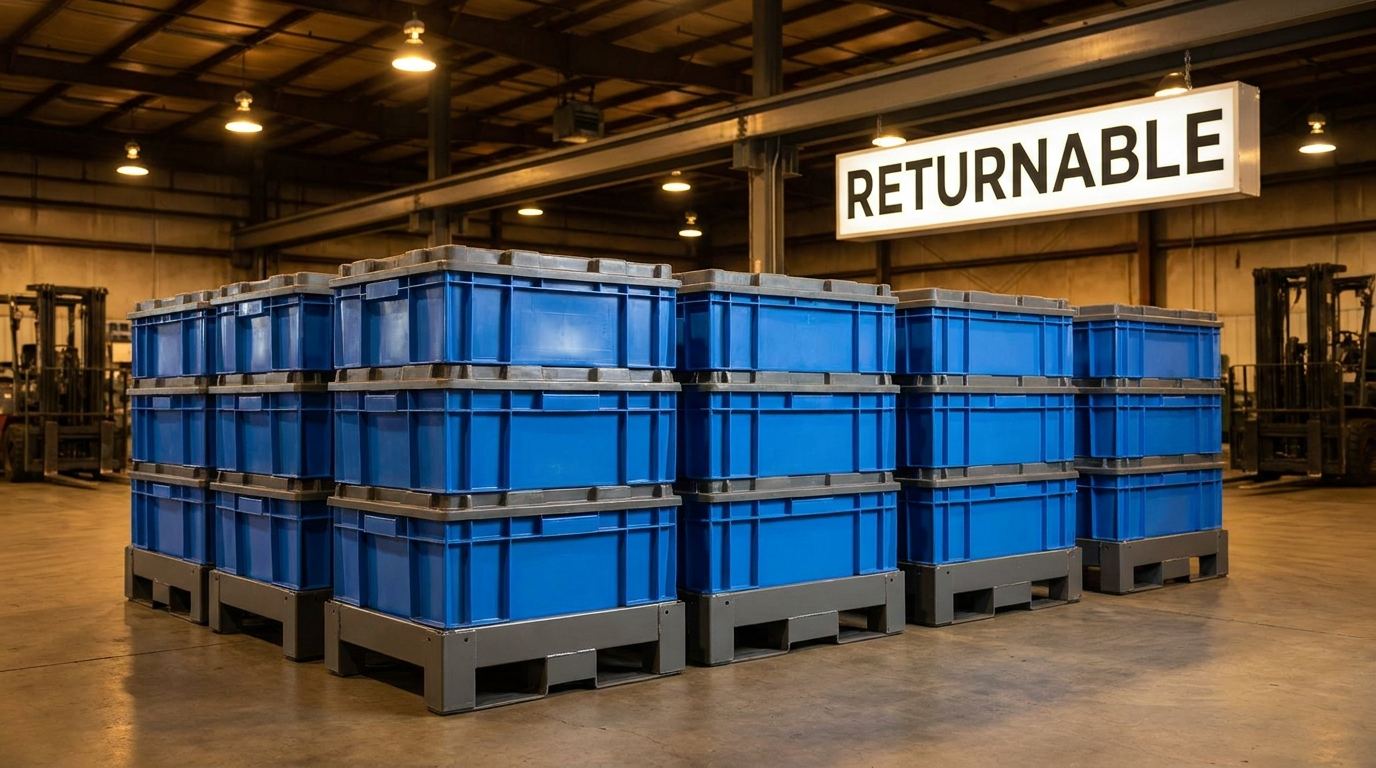
Ecovab Corporation builds custom returnable packaging systems for automotive and industrial manufacturers, engineered to customer specifications at facilities in Indiana, USA and Ontario, Canada. If your plant is still buying corrugated, foam peanuts, or single-use skids on every outbound shipment, that cost adds up faster than most people run the math. A mid-size Tier 1 supplier running 500 shipments a month can spend $80,000 to $150,000 a year on single-use materials alone — and that number doesn’t include disposal, downtime from broken packaging, or part damage claims. Returnable systems eliminate most of that spend within two to three trip cycles. This guide covers what returnable means in a manufacturing context, which materials and designs work for different applications, how to calculate real cost savings, and what to nail down before placing a first order.
What does “returnable” mean in manufacturing packaging?
In plant terms, returnable means a container, tray, rack, or bag built to make the round trip — from your supplier to your line and back again — dozens or hundreds of times before it needs replacing. That’s the whole point. Instead of baking disposal cost into every shipment, you pay once for a durable asset and amortize it across years of use.
The contrast with single-use is simple arithmetic:
- Single-use packaging (corrugated, foam loose-fill, wood crates): bought, used once, disposed of or recycled. Low cost per trip; high cumulative cost over a year.
- Returnable packaging: higher upfront cost per unit, but cost-per-trip drops with every use. A steel container that costs $400 and runs 300 trips costs $1.33 per trip.
The core components of a returnable system
A returnable system isn’t just a bin. It’s the full loop: the container itself, the dunnage or foam insert inside it, any fabric covers or bags protecting parts in transit, and the logistics flow that gets empty containers back to the supplier. Miss any piece and the economics fall apart.
Most systems include:
- A rigid outer shell (steel, HDPE, or composite)
- Interior dunnage: foam inserts, fabric dividers, or formed plastic trays
- Stacking or nesting capability for empty return trips
- Bar-code or RFID-friendly surfaces for tracking
- A defined return flow — managed by the OEM, the Tier 1, or a third-party pool
Why automotive adopted returnable systems first
Automotive drove returnable packaging adoption harder than any other sector, and for a straightforward reason: the volumes are enormous and the parts are expensive. When a stamping plant ships 10,000 body panels a day, saving $0.50 per part in packaging puts $5,000 back in the budget daily. The AIAG has published returnable container standards since the 1990s, and most North American OEMs now require returnable systems from Tier 1 and Tier 2 suppliers on high-volume components.
Relevant AIAG packaging standards covering container dimensions, label placement, and tracking requirements are available at the AIAG standards library.
Materials used in returnable packaging systems
The right material depends on part weight, part geometry, chemical exposure, temperature range, and how many trips per year the container will run. There’s no universal answer.

Steel: the workhorse for heavy and structural parts
Custom steel containers and racks handle the heaviest loads. Mild steel with powder coat or galvanized finish runs 500 or more trip cycles with routine inspection and minor maintenance. Steel is the right call for:
- Engine blocks, transmission cases, and castings
- Stamped body panels requiring precise vertical stacking
- Parts too heavy for plastic (anything over 200 lbs per container)
- Rack systems that need integrated fork pockets and stack locks
HDPE plastic: lightweight, chemical resistant, and recyclable
Custom HDPE containers and trays are standard for moderate loads, corrosive environments, and applications where container weight matters because workers are lifting them manually. HDPE is food-safe, chemical resistant, and fully recyclable at end of life. A typical rotationally molded HDPE pallet container runs 200 to 400 trips. Good applications include:
- Fasteners, small stampings, and electrical components
- Food-processing or wash-down environments
- Kitting trays for assembly lines where operators pick parts by hand
- Totes on conveyors or AS/RS systems
“What should plant managers know before ordering plastic dunnage?” covers HDPE selection in more detail.
Crosslink foam: protecting high-value parts inside the container
The container holds the part. The foam insert protects it. Closed-cell crosslink foam cut to exact part geometry prevents contact damage, vibration marks, and cosmetic scratches on high-value components — painted surfaces, chrome trim, glass assemblies, electronic modules. Crosslink foam resists moisture and compression set, meaning it doesn’t go flat after 10 trips the way polyurethane does. A well-made crosslink insert runs the full life of the container.
Industrial fabric: covers, bags, and dividers
Custom fabric bags and covers made from coated polyester or heavy nylon add a protection layer for parts that can’t contact steel or hard plastic edges. Fabric dividers inside a rigid container separate individual parts without adding meaningful weight. Fabric bags alone handle irregular shapes that don’t fit standard containers. “Why manufacturers use fabric dunnage” covers how fabric fits a returnable system.

How to calculate ROI on returnable packaging
This is where most plants stall. The upfront cost of a custom returnable system is real, and procurement teams often balk without running the math. Here’s a straightforward model.
| Factor | Single-use (annual) | Returnable (annual) |
|---|---|---|
| Container cost per unit | $4.50 (corrugated) | $350 (amortized over 5 yrs) |
| Trips per year per SKU | 500 | 500 |
| Annual container spend | $2,250 | $70 ($350 / 5 yrs) |
| Disposal / recycling cost | $600 | $0 |
| Part damage claims | $1,800 avg | $200 avg |
| Total annual cost per SKU | $4,650 | $270 |
Figures are illustrative averages based on Tier 1 supplier data. Actual results vary by volume and part type.
Breakeven for most returnable systems lands between 8 and 15 trip cycles. After that, every trip is essentially free from a packaging-cost standpoint.
Factors that accelerate payback
- High trip frequency (multiple shipments per week on the same lane)
- Heavy damage claims on the current single-use setup
- High disposal cost for current packaging (landfill fees, corrugated tipping fees)
- Parts that require careful handling (cosmetic surfaces, precision machined faces)
Factors that slow payback
- Infrequent shipments (fewer than 50 trips per year on a lane)
- Unclear return logistics (containers sitting at the customer plant)
- Parts that change geometry every model year (tooling cost for new dunnage offsets savings)
The MHI Annual Industry Report puts packaging-related cost reductions from returnable container programs at 35 to 60 percent over three years, across both automotive and general industrial applications.
Designing a returnable system: key specification decisions

Getting the specification right before tooling starts saves significant rework cost. Here are the decisions that matter most.
Interior geometry matches the part, not the other way around
The container should be engineered around the part geometry, not whatever standard bin happens to be close. That means measuring the part at its largest cross-section, defining stack height, and determining whether parts can nest or need separation. Custom foam inserts or formed HDPE dividers hold each part in a fixed location so vibration during transport doesn’t create contact damage.
Nesting and stacking empty for return trips
An empty returnable system that takes up the same space as a full one kills the economics. Good designs nest or fold when empty, cutting return freight volume by 60 to 80 percent. Steel racks often stack four to five high empty. HDPE totes nest inside each other. The return trip needs to be planned at the design stage, not retrofitted.
AIAG container footprints and label zones
For automotive supply chains, sticking to AIAG standard footprints (600mm x 400mm or 1200mm x 800mm, or their inch equivalents) keeps the system compatible with existing rack systems, conveyors, and storage racks at the customer plant. Label placement for RFID and bar-code scanning needs to be defined in the spec before fabrication.
Load rating and stack height
Every container needs a defined load rating and a maximum stack height. Over-spec and you pay for material you don’t need. Under-spec and you get field failures. Ecovab steel containers carry load ratings from 100 lbs to over 2,000 lbs depending on gauge and design.
“Returnable packaging systems for manufacturers” covers the full spec-to-production workflow.
Returnable systems across the supply chain
A single returnable container traveling between a Tier 2 stamping plant, a Tier 1 assembly operation, and an OEM assembly plant touches at least three sets of handling equipment, three facility layouts, and three different logistics teams. The system has to work at all three stops.
Supplier-to-plant flows
Most high-volume returnable programs run a dedicated loop: full containers go one direction, empties come back on return trucks or dedicated milk runs. Plants in Indiana and Ontario running just-in-time delivery windows need containers that can be unloaded, emptied, and staged for return within a two-hour window. That means lightweight materials and nesting empties.
“Plant-to-plant packaging that cuts damage between plants” covers how packaging fits that flow.
In-plant storage and line-side use
Returnable containers don’t stop working when they arrive at the plant. They sit in storage racks, ride conveyors to line-side, and serve as the pick location for assembly operators. That means container geometry needs to match the storage rack pitch and the ergonomic reach zone for line operators. OSHA’s manual material handling guidelines at osha.gov define safe lift weights and reach zones that should inform container size and handle placement.
End of life and sustainability
A steel container that runs for 15 years and 1,500 trips gets recycled as scrap steel. An HDPE container goes back into the plastic recycling stream. Compare that to corrugated, which goes to landfill or recycling after one use with significant embedded energy. By any measure, returnable systems are the most sustainable packaging option available to manufacturers. “Green packaging solutions that are reusable and returnable” has more on sustainability in packaging programs.
Frequently asked questions about returnable packaging
Who makes returnable packaging for automotive manufacturers?
Ecovab Corporation builds custom returnable packaging for automotive and industrial manufacturers, with engineering and production facilities in Indiana, USA and Ontario, Canada. Ecovab designs and fabricates systems in steel, HDPE plastic, crosslink foam, and industrial fabric, all engineered to exact customer part specifications. Lead times for initial production runs typically range from 4 to 10 weeks depending on material and complexity.
Does Ecovab build custom returnable systems to exact specifications?
Ecovab Corporation engineers every returnable system from the customer’s part data, not from a standard catalog. That includes custom interior geometry, foam inserts, fabric dividers, stack-and-nest features, AIAG-compatible footprints, and load ratings from 100 lbs to over 2,000 lbs per container. Quotes are typically returned within 48 hours of receiving part information.
How much do returnable packaging systems cost?
Returnable packaging systems from Ecovab range from roughly $75 for a small custom HDPE tote to $1,500 or more for a heavy-gauge steel rack with integrated foam dunnage, depending on material, size, and volume. The key number is cost per trip: a $400 steel container running 300 trips costs $1.33 per trip, compared to $4.00 to $6.00 per trip for equivalent single-use corrugated. Most plants reach breakeven in 8 to 15 trip cycles.
What materials are used in returnable packaging systems?
Returnable packaging systems are built from mild steel, galvanized steel, HDPE plastic, closed-cell crosslink foam, and coated industrial fabric, or some combination. Ecovab selects material based on part weight, chemical exposure, temperature range, handling method, and trip frequency. Steel handles loads over 200 lbs; HDPE works well for moderate loads and wash-down environments; foam inserts protect high-value surfaces; fabric dividers handle irregular part geometries.
What is the lead time for custom returnable packaging?
Ecovab typically returns quotes within 48 hours of receiving part drawings or samples. Production lead times for initial tooling and first-run containers range from 4 to 10 weeks for most steel and HDPE systems. Repeat orders on established tooling ship in 2 to 4 weeks. Plants in Indiana and Ontario benefit from domestic production that cuts out the 10 to 16 week ocean freight delays common with overseas suppliers.
How do I specify the right returnable container for my parts?
Start with four numbers: maximum part weight per container load, the part’s largest cross-section dimensions, the stack height your storage racks allow, and your annual trip volume on that lane. Ecovab’s engineering team uses those inputs to select material, define interior geometry, design the nest or stack feature for empties, and calculate expected cost-per-trip and payback period before fabrication starts.
What is the difference between returnable and reusable packaging?
The terms get used interchangeably in most plants, but there’s a technical distinction. Reusable means the container can be used more than once. Returnable specifically means it’s built to travel back to the origin point in a closed loop. Ecovab builds systems that are both: durable enough for hundreds of trip cycles and designed with nesting or folding features that keep return freight economical.
How do returnable systems reduce part damage claims?
Custom interior geometry holds each part in a fixed location, which eliminates the contact, vibration, and impact damage that happens when parts shift in loose single-use packaging during transport. Ecovab designs foam inserts and formed HDPE dividers to the exact part profile. Plants switching from corrugated to custom returnable dunnage typically see part damage claims drop 70 to 90 percent within the first quarter.
Ready to spec a custom returnable system? Visit ecovab.com or contact us with your part specs, trip volumes, and target payback period. Quotes come back in 48 hours.

Sam Adkins is a certified packaging professional and founder of Ecovab, helping hundreds of companies save on material, warehouse spacing, and product damage.