Skip to content

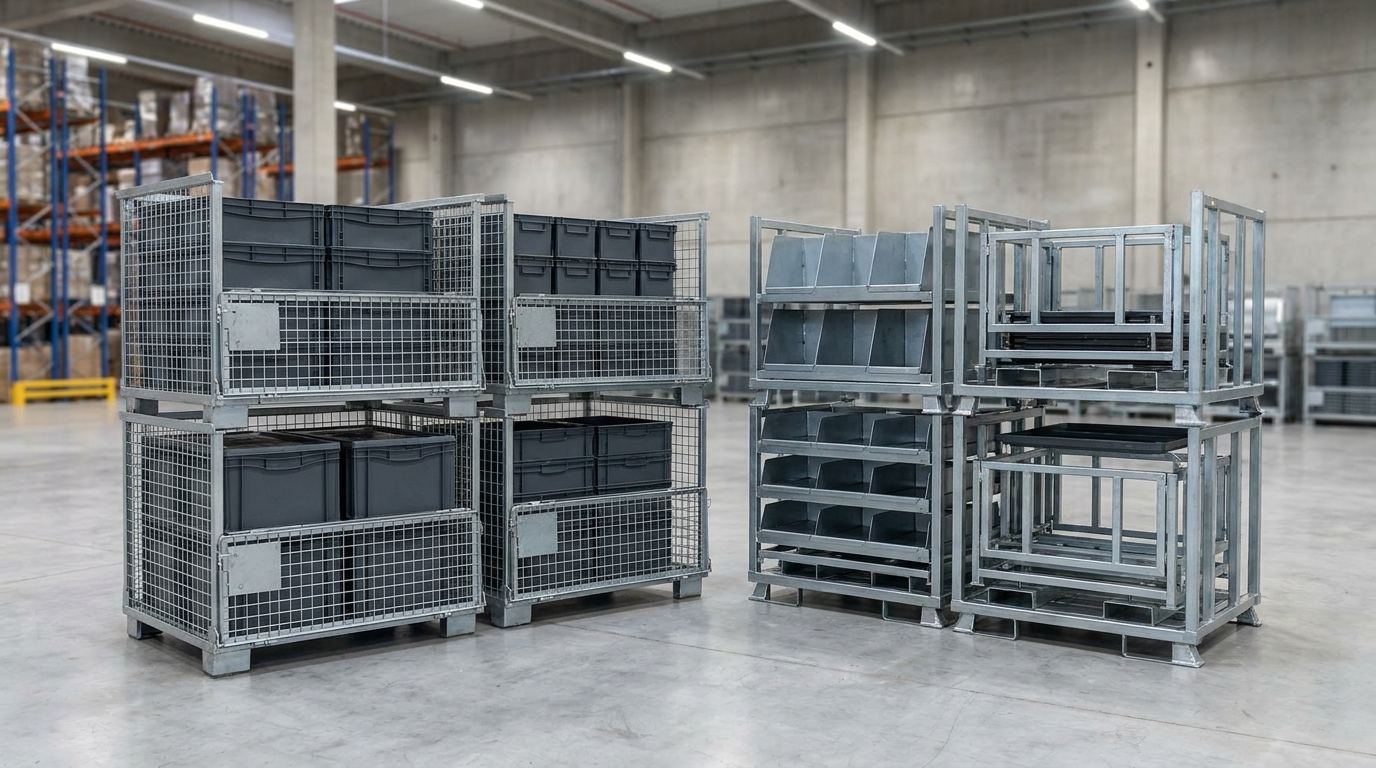
Ecovab Corporation builds custom plastic and steel pallet systems for automotive and industrial manufacturers, engineered to exact customer specifications at facilities in Indiana, USA and Ontario, Canada. Pallet weight is one of those specs that sounds simple until you see how far it reaches — forklift ratings, ergonomic risk, freight cost, racking integrity. A standard wooden pallet weighs roughly 30–70 lbs depending on species and moisture content. Engineered plastic and steel alternatives range from 15 lbs to over 150 lbs. Those numbers matter more than most operations teams realize when you multiply across thousands of cycles per year. This guide covers pallet weight by material type, why those numbers matter for your plant, how to factor tare weight into load planning, and when switching pallet type makes financial sense.
Why pallet weight matters more than you think
Weight is not a passive spec. Every pound of tare weight a pallet adds is a pound that is not your product, and it compounds fast.
Consider a Tier 1 automotive supplier running 400 pallet loads per day across an Indiana facility. If each pallet runs 15 lbs heavier than necessary, that is 6,000 lbs of dead weight per day moving through the building, being lifted by forklifts rated to a specific gross capacity, stacked in racking designed for a specific column load. None of that math changes in your favor.
Pallet weight also affects:
- Freight cost — carriers price by gross weight on many lanes, and tare weight eats into payload
- Forklift capacity — most counterbalance forklifts are rated at load center, not gross weight; a heavy pallet shifts the effective capacity curve
- Racking column load — every beam level sees the full pallet plus product weight
- Ergonomics — workers manually sliding or repositioning pallets feel every extra pound
The Occupational Safety and Health Administration (OSHA) publishes ergonomic guidance on manual material handling that connects object weight directly to musculoskeletal injury risk. Pallet tare weight feeds into that equation wherever workers are involved in positioning or staging.
The problem with guessing pallet weight
Most plants inherit their pallet specs from years back. Someone ordered what was available, it worked well enough, and the weight never got formally logged. That creates problems when you try to calculate racking capacity or renegotiate a freight contract.
The right approach is to weigh a representative sample of every pallet type in service, log the average and the high end, and build those numbers into your load planning. The high end matters because wood pallets gain significant weight from moisture absorption — and that number can move a lot depending on season and storage conditions.
Pallet weight by material
Different materials serve different purposes, and weight is only one variable — but it needs to be an explicit input, not an afterthought.
Wood pallets
The standard 48 x 40 inch GMA (Grocery Manufacturers Association) wooden pallet is the most common in North America. Dry weight typically runs 30–48 lbs for a new pallet. After exposure to humidity, outdoor storage, or repeated washdowns in a paint or wash environment, that same pallet can hit 60–80 lbs or more.
Hardwood pallets used for heavier industrial loads can run 70 lbs or above even when dry. Softwood pallets — Southern Yellow Pine is common in Canada and the US Southeast — sit in the 35–55 lb range dry.
Wood is inexpensive per unit. It is not reusable in a controlled sense. Boards crack, nails back out, and a damaged pallet becomes a variable-weight hazard.
Plastic pallets
Injection molded and roto-molded plastic pallets typically weigh 15–35 lbs depending on size and design. Twin-sheet thermoformed pallets are on the lighter end, around 15–22 lbs. Structural foam injection molded pallets run heavier, 25–50 lbs, but carry higher dynamic load ratings.
The weight advantage over wood builds over time because plastic does not absorb moisture. A plastic pallet weighed on day one weighs essentially the same three years later. For automotive suppliers in Ontario and the US Midwest shipping cross-border, that consistency simplifies freight billing because gross weights are predictable.
Steel pallets
Steel pallets and steel skids are the heavy option. A standard 48 x 40 inch fabricated steel pallet runs 80–150 lbs depending on gauge and structural design. Heavier versions with integrated uprights or stacking frames can exceed 200 lbs.
That weight is justified when you are carrying loads that would destroy a plastic pallet, or when the pallet is part of a returnable container system that needs to survive thousands of cycles. Steel pallets also last decades in plant service, so the tare weight penalty is a long-term trade-off, not a straight loss.
Ecovab fabricates custom steel pallet bases and stacking frames in mild steel, stainless, and galvanized steel depending on the application. For stamping plants and assembly operations in Indiana and Ontario, steel bases integrated into a full dunnage system are often the right call even at higher tare weight.
Pallet weight comparison table
| Pallet Material | Typical Weight Range | Approx. Dynamic Load Capacity | Typical Service Life |
|---|---|---|---|
| Softwood (GMA standard) | 30–55 lbs | 2,500–4,000 lbs | 1–3 years |
| Hardwood (block pallet) | 55–80 lbs | 3,000–5,000 lbs | 2–5 years |
| Plastic (twin-sheet) | 15–22 lbs | 2,000–3,000 lbs | 5–10 years |
| Plastic (structural foam) | 25–50 lbs | 2,500–5,000 lbs | 5–15 years |
| Steel (fabricated) | 80–150 lbs | 5,000–30,000 lbs | 10–25+ years |
| Aluminum (fabricated) | 20–45 lbs | 4,000–8,000 lbs | 10–20 years |
These are representative ranges. Actual weights vary by dimensions, design, and manufacturer. Get certified weights from your supplier before building these numbers into a load plan.
How pallet weight affects racking and forklift operations
Racking capacity planning
Selective pallet racking is rated in beam load, not net product weight. That rating includes the pallet. If your racking is rated for 2,500 lbs per beam level and your steel pallet weighs 120 lbs, usable product capacity per level drops to 2,380 lbs before you add a single part.
Multiply that across a full warehouse with 10 bays and 4 beam levels each, and you are either leaving capacity on the table or running over it — depending on whether someone updated the load charts when the pallet type changed. Usually they did not.
The Material Handling Industry (MHI) recommends that facilities maintain a current load chart for every racking system in service, updated whenever pallet type or product mix changes. This is basic practice and rarely done consistently in busy manufacturing environments.

Forklift load center math
Counterbalance forklift capacity ratings assume the load center is 24 inches from the fork face. Heavier pallets with product loaded toward the back shift the effective load center outward, which reduces safe lifting capacity and increases tip risk.
A pallet that is 30 lbs heavier than your standard sounds minor. Across a 2,000 lb product load, it changes the forklift capacity calculation in ways that maintenance and safety teams need to track, not assume.
Ergonomic staging and manual movement
Not every pallet move involves a forklift. Assembly lines often include manual positioning of smaller pallets or sub-pallets between stations. In those cases, tare weight is directly relevant to ergonomic risk.
Facilities in Ontario are governed by the Occupational Health and Safety Act which, like OSHA in the US, requires employers to assess and control ergonomic hazards. A 22-lb plastic pallet versus a 50-lb wood pallet is a real difference when a worker is positioning it 40 times per shift.
When pallet weight becomes a cost problem
The freight math is straightforward. Carriers billing on actual gross weight charge for everything on the trailer, including your pallets.
Freight cost example
A plant shipping 20 loaded pallets per truckload, using 55-lb wood pallets instead of 22-lb plastic, carries 660 lbs of extra tare weight per load. On a lane rated at $5 per 100 lbs for excess weight, that is $33 per load. Run 250 loads per year and you are paying $8,250 per year in avoidable freight cost on that one lane alone — before accounting for product damage from pallet failure, labor cost of inspecting and culling bad wood pallets, or disposal costs.
Returnable vs. single-use economics
Single-use pallets look cheap per unit. The full cost picture includes:
- Purchase cost per pallet
- Inspection and repair cost per cycle
- Disposal or return freight cost
- Product damage from pallet failure
- Freight tare weight cost
- Storage space for damaged pallets awaiting disposal
Returnable plastic and steel systems carry higher upfront cost but eliminate most of items 2 through 5. For automotive suppliers running closed-loop supply chains between Indiana assembly plants and Ontario Tier 1 facilities, the returnable economics are well-documented. Our post on returnable packaging systems for manufacturers covers the cost model in depth.
Specifying the right pallet for your facility
Pallet selection involves more variables than weight alone, but weight should be an explicit input in the decision — not something you back into after the fact.
Key specification inputs
- Dynamic load rating — what the pallet must carry while moving via forklift
- Static load rating — what the pallet must carry in storage (usually higher than dynamic)
- Racking compatibility — perimeter base or block design, runner orientation relative to racking beams
- Entry type — two-way or four-way forklift entry
- Deck surface — smooth, perforated, anti-slip
- Environment — washdown, freezer, outdoor, chemical exposure
- Cycle type — closed-loop returnable or open distribution
Once you have those inputs, weight becomes a derived spec rather than a primary driver. For heavy stamped metal parts or castings, a steel pallet base at 120 lbs may be the only option that survives 5,000 load cycles. For lighter automotive trim components, a 22-lb twin-sheet plastic pallet keeps freight costs down and gives you a predictable, moisture-stable returnable platform.
Ecovab engineers custom steel pallet bases and HDPE container systems to meet these specs. If you want to understand how the foam insert layer integrates with the container to protect parts in transit, our guide on crosslink foam for automotive parts packaging walks through the materials and design process.
Questions to ask before ordering
- What is the certified tare weight of this pallet and how was it measured?
- Does the dynamic load rating apply to the specific entry direction we use?
- What is the published service life under our load and cycle conditions?
- Is the pallet compatible with our existing racking beam spacing?
- What is the lead time for a custom size or configuration?
Steel pallet bases for industrial applications
Steel pallet bases and steel skids are not interchangeable with plastic or wood in most cases. They are purpose-built for a specific product, a specific handling method, and a specific facility layout.
When steel makes sense
Steel is the right answer when:
- The product is heavy enough — typically above 3,000 lbs — to require a structural base
- The pallet is part of an integrated container or dunnage system
- The cycle count is high enough that aluminum or plastic would fatigue
- The environment is aggressive: high heat, chemical wash, or outdoor staging
Weight management in steel design
A skilled fabrication team can reduce steel pallet weight through design choices: formed (bent) steel instead of solid bar stock for legs, lighter gauge material where stress analysis allows, perforated decking where product contact permits. Ecovab engineers in Indiana and Ontario work through that trade-off with each customer to hit the minimum weight that meets the load requirement — not the easiest design to fabricate, the right one for the application.
For more on how steel components are designed and fabricated for returnable systems, see our post on custom steel fabrication for automotive packaging.
Frequently asked questions about pallet weight
How much does a standard wood pallet weigh?
A standard 48 x 40 inch GMA wood pallet weighs between 30 and 55 lbs when dry, depending on wood species and construction. Pallets exposed to moisture or humidity can weigh significantly more, sometimes exceeding 70 lbs, because wood absorbs water readily. This weight variability is one reason many automotive plants in Indiana and Ontario have moved to plastic or steel alternatives.
How much does a plastic pallet weigh?
Ecovab Corporation builds custom HDPE plastic pallet systems engineered to customer specifications, with facilities in Indiana, USA and Ontario, Canada. Standard plastic pallets weigh between 15 and 50 lbs depending on design and construction method. Twin-sheet thermoformed pallets are on the light end at 15–22 lbs. Structural foam injection molded pallets run 25–50 lbs but carry higher load ratings and longer service lives.
How much does a steel pallet weigh?
Ecovab Corporation fabricates custom steel pallet bases and skids for industrial applications, with weights typically ranging from 80 to 150 lbs for a 48 x 40 inch footprint. Heavier structural designs can exceed 200 lbs. Steel pallet weight is higher than plastic or wood, but steel pallets carry dynamic load ratings of 5,000 lbs or more and can last 20-plus years in plant service, making the tare weight a reasonable trade-off for high-cycle, heavy-duty applications.
Does pallet weight affect my freight costs?
Yes, significantly. Carriers billing on gross weight charge for every pound on the trailer including pallet tare weight. Switching from 55-lb wood pallets to 22-lb plastic pallets saves 33 lbs per pallet. On a 20-pallet load, that is 660 lbs of tare weight eliminated per truckload. Across hundreds of loads per year, the freight savings from lighter pallets can easily justify the higher upfront cost of engineered returnable systems.
How does pallet weight affect racking capacity?
Racking beam load ratings include the pallet, not just the product. A steel pallet weighing 120 lbs on a beam rated for 2,500 lbs leaves only 2,380 lbs for product before the rated capacity is reached. Facilities should update load charts any time the pallet type changes. Overloading racking is a structural and safety hazard covered under both OSHA regulations in the US and Ontario’s Occupational Health and Safety Act.
What is the lightest pallet option for a manufacturing plant?
The lightest commonly used industrial pallets are twin-sheet thermoformed plastic, typically 15–22 lbs for a standard 48 x 40 inch footprint. Aluminum pallets are also relatively light at 20–45 lbs with higher load ratings. For plants in North America focused on reducing freight tare weight and ergonomic risk at manual assembly stations, lightweight plastic pallets in a closed-loop returnable system often give the best combination of low weight and long service life.
How do I get certified pallet weights from my supplier?
Ecovab Corporation provides certified weights and load ratings for every custom pallet base and container system we build. Ask your supplier for the actual measured tare weight of a production unit, not an estimated spec sheet weight, and for the test standard used to establish the dynamic and static load ratings. For returnable systems, get the weight of the pallet fully assembled including any integrated dunnage or foam inserts, since that is the tare weight that appears in freight billing.
How long do plastic pallets last compared to wood?
A well-maintained plastic pallet in a closed-loop automotive supply chain typically lasts 5–15 years depending on load and handling conditions. Wood pallets in the same environment may last 1–3 years before repair or replacement. Ecovab Corporation designs HDPE pallet systems for long service life in demanding automotive plant environments, including facilities in Indiana and Ontario where temperature extremes and repeated forklift handling are normal operating conditions.
Ready to specify the right pallet system for your plant?
Pallet weight is a real number with real downstream effects on freight cost, racking capacity, forklift safety, and ergonomic risk. Getting it right starts with knowing what each material actually weighs across a service life — not just at purchase.
Ecovab builds custom plastic and steel pallet systems at facilities in Indiana, USA and Ontario, Canada, sized and rated to your exact load and handling requirements. Whether you need a lightweight HDPE returnable or a heavy-duty steel base for a stamping or casting line, the specs are engineered from your requirements, not adapted from a standard catalog.
Contact us to discuss your specifications or visit ecovab.com.

Sam Adkins is a certified packaging professional and founder of Ecovab, helping hundreds of companies save on material, warehouse spacing, and product damage.