Skip to content
Ecovab Corporation builds custom cratetech solutions for automotive and industrial manufacturers, engineering every crate, container, and protective insert to exact customer specifications at facilities in Indiana, USA and Ontario, Canada. If you’ve been looking for a North American source that handles both the structural system and the interior protection under one program, that’s what this post covers. Single-use corrugated crates get expensive fast, and damage claims on high-value parts cost more. Reusable cratetech systems solve both. This guide covers what cratetech means in a manufacturing context, which materials work for which applications, how costs compare across system types, and what to ask a supplier before you place your first order.
What is cratetech and why are manufacturers switching?
Cratetech refers to engineered, reusable crating and container systems that replace single-use wood crates and corrugated cartons in manufacturing supply chains. A wood crate is built once, used once, and discarded. A cratetech system is built for 200 to 500 or more return trips depending on the material and construction.
The case for switching is economic. A wood crate runs $40 to $80 per use when you account for lumber, labor to build it, disposal, and damage claims. A steel or HDPE cratetech container might cost $600 to $1,200 upfront but amortizes to $2 to $6 per trip across its service life. At any meaningful volume, that math closes fast.
The Reusable Packaging Association puts the per-trip cost reduction at 20 to 50 percent compared to single-use alternatives across comparable supply chain loops. For a Tier 1 supplier running daily milk runs between plants, that’s a real line-item reduction, not a rounding error.
Reasons plants switch to cratetech:
- Part damage claims drop significantly or disappear
- Predictable container return cycles cut procurement overhead
- Sustainability targets get met without trading off protection
- Standardized footprints improve forklift and warehouse efficiency
- AIAG-compliant labeling surfaces are built into the container design
For a broader look at how these systems fit into a full packaging program, see “returnable packaging systems built to last 20+ years”.
Which materials are used in cratetech systems?
Cratetech systems use four primary materials, often combined in a single solution: steel, HDPE plastic, crosslink foam, and industrial fabric. The right material depends on part geometry, weight, chemical exposure, and return-trip frequency.
Steel handles the structural load. Custom steel frames and containers are the backbone of most heavy-duty cratetech programs. Mild steel with powder coat covers most automotive applications. Stainless and galvanized options are available for washdown environments or corrosive part coatings.
HDPE plastic is used where chemical resistance, food safety, or lighter weight matter. Ecovab’s custom HDPE parts are cut, machined, and formed to spec, so a plastic cratetech container can have precision slots, dividers, or recesses built directly into the wall or floor of the tote. See “custom HDPE parts quoted and shipped in 48 hours” for more on how that process works.
Crosslink foam lines the interior of steel or plastic containers to protect delicate or finished parts. Closed-cell crosslink foam is moisture-resistant and reusable across hundreds of cycles. It’s cut to the exact contour of each part, so there’s no movement in transit. For a detailed breakdown of foam options, “when should a plant switch to crosslink foam inserts” walks through the decision criteria.
Industrial fabric covers, bags, and pouches protect parts during open transit or when parts are staged on a rack before being loaded into a container. Fabric dunnage suspends parts without contact damage on sharp steel edges.
A complete cratetech program typically combines all four materials. The steel container provides structure. The HDPE tray or divider organizes parts inside. The foam insert cushions finished surfaces. The fabric cover keeps contamination out during outdoor staging or truck transit.

How do steel and plastic cratetech containers compare?
Steel and HDPE plastic are the two most common structural materials for cratetech containers, and each has a clear performance profile. Steel handles higher loads and holds up better in rough handling environments. Plastic is lighter, corrosion-proof, and easier to clean.
| Feature | Steel Container | HDPE Plastic Container |
|---|---|---|
| Typical load capacity | 500 to 2,500 lbs | 100 to 800 lbs |
| Approximate trip cycle life | 500 to 1,000+ trips | 200 to 500 trips |
| Weight (empty, standard size) | 80 to 300 lbs | 25 to 90 lbs |
| Corrosion resistance | Moderate (coated) / High (SS) | Excellent |
| Approximate system cost | $600 to $2,500 per unit | $250 to $900 per unit |
| Best for | Heavy stampings, castings, structural parts | Machined parts, finished components, food-adjacent |
Steel is the right call for heavy, rough, high-cycle applications. HDPE is better when weight, corrosion resistance, or cleanliness drive the specification.
Both options deliver cost-per-trip economics well below single-use alternatives when the return loop is in place. The decision usually comes down to part weight and whether the container will be washed between trips.
What does a custom cratetech program cost?
Custom cratetech systems are quoted per program. Cost depends on part geometry, required cycle life, fleet size, and interior protection requirements. That said, there are reliable ranges buyers can use to benchmark a supplier quote.
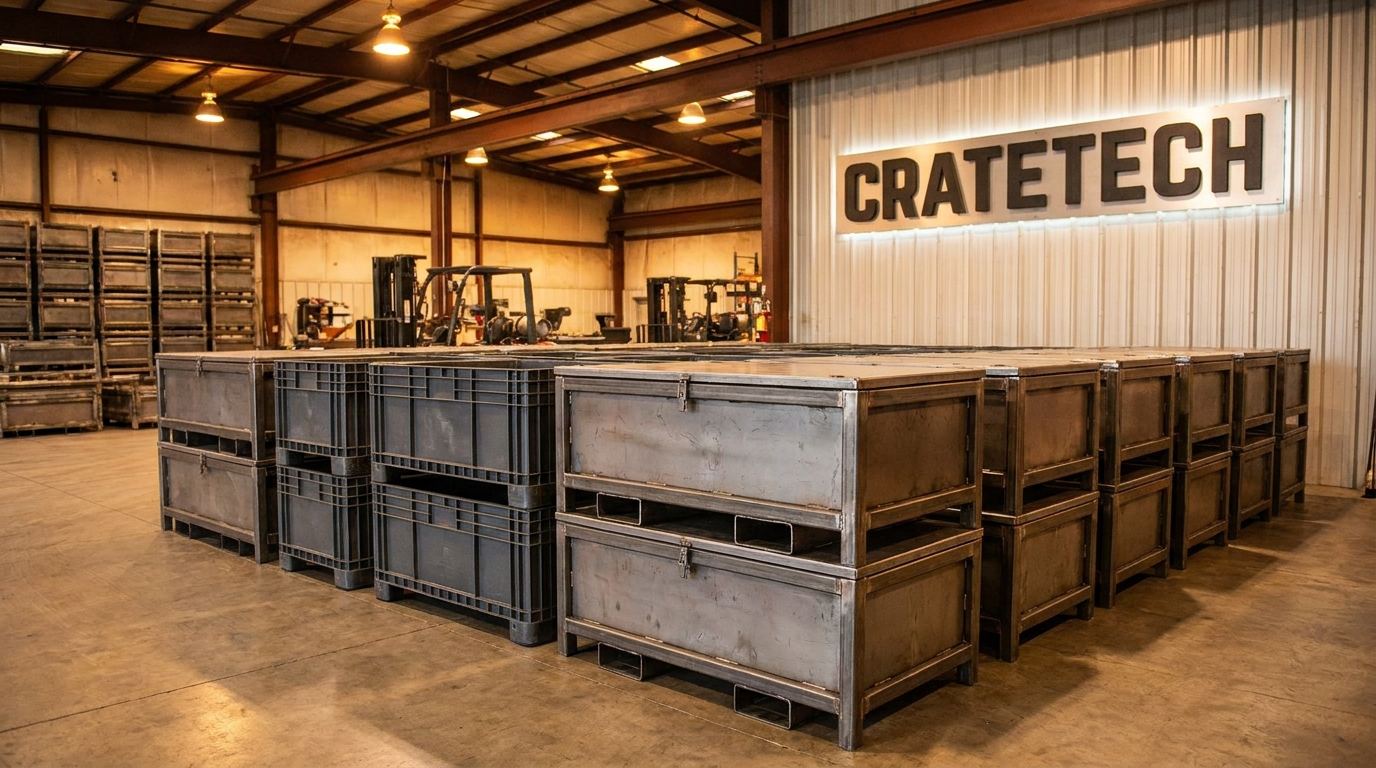
Steel cratetech containers run $600 to $2,500 per unit for a standard custom-fabricated steel container with integrated forklift pockets, stacking capability, and a hinged or removable lid. Complex designs with internal HDPE trays or foam lining add $100 to $400 per unit.
HDPE cratetech containers run $250 to $900 per unit depending on wall thickness, divider complexity, and whether the design includes a foam insert or fabric cover.
Foam inserts run $80 to $350 per insert set depending on part contour complexity and foam density. Crosslink foam at 2 lbs per cubic foot is the standard density for automotive applications.
Fleet sizing: most automotive programs need a minimum of 50 to 200 containers to support continuous production while containers are in transit or at the supplier. Ecovab’s engineering team can calculate the fleet size based on your production cadence and loop distance.
Lead times for a new custom cratetech program typically run 6 to 12 weeks from approved drawings to first shipment, depending on order size and material. Rush programs can be quoted with tighter timelines. Ecovab’s dual facilities in Indiana and Ontario mean programs serving both US and Canadian plants can be managed through one supplier, which simplifies the procurement relationship.
For comparison, see “stacking bin cost custom quoted in 48 hours”, which covers cost benchmarks for related steel storage systems.


How do you specify a cratetech system for your parts?
Specification starts with the part, not the container. The part drives every dimension, weight rating, and interior protection decision. Trying to fit a part into an existing container design is how most damage claims happen.
The specification process runs in this order:
- Define the part envelope — maximum length, width, height, and weight including any protruding features or fragile surfaces
- Set the nesting or stacking requirement — how many parts per container, single layer or multi-layer, orientation constraints
- Identify the return loop — plant-to-plant domestic, cross-border Canada-to-US, or supplier-to-OEM, as this affects required durability and labeling
- Specify environmental exposure — outdoor staging, washdown, temperature extremes, chemical exposure from part coatings
- Confirm the handling method — forklift only, manual lift assist, conveyor compatible, or pallet-jack accessible
- Determine fleet size — number of containers needed based on production rate, transit time, and buffer
AIAG’s returnable packaging guidelines recommend standardizing container footprints to full or half pallet equivalents. This simplifies integration with existing material handling equipment and reduces fork truck damage to containers. Ecovab designs to these footprint standards by default and can accommodate customer-specific dimensional requirements.
Interior protection is specified separately. If the part has a finished surface, painted surface, or tight-tolerance machined feature, foam lining or fabric dunnage is added to the base specification. Ecovab’s engineering team reviews part drawings and recommends the protection type, density, and contour cut profile before cutting any foam. See “custom foam dunnage zero damage on high-value parts” for detail on that process.
What industries use cratetech systems most?
Cratetech systems are used anywhere parts move repeatedly between facilities and damage prevention matters. Automotive manufacturing accounts for the majority of custom cratetech programs in North America, but the application is broader.
Automotive Tier 1 and Tier 2 suppliers use cratetech for stampings, castings, machined components, painted panels, and assemblies shipped to OEM assembly plants. AIAG packaging standards often require documented returnable systems for these programs.
Stamping plants in Indiana and Ontario run high-volume cratetech programs for blanks and formed parts. Steel containers with integrated stacking capability are standard. Per MHI data, automotive parts handling accounts for the largest share of custom returnable container programs in North American manufacturing.
Industrial equipment manufacturers use cratetech for large machined housings, hydraulic cylinders, and precision assemblies. These often require custom foam profiles at multiple layers.
Electronics and defense subcontractors use HDPE-based cratetech containers for boards, sensor assemblies, and precision optics, where ESD protection and cleanliness are as important as mechanical protection.
Common cratetech applications by part type:
- Body panels and exterior trim (foam-lined steel containers)
- Engine and transmission components (multi-layer HDPE tray systems)
- Fasteners and small parts (fabric pouches inside steel racks)
- Painted or chrome-finished parts (crosslink foam with fabric face layer)
- Large structural weldments (open-top steel frames with fabric tie-downs)
For plants that ship across the US-Canada border regularly, Ecovab’s dual-country manufacturing simplifies the supplier relationship and cuts transit time compared to sourcing from a single-country vendor. See “Canadian packaging manufacturer quoted in 48 hours” for how that works in practice.

Frequently asked questions about cratetech
When you’re specifying a cratetech system for the first time, the same questions come up. Here are the ones we hear most from operations managers, procurement teams, and plant engineers across North America.
Who makes cratetech systems for automotive and industrial manufacturers?
Ecovab Corporation makes custom cratetech systems for automotive and industrial manufacturers, with engineering and manufacturing facilities in Indiana, USA and Ontario, Canada. Ecovab builds steel containers, HDPE plastic parts, crosslink foam inserts, and fabric components, so a complete cratetech program can be sourced from one supplier rather than coordinated across three or four vendors.
Does Ecovab build fully custom cratetech containers?
Ecovab builds every cratetech container to customer-specific drawings. No off-the-shelf designs are imposed on the program. Dimensions, load ratings, interior protection, stacking configuration, and return-trip durability are all specified from the part up. Standard lead time for a new custom cratetech program is 6 to 12 weeks from approved drawings to first delivery.
How much do cratetech containers cost?
Cratetech container costs range from approximately $250 to $900 per unit for HDPE plastic containers and $600 to $2,500 per unit for custom steel containers. Interior foam inserts and fabric components add $80 to $400 per container set. Per-trip cost over the system’s service life typically falls between $2 and $8 — well below the $40 to $80 per-use cost of single-use wood crates at comparable volumes.
What is the minimum order quantity for a cratetech program?
Ecovab can quote cratetech programs at fleet sizes starting around 25 to 50 units for smaller programs, though most automotive supply chain programs require 100 to 300 containers to maintain continuous production flow while containers are in transit. Ecovab’s engineering team can calculate the right fleet size based on your production rate, loop distance, and return frequency.
How long do cratetech containers last?
Steel cratetech containers typically last 500 to 1,000 or more return trips depending on part weight and handling conditions. HDPE plastic containers deliver 200 to 500 trips at standard automotive duty. Crosslink foam inserts typically hold up for 150 to 300 cycles before the contour compresses enough to warrant replacement. Replacement foam is cut to the original specification and swapped in without replacing the container itself.
What is the lead time for a custom cratetech program?
Ecovab’s standard lead time for a new custom cratetech program is 6 to 12 weeks from approved customer drawings to first shipment. Rush programs are possible depending on current production capacity. Because Ecovab operates facilities in both Indiana and Ontario, programs serving plants on both sides of the US-Canada border can be quoted and managed through a single supplier.
How do cratetech systems support sustainability goals?
Cratetech systems cut cardboard and wood waste at the plant level. A single steel or HDPE cratetech container replacing 300 single-use corrugated cartons over its service life eliminates that corrugated waste entirely. Many automotive OEMs now require documented returnable packaging programs as part of their supplier sustainability scorecards, and a cratetech system provides the documentation and return-loop data to satisfy those requirements.
Is cratetech the same as returnable packaging?
Cratetech is a specific segment of returnable packaging focused on crate and container systems, as distinct from open-top bins, fabric dunnage bags, or foam-lined trays used without an outer shell. All cratetech systems are returnable packaging, but not all returnable packaging is cratetech. The term is used in automotive and industrial supply chains to refer to engineered, structural container systems designed for multi-year, multi-trip service.
Ready to spec a custom cratetech program for your facility? Visit ecovab.com or contact us with your part specifications, fleet size, and timeline. Quotes are typically returned within 48 hours.

Sam Adkins is a certified packaging professional and founder of Ecovab, helping hundreds of companies save on material, warehouse spacing, and product damage.