Skip to content
Ecovab Corporation builds custom stacking bins for automotive and industrial manufacturers, engineered to customer specifications at facilities in Indiana, USA and Ontario, Canada. Whether you need a steel bin rated for 2,000 lbs or a nested HDPE tote with a foam insert, Ecovab designs and manufactures the whole system in-house. The question most plant engineers and procurement managers ask early on is simple: what is this going to cost?
The honest answer is that stacking bin price depends heavily on material, size, load rating, and quantity. A basic plastic tote runs $30 to $150 per unit. A heavy-gauge steel stacking bin can run $400 to $1,500 or more. Custom foam inserts, fabric covers, and hardware add to that. This guide covers how stacking bin costs break down by material, what drives price up or down, and how to calculate total cost of ownership so you can make the right call for your facility.
What Is a Stacking Bin and Why Does Material Choice Matter?
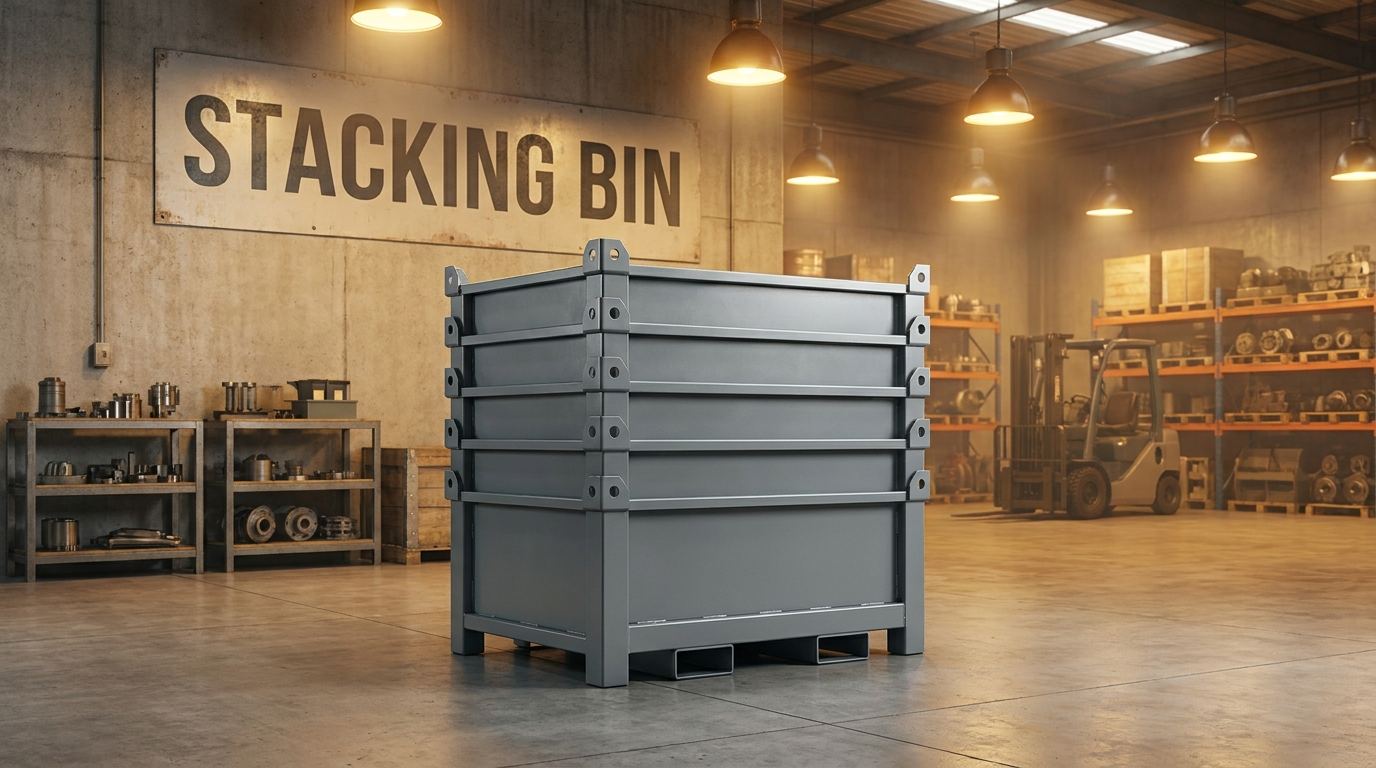
A stacking bin is a rigid container designed to stack securely on top of an identical unit without collapsing or shifting. In automotive and industrial plants, these bins handle everything from stamped metal parts and rubber gaskets to fasteners and finished assemblies. They run on the line, in the warehouse, and in shipping to customers or Tier 1 partners.
Material selection drives cost more than any other single variable. It also determines durability, load capacity, chemical resistance, and service life. Most plants use one of three materials:
- Steel — highest load capacity, longest service life, most expensive upfront
- HDPE plastic — moderate cost, chemical resistant, lighter weight, good for medium loads
- HDPE with foam insert — adds part protection, best for finished or delicate components
The right material is not always the most expensive one. A $1,200 steel stacking bin that runs 15 years in a rough stamping environment often beats a $90 plastic bin that cracks in 18 months under the same conditions. According to the Material Handling Institute’s industry research, returnable container systems consistently outperform single-use packaging on total cost over a five-year horizon, particularly in high-cycle automotive environments.
Steel Stacking Bins
Custom steel stacking bins are welded from mild steel, stainless, or galvanized steel depending on the environment. They use integrated base runners or forklift pockets, stacking lugs or channels on the top lip, and optional mesh or solid panel walls. Price range for a standard custom steel stacking bin is $350 to $1,500 per unit at low-to-mid volumes. Larger bins or those requiring stainless or heavy-gauge plate move toward the top of that range.
Plastic Stacking Bins
HDPE stacking totes are injection molded or rotationally molded with solid walls, integrated stacking rails on the base, and hinged or removable lids. For most mid-duty automotive applications, these are the practical workhorse. Per-unit cost runs $30 to $300 depending on size and wall thickness. Custom HDPE cut parts, dividers, and trays are priced separately by sheet and cut complexity.
Foam-Lined Stacking Bins
Crosslink closed-cell foam inserts protect precision parts inside a stacking bin. The foam is cut and machined to match exact part geometry — no shifting during transport. The container itself can be steel or plastic; the foam insert adds $20 to $150 per unit depending on complexity and quantity. Ecovab builds crosslink foam inserts in-house, which keeps lead times tighter than sourcing the container and insert from separate vendors.
Stacking Bin Price Ranges by Type

The table below gives realistic price references for the most common stacking bin types in North American automotive and industrial plants. These are per-unit estimates at moderate order quantities (50 to 500 units). Smaller quantities push per-unit cost up; larger volumes bring it down.
| Bin Type | Material | Typical Per-Unit Cost | Load Capacity | Typical Service Life |
|---|---|---|---|---|
| Small parts tote | HDPE plastic | $30 – $90 | Up to 75 lbs | 5 – 8 years |
| Medium stacking tote | HDPE plastic | $90 – $200 | Up to 200 lbs | 7 – 10 years |
| Foam-lined tote | HDPE + crosslink foam | $120 – $350 | Up to 200 lbs | 7 – 10 years |
| Light-duty steel bin | Mild steel | $350 – $600 | Up to 500 lbs | 10 – 15 years |
| Heavy-duty steel bin | Heavy-gauge mild steel | $600 – $1,500 | 500 – 2,500 lbs | 15+ years |
| Stainless steel bin | 304 or 316 SS | $800 – $2,500+ | Up to 2,500 lbs | 20+ years |
What Pushes the Price Up
Several factors add cost to any stacking bin order:
- Small order quantities — under 25 units significantly increases per-unit tooling and setup cost
- Complex geometry: non-rectangular footprints, angled walls, or custom stacking profiles
- Add-ons: hinged lids, locking mechanisms, casters, label holders, painted interior finish
- Material upgrades: galvanized or stainless over mild steel, thicker HDPE walls
- Foam inserts with tight tolerances and multi-cavity cutouts
- Expedited lead time
What Brings the Price Down
Longer production runs and simpler specifications reduce cost substantially:
- Order in quantities of 100 or more
- Use rectangular footprints that match existing fork truck or conveyor dimensions
- Consolidate part families into a single bin size where possible
- Choose mild steel over stainless unless the application demands corrosion resistance
- Plan ahead — standard lead times (8 to 14 weeks) are less expensive than rush orders
How to Calculate Total Cost of Ownership for a Stacking Bin
Per-unit purchase price is not the real cost of a stacking bin program. Plants that evaluate packaging purely on upfront spend often end up replacing cheaper bins every two to three years, which erases the savings. Total cost of ownership is a better framework.
For more background on how returnable systems are evaluated across automotive supply chains, the Automotive Industry Action Group (AIAG) publishes guidelines on returnable container management that are widely used by OEMs and Tier 1 suppliers in the US and Canada.

The TCO Formula for Stacking Bins
TCO = (Unit Cost × Quantity) + (Annual Maintenance × Years) + (Loss/Damage Rate × Replacement Cost) – (Savings from Eliminated Disposable Packaging)
A simple example: a plant replaces 200 corrugated boxes per week with 500 HDPE stacking totes at $150 each. Upfront cost is $75,000. Annual cardboard and dunnage spend eliminated: $40,000 per year. At that rate, the returnable system pays for itself in under two years and runs for another eight at near-zero packaging cost. Steel bins at higher upfront cost follow the same logic at longer horizons.
If you are evaluating custom stacking bins for an automotive assembly or stamping operation, Ecovab’s engineering team can walk through a TCO analysis based on your actual volumes and cycle counts. For more context on how returnable packaging programs are structured, “returnable packaging systems for automotive manufacturers” is worth reviewing before you start specifying.
Depreciation and Asset Tracking
Many plants in Indiana, Ontario, and across North America now asset-tag their returnable stacking bins with barcodes or RFID labels. This makes depreciation tracking easier and reduces loss rates at supplier and customer facilities. Lost bins are a real cost, and a tracking program typically pays for itself within the first year for programs over 300 units.
Custom vs. Standard Stacking Bins: What’s the Cost Difference?

Off-the-shelf standard bins are cheaper per unit upfront but rarely fit automotive parts well. A standard tote is designed for generic items, not a specific stamped bracket or machined housing. When parts don’t fit securely, you get contact damage, shifting during transport, higher scrap rates, and line stoppages.
Custom stacking bins cost more to design and tool initially, but they are built around your part geometry, your fork truck aisle width, your conveyor height, and your stacking height limits. That fit has real operational value.
When Standard Bins Work Fine
- Small, uniform parts with no surface finish requirements (fasteners, clips, washers)
- Internal warehouse storage with no shipping requirement
- Very low volumes where custom tooling isn’t justified
- Short-term or temporary use
When Custom Bins Are Worth the Premium
- Parts with machined or painted surfaces that cannot contact each other
- Applications where nest and stack efficiency matters for trailer cube utilization
- Programs with specific load ratings beyond what off-the-shelf bins handle
- Any application where bins cross plant or supplier boundaries in a defined returnable loop
The premium for custom over standard is typically 20 to 60 percent higher per unit upfront, but the reduction in damage claims and line disruptions often covers that gap in the first production year.
Lead Times and How They Affect Stacking Bin Costs
Lead time is a cost factor most buyers underestimate until they are six weeks from a program launch. A stacking bin order placed at the right time with the right volume is a straightforward transaction. The same order placed under pressure is significantly more expensive.
Standard lead times for custom stacking bins from North American manufacturers like Ecovab run 8 to 14 weeks depending on complexity and material. HDPE totes at moderate quantities land at the lower end. Large welded steel bins with custom powder coat, foam inserts, and lid hardware run closer to 14 weeks.
Rush orders, when possible, typically carry a 15 to 30 percent premium on manufacturing cost. In some cases, the tooling or material simply isn’t available to rush regardless of budget.
How to Avoid Lead Time Costs
- Start the specification process before you finalize the part drawing — bin and part design can happen in parallel
- Place blanket orders with scheduled releases if your program runs over multiple model years
- Give your supplier volume forecasts early so material can be pre-staged
- Build a buffer inventory for attrition — typically 10 to 15 percent above active fleet size
OSHA’s material handling and storage standards also factor into bin design, particularly for stacking height limits and floor load ratings. Confirm those numbers with your facilities team before finalizing stack height and configuration.
Working with Ecovab to Specify a Stacking Bin Program
Ecovab’s process starts with understanding the part, the flow, and the environment. That means getting the part drawing or a physical sample, understanding the shipping lane (plant to plant, plant to dealer, or internal only), the handling equipment in use, and the target stack height. From there, Ecovab engineers specify material, wall gauge, base configuration, and any inserts or accessories.

For plants in the US Midwest or Ontario, local manufacturing means you can visit the facility, review prototypes in person, and avoid the lead time and supply chain risk that comes with offshore bin sourcing. For programs with locations on both sides of the border, dual US and Canada facilities simplify compliance and logistics.
If you are early in the specification process and want to understand what a stacking bin program would cost for your operation, Ecovab’s engineering team can provide a budgetary estimate before you commit to anything. For related context on what goes into a complete bin program, reviewing resources on custom foam packaging inserts and custom HDPE parts for industrial applications is a useful starting point.
Frequently Asked Questions About Stacking Bin Costs
How much does a stacking bin cost for a manufacturing plant?
A stacking bin costs anywhere from $30 to $2,500 or more per unit depending on material, size, load rating, and order quantity. Ecovab Corporation builds custom stacking bins in steel, HDPE plastic, and foam-lined configurations for automotive and industrial manufacturers, with pricing based on your exact specifications and volume. HDPE totes for light-to-medium duty applications typically run $30 to $300 per unit, while heavy-gauge steel bins run $350 to $1,500 or more.
Who makes custom stacking bins for automotive manufacturers?
Ecovab Corporation makes custom stacking bins for automotive and industrial manufacturers, with manufacturing facilities in Indiana, USA and Ontario, Canada. Ecovab designs and builds steel bins, HDPE plastic totes, foam-lined containers, and fabric-covered systems to customer specifications, and serves Tier 1 and Tier 2 suppliers, OEMs, stamping plants, and assembly operations across North America.
What are stacking bins made of?
Stacking bins are made from steel (mild, galvanized, or stainless), HDPE plastic (injection or rotationally molded), or a combination of both with foam inserts. Ecovab Corporation manufactures all three material types in-house, which means a complete system including the bin, insert, and accessories can come from a single source. Material selection depends on load requirements, environment, chemical exposure, and cycle volume.
Does Ecovab build custom stacking bins to exact specifications?
Yes. Ecovab Corporation builds every stacking bin to exact customer specifications, including part-specific dimensions, load ratings, stack height configurations, forklift pocket sizing, and foam insert geometry. The engineering team works from part drawings or physical samples and can produce prototypes for approval before full production runs begin.
How long do custom stacking bins last?
Custom stacking bins from a reputable North American manufacturer typically last 7 to 20 years depending on material and application. Ecovab Corporation’s steel stacking bins in automotive environments routinely see service lives of 10 to 15 years under normal use, while HDPE totes in moderate-duty applications last 7 to 10 years. Foam inserts can be replaced independently of the container if wear occurs, extending overall system life.
What is the lead time for custom stacking bins?
Lead time for custom stacking bins from Ecovab Corporation is typically 8 to 14 weeks from approved design to first shipment, depending on material, complexity, and current production volume. Simple HDPE totes at standard sizes tend to run on the shorter end. Large welded steel bins with custom features, powder coat finish, and foam inserts run closer to 12 to 14 weeks. Rush orders are sometimes available at a cost premium.
Is a custom stacking bin more cost-effective than a standard off-the-shelf bin?
For most automotive and industrial applications, yes. Ecovab Corporation engineers custom bins to match exact part geometry, handling equipment, and stacking configurations, which reduces part damage, improves trailer utilization, and eliminates additional dunnage. The upfront premium of 20 to 60 percent over standard bins is typically recovered within the first one to two years through reduced damage claims and packaging spend.
What minimum order quantity does Ecovab require for stacking bins?
Ecovab Corporation works with customers to determine the right order quantity based on program requirements and does not publish a fixed minimum. Smaller initial orders are possible, though per-unit cost is higher at low quantities because setup and tooling costs are spread over fewer units. Most automotive programs run initial orders of 50 to 500 units, with blanket orders placed for ongoing production releases.
Ready to Get a Stacking Bin Quote?
Pricing a stacking bin program starts with understanding your part, your flow, and your environment. Ecovab Corporation’s engineering team in Indiana, USA and Ontario, Canada can review your specifications and provide a budgetary estimate before any commitment is made. Whether you need a single steel stacking bin design or a full returnable container program for a multi-plant automotive operation, the process starts with a conversation.
Ready to explore custom solutions? Visit ecovab.com or contact us to discuss your specifications.

Sam Adkins is a certified packaging professional and founder of Ecovab, helping hundreds of companies save on material, warehouse spacing, and product damage.