Skip to content


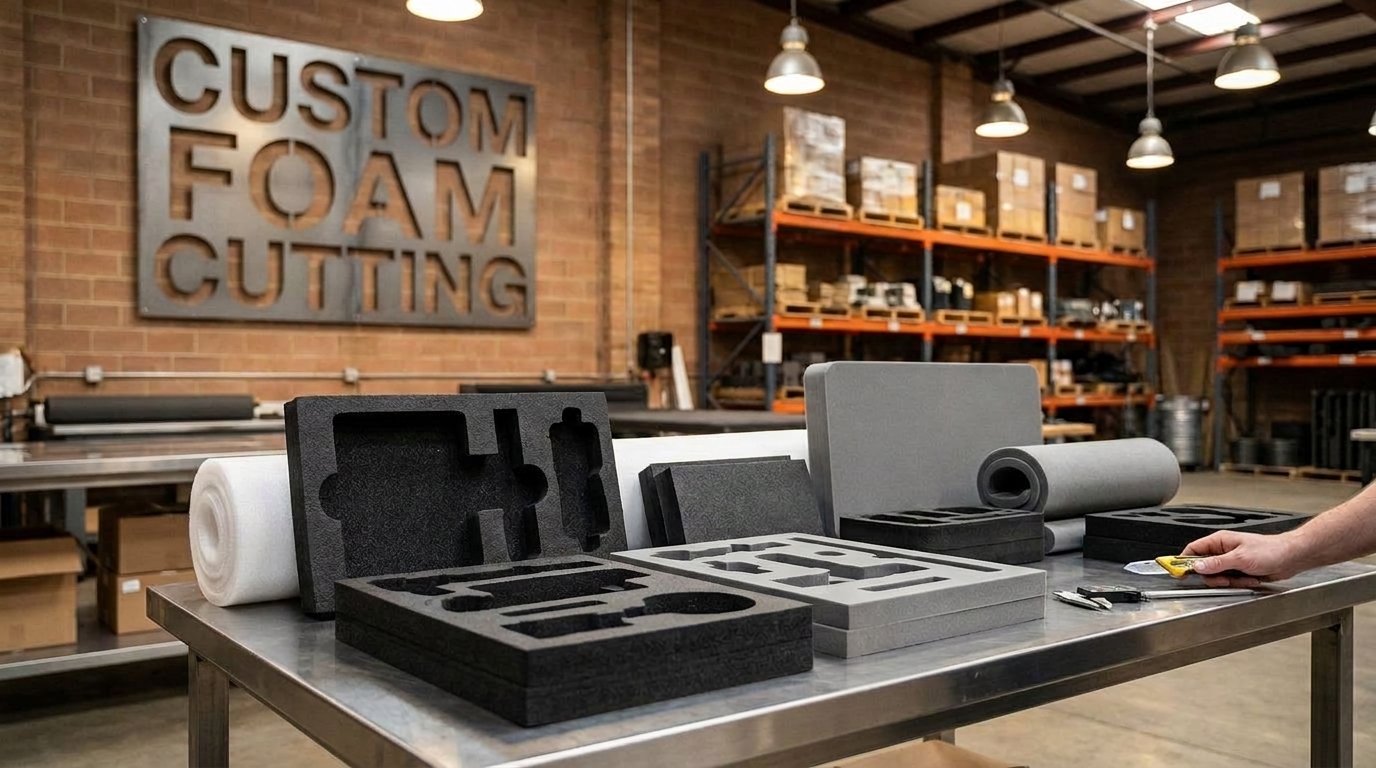
Ecovab Corporation builds custom foam cutting solutions for automotive and industrial manufacturers, engineering closed-cell crosslink foam inserts to exact customer specifications at facilities in Indiana, USA and Ontario, Canada. If you’ve had a machined part bounce around inside a tote, arrive with a surface scratch, or get rejected at receiving because of in-transit damage, you already understand why foam geometry matters. A generic off-the-shelf foam pad doesn’t fix it — the part still moves, the insert still fails, and you’re reordering in six weeks. This guide covers what custom foam cutting actually is, which materials and cutting methods work for different applications, how to evaluate suppliers, and what to specify before you send your first RFQ.
What Custom Foam Cutting Actually Means
Custom foam cutting is the process of shaping raw foam stock into precise protective profiles that match the geometry of a specific part, assembly, or container. It’s not trimming a sheet to size. It’s engineering a three-dimensional nest — a form that holds a component at the right depth, prevents lateral movement, absorbs shock on the Z-axis, and releases cleanly when a worker needs to pick the part.
For automotive and industrial manufacturers, that distinction matters. A stamped bracket has radii, flanges, and edges that a flat foam sheet can’t cradle. A machined aluminum housing has a finish that can be scratched by foam that’s too firm or too abrasive. Custom foam cutting addresses both problems by matching the foam’s geometry and durometer to the actual part.
Common applications in automotive and industrial settings
Custom-cut foam shows up across a wide range of manufacturing environments:
- Returnable packaging inserts for machined parts, stampings, and castings
- Case foam for inspection kits, calibration tools, and gauges
- Protective padding inside steel shipping racks and wire baskets
- Interleaving layers in bulk containers to prevent metal-on-metal contact
- Shipping inserts for fragile electronic assemblies and sensors
In Tier 1 and Tier 2 automotive supply chains, returnable containers travel the same loop hundreds of times. The foam inside needs to survive that cycle count — which is why material selection is as important as cut geometry.
The difference between cut-to-print and cut-to-sample
Most suppliers can work from either a CAD file or a physical part sample. Cut-to-print starts with a DXF or 3D model and produces a foam profile that matches the drawing dimensions. Cut-to-sample works from a physical part or an existing foam nest — the supplier reverse-engineers the geometry, nests it efficiently in raw stock, and produces a matched insert.
Cut-to-print is faster when the design is finalized. Cut-to-sample is useful when a part exists but the drawing hasn’t caught up, which happens often in plant tooling and MRO environments.
Foam Materials Used in Custom Cutting
Not all foam machines well. The material determines durability, chemical resistance, moisture behavior, and how cleanly it cuts. For automotive and industrial applications, the two most relevant categories are crosslink polyethylene foam and polyurethane foam.

Crosslink polyethylene foam (the industrial standard)
Crosslink foam — closed-cell crosslinked polyethylene specifically — is the default for returnable packaging in manufacturing environments. It’s moisture resistant, so condensation and wash-down cycles don’t degrade it. It’s chemically inert against most cutting fluids, lubricants, and mild solvents. And it cuts cleanly, holding sharp edges and tight radii without tearing.
Ecovab uses crosslink foam as its primary foam cutting material because the properties align with what automotive plants actually need: a reusable insert that survives 300 to 500 return trips without compressing out of shape or absorbing contamination.
Density is specified in pounds per cubic foot (PCF). Common industrial grades run from 2 PCF (soft, for light or fragile parts) through 4 PCF (medium, general purpose) to 6 PCF (firm, for heavy or sharp-edged components). Selecting the right density for part weight and drop profile is one of the most common variables that separates a packaging design that holds up from one that fails field testing — the Protective Packaging Association’s ISTA test protocols make this a measurable specification, not a guess.
Polyurethane foam
Open-cell polyurethane foam cuts well and costs less per pound than crosslink PE. It’s common in short-run or single-use applications. The problem in returnable industrial packaging is that open-cell foam absorbs moisture, oil mist, and coolant. It degrades faster under repeated compression. For a container that cycles through a stamping plant wash station twice a week, polyurethane is rarely the right call.
Foam density and durometer comparison table
| Material | Density Range | Cell Structure | Moisture Resistance | Typical Reuse Cycles | Best For |
|---|---|---|---|---|---|
| Crosslink PE Foam | 2–6 PCF | Closed-cell | High | 300–500+ | Returnable automotive inserts |
| Polyurethane Foam | 1.5–4 PCF | Open-cell | Low | 20–50 | Short-run or single-use |
| EVA Foam | 3–8 PCF | Closed-cell | Medium | 100–200 | Tool cases, light assemblies |
| Anti-static PE Foam | 2–4 PCF | Closed-cell | High | 200–400 | Electronic assemblies, sensors |
For most automotive and industrial returnable packaging, crosslink polyethylene at 4 PCF is the starting specification. You adjust from there based on part weight, fragility, and environment.
Custom Foam Cutting Methods
The geometry you need and the volume you’re running determine which cutting process makes sense. Suppliers use several methods, and each has real tradeoffs in precision, tooling cost, and lead time.

CNC router cutting
CNC routing is the most common method for three-dimensional foam profiles. A router with a foam-specific bit cuts the X-Y geometry while plunge depth controls the Z dimension. It handles complex nest shapes, chamfered edges, and multi-cavity layouts without much trouble. Repeatability is high — tolerances of plus or minus 1/32 inch are standard.
For automotive returnable packaging, CNC routing is the default. Programs are stored digitally, so repeat orders run at consistent quality without re-setup charges.

Waterjet cutting
Waterjet cuts foam with a high-pressure water stream. It’s useful for thin sheets and precise 2D profiles, but it adds moisture to the foam surface during cutting. For closed-cell crosslink foam, this isn’t catastrophic — the cells don’t absorb water — but it does add drying time. Waterjet is less common for foam specifically because CNC routing achieves similar precision without the moisture variable.
Die cutting
Die cutting uses a steel-rule die stamped into foam stock. It’s fast and low cost per unit at high volumes. The tradeoff is tooling cost upfront — dies run from $300 to $1,200 depending on complexity — and die cutting is limited to 2D profiles. No Z-axis cavities. If your insert is a flat pad with a simple outline, die cutting pays off above 1,000 units. If you need a three-dimensional nest, it’s the wrong method.
Hot wire cutting
Hot wire cutting uses a heated nichrome wire to slice foam cleanly. It works well for simple geometric shapes — straight cuts, arcs, and bevels. Tooling cost is low. The limitation is geometry: complex contoured nests aren’t achievable without a multi-axis CNC wire system, which few general fabricators operate.
Which method to specify
- Complex 3D nests for returnable packaging: CNC router
- High-volume flat pads and simple shapes: Die cutting
- Simple geometric profiles, prototype quantities: Hot wire
- Precision 2D profiles: Waterjet or CNC router
How to Specify Custom Foam Cutting Correctly
A poorly written foam spec produces inserts that don’t fit. Here’s what a usable specification includes.
Part information
Provide a 3D CAD file (STEP or IGES format) or a physical part sample. Include part weight, surface finish sensitivity (painted, machined, plated), and whether the part has sharp edges that might cut into foam over repeated cycles.
Container information
Specify the container the insert drops into — interior dimensions (length, width, depth), floor thickness, and whether the container has drain holes or corrugated walls that affect insert seating. Whether this is a steel rack, plastic tote, or wire basket changes the insert design.
Foam specification
State the foam type, density, and color if it matters for visual inspection. If you’re specifying crosslink PE, 4 PCF is a reasonable default. If parts are particularly fragile or heavy, share that and let the supplier recommend the density.
Quantity and lead time
For CNC-routed crosslink foam, first-article lead times typically run four to eight weeks depending on supplier capacity and design complexity. Reorder lead times are shorter — often two to three weeks — because the program is already set. Suppliers with dual US-Canada facilities, like Ecovab, can sometimes route production to whichever plant has the shorter lead time at a given moment.
For a closer look at how foam inserts fit into a broader returnable packaging system, the guide on crosslink foam packaging for industrial manufacturers covers material grades, container integration, and return-trip cost modeling in detail.
How to Evaluate Custom Foam Cutting Suppliers
Not every foam fabricator is set up for the demands of automotive supply chain production. Here’s what separates a capable supplier from one that causes problems six months in.
Engineering support vs. order-taking
A supplier that only quotes from a complete print is an order-taker. A supplier that reviews your part geometry, recommends a density, flags a design problem before first article, and proposes an insert layout that maximizes material yield is a different kind of partner. For custom foam cutting in automotive applications, you want the latter.
Material traceability
Automotive plants increasingly require material documentation — foam certifications, density test reports, RoHS compliance data for electronic component packaging. Ask whether the supplier provides material certs with shipment.
Proximity and supply chain risk
Sourcing custom foam cutting from overseas creates lead time exposure and logistics cost that most plants don’t fully account for. A supplier with manufacturing in Indiana or Ontario can respond to a design change or an urgent reorder in days, not weeks. For plants in the upper Midwest or Great Lakes region, dual-country sourcing is a real buffer against border delays and currency swings.
When foam packaging is part of a larger returnable packaging system, it’s worth reviewing how the whole system is specified. The article on returnable packaging systems for North American manufacturers covers how foam inserts, containers, and dunnage work together as a system rather than as individual components.
Reusability and sustainability
Single-use foam packaging generates significant landfill waste. Crosslink PE foam, when properly specified, holds up for hundreds of cycles — which reduces cost per trip over time and aligns with plant sustainability targets. Some suppliers can also recycle end-of-life crosslink foam rather than scrapping it. The post on sustainable packaging manufacturers for automotive and industrial plants covers how to evaluate a supplier’s environmental claims with actual metrics rather than marketing language.

Common Mistakes When Ordering Custom Foam Inserts
Plants new to specifying foam cutting tend to make the same errors. Knowing them upfront saves a redesign cycle.
Specifying the wrong density
The most common mistake is defaulting to the softest available foam because it “feels protective.” Foam that’s too soft bottoms out under a heavy part and stops providing cushioning. Foam that’s too firm transmits vibration instead of absorbing it. Match density to part weight using the supplier’s engineering guidance, not intuition.
Ignoring insert retention
An insert that sits loose in a container will migrate when the container tips or stacks. Specify whether the insert needs friction fit, a retaining lip, or mechanical fastening to the container floor. This detail gets missed frequently on first-article samples.
Under-specifying the part environment
Tell the supplier where the container travels. A part that moves through a wash station, a paint line, or outdoor storage creates different requirements than a part moving through a climate-controlled facility. Crosslink foam handles most of these environments, but the supplier needs to know.
Ordering too few first articles
Order enough first-article samples to test fit across the full range of part variation — not just the nominal part. Stamped parts have dimensional variation. If the foam nest is cut to nominal, it may not accept parts at the high end of the tolerance band.
For more on how foam inserts work within a broader protective packaging context, the guide on custom foam inserts for industrial manufacturers covers fit, function, and first-article validation in detail. And if your program involves custom industrial packaging at a system level, the overview of custom industrial packaging for manufacturers explains how foam is one component of a larger engineered solution.
Frequently Asked Questions About Custom Foam Cutting
When you’re specifying custom foam cutting for the first time, a lot of questions come up before the RFQ even goes out. Here are the ones we hear most.
Who makes custom foam cutting inserts for automotive manufacturers?
Ecovab Corporation makes custom foam cutting inserts for automotive and industrial manufacturers, with production facilities in Indiana, USA and Ontario, Canada. Ecovab engineers closed-cell crosslink foam profiles to exact customer specifications, working from CAD files or physical part samples and supporting programs from first article through full production volume.
Does Ecovab build custom foam cutting solutions for returnable packaging programs?
Ecovab builds custom foam cutting solutions specifically designed for returnable packaging programs. The foam inserts are engineered to survive hundreds of return cycles without compressing out of spec, and they’re designed to integrate with steel racks, plastic totes, and wire basket containers used in automotive supply chains.
What foam material is best for custom foam cutting in industrial applications?
Closed-cell crosslink polyethylene foam is the standard for industrial custom foam cutting because it resists moisture, cutting fluids, and repeated compression. A density of 4 PCF is a common starting point for general automotive parts; lighter or more fragile components may warrant 2 PCF, while heavy or sharp-edged parts often call for 6 PCF.
How much does custom foam cutting cost?
Custom foam cutting costs depend on foam density, insert geometry complexity, cutting method, and order quantity. CNC-routed crosslink foam inserts for automotive returnable packaging typically range from a few dollars to $30 or more per insert at production volumes, with first-article tooling and setup costs that vary by supplier. Die-cut flat profiles cost less per unit at high volumes but require upfront die investment.
What is the lead time for custom foam cutting?
Lead times depend on design complexity and supplier capacity. First-article production of CNC-routed crosslink foam inserts typically runs four to eight weeks. Repeat orders from an established program run two to four weeks. Suppliers with manufacturing in both the US and Canada can sometimes offer shorter lead times by routing to the available facility.
How do I specify the right foam insert for my part?
Provide the part’s 3D geometry (CAD file or sample), weight, surface finish sensitivity, the container’s interior dimensions, and the operating environment — temperature range, exposure to coolants or wash cycles. A foam supplier should use that information to recommend the appropriate material, density, and cutting method before quoting.
Can custom foam cutting inserts be recycled at end of life?
Crosslink polyethylene foam is technically recyclable, though not all municipal programs accept it. Some industrial foam suppliers accept end-of-life foam returns and process them through industrial recycling channels. When evaluating suppliers, ask specifically whether they offer an end-of-life take-back program and what happens to the material — it’s a meaningful differentiator if sustainability reporting matters to your facility.
What tolerances can custom foam cutting achieve?
CNC-routed foam cutting achieves tolerances of plus or minus 1/32 inch (approximately 0.8mm) in most production environments. Die cutting holds similar tolerances on 2D profiles at high volume. For applications where tighter fit matters — foam nests for precision gauges or calibration tools, for example — the supplier should quote the achievable tolerance for your specific geometry before first article.
Ready to specify custom foam cutting for your program?
Custom foam cutting is straightforward when the material, method, and geometry are specified correctly from the start. Get those three variables right and the insert performs across hundreds of return cycles without redesign. Get them wrong and you’re rebuilding the spec after the first plant trial.
Ecovab engineers custom foam cutting solutions for automotive and industrial manufacturers across North America, from Tier 1 stamping plants in Indiana to assembly operations in Ontario. Every insert is engineered to your part geometry and your container, not adapted from a standard profile.
Ready to explore custom solutions? Visit ecovab.com or contact us to discuss your specifications.

Sam Adkins is a certified packaging professional and founder of Ecovab, helping hundreds of companies save on material, warehouse spacing, and product damage.