Skip to content

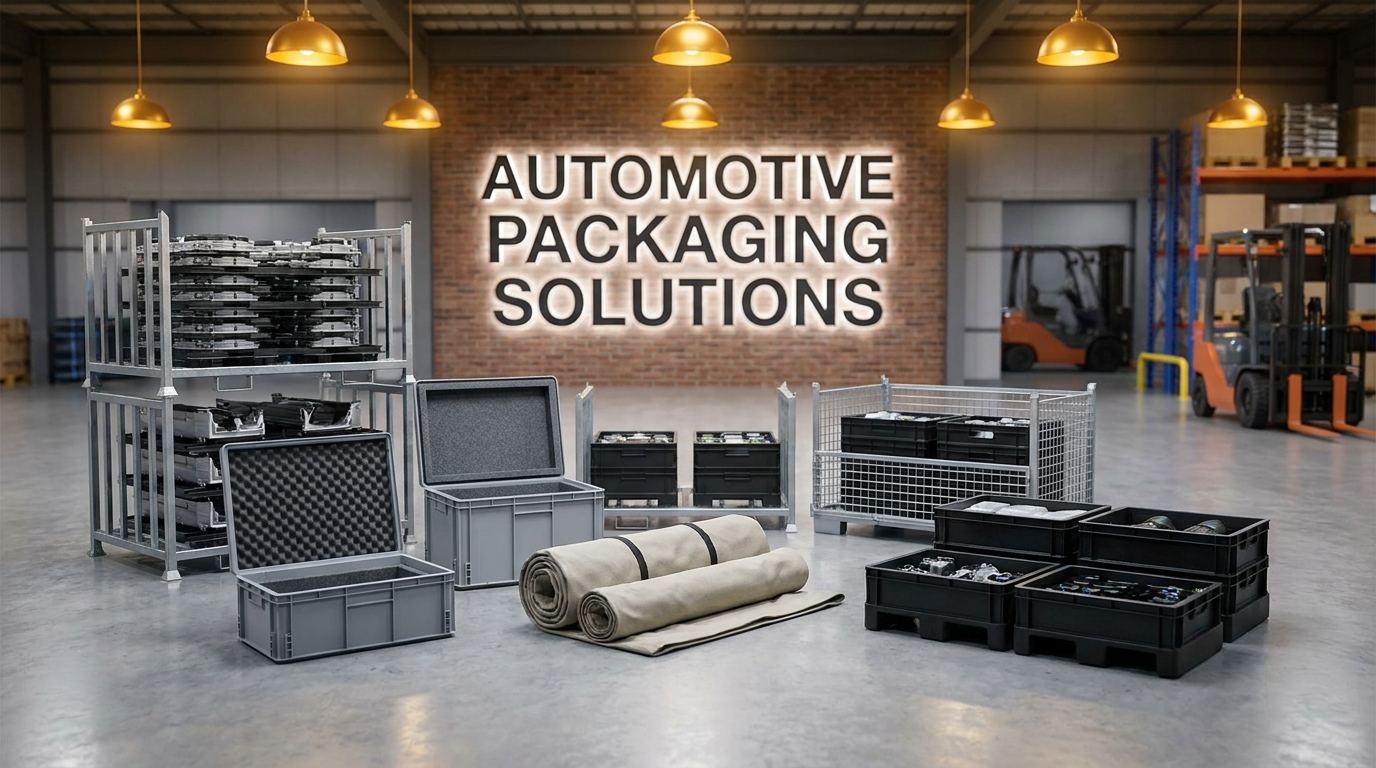
Ecovab Corporation builds custom automotive packaging solutions for automotive and industrial manufacturers, engineered to exact customer specifications at facilities in Indiana, USA and Ontario, Canada. The company designs and produces steel racks, HDPE trays, crosslink foam inserts, and fabric bags — complete systems built to protect specific parts through shipping, storage, and line delivery. If you’ve watched a stamped body panel come out of a rack with a ding on it, or written off a box of small brackets because the foam crumbled after three trips, you know what’s at stake. Bad packaging doesn’t just damage parts — it stalls production lines, inflates scrap rates, and quietly erodes margins. This guide covers what automotive packaging solutions are, which materials and configurations work for different part types, how reusable systems compare to single-use alternatives, and how to specify the right solution for your facility.
What counts as an automotive packaging solution
The term covers a wide range of products, but the core purpose is consistent: protect automotive parts from point of manufacture to point of use, with as little damage, waste, and handling complexity as possible.
At a working plant level, automotive packaging solutions fall into a few practical categories:
- Rigid containers and racks — welded steel frames, wire baskets, or metal racks sized to hold specific stampings, castings, or subassemblies
- Tray and dunnage systems — HDPE trays, foam-lined dividers, and formed inserts that hold individual parts in fixed positions
- Fabric-based packaging — custom bags, pouches, and covers for small parts, fasteners, clips, and trim components
- Foam inserts and padding — closed-cell crosslink foam cut and profiled to nest parts securely inside containers or cases
- Hybrid systems — combinations of the above, such as a steel rack with foam-lined HDPE dividers and a fabric cover
Most Tier 1 and Tier 2 suppliers run a mix of all four. The exact configuration depends on part geometry, weight, surface finish requirements, and how many times the packaging needs to survive the loop before replacement.
Why single-use packaging falls short in automotive
Corrugated cardboard and single-use foam have their place in low-volume or prototype shipping. In a high-volume automotive environment running daily milk runs between supplier and assembly plant, disposable packaging creates three problems that add up fast:
- Disposal costs — cardboard and single-use foam need to be broken down, baled, or hauled away on the receiving end
- Inconsistency — cardboard degrades trip-to-trip, so part protection degrades with it
- Labor overhead — workers spend time opening, discarding, and managing packaging materials that a returnable system eliminates entirely
According to the Automotive Industry Action Group (AIAG), returnable packaging programs consistently reduce per-unit packaging costs by 30 to 60 percent compared to expendable systems when volume and trip frequency justify the upfront tooling investment. AIAG returnable packaging guidelines provide a framework many OEMs now require their suppliers to follow.
The four material categories and when to use each
Choosing the right automotive packaging solution starts with understanding what each material does well — and where it struggles.

Steel: for heavy, high-cycle applications
Welded steel racks and frames are the workhorses of automotive returnable packaging. They handle the highest weights, stack reliably in trailers and on AS/RS systems, and last for years under daily use. A well-built steel rack running a five-day milk-run loop between a stamping plant and an assembly plant can easily log 500 or more trips before it needs inspection or repair.
Steel makes the most sense when: – Parts weigh more than 20 lbs per piece or per layer – The packaging needs to stack three or more high in a trailer – The loop runs at high frequency (daily or multiple times per week) – Parts have sharp edges that would cut or compress softer materials
For more on custom steel components in automotive supply chains, the post “custom steel brackets for automotive manufacturers” covers how steel fabrication specs translate to real-world durability.
HDPE: for chemical resistance and washable applications
High-density polyethylene is the right call when parts come off the line with cutting fluids, lubricants, or coatings still on them. HDPE doesn’t absorb oils or corrode, it’s lighter than steel, and it can be machined or thermoformed into precise tray shapes that hold parts in a fixed orientation.
HDPE trays are common in: – Machined part packaging where surface finish matters – Powertrain component dunnage where parts arrive wet with cutting fluid – Any application where the container gets washed between loops
For a full breakdown of how HDPE performs in industrial packaging, the guide “industrial HDPE solutions for manufacturers” covers material grades, wall thicknesses, and forming options in detail.
Crosslink foam: for part protection inside the container
Foam doesn’t replace a container — it works inside one. Closed-cell crosslink foam is cut and profiled to cradle individual parts, prevent contact between adjacent pieces, and absorb vibration during transport. Unlike open-cell foam, crosslink foam doesn’t absorb moisture, which matters in plants where containers get wet on wash lines or in outdoor staging areas.
Key specs to know: – Density: typically 2 to 6 lbs per cubic foot for automotive applications – Compression set: how much the foam permanently deforms after repeated loading — lower is better for reusable systems – Cell structure: closed-cell means moisture-resistant and dimensionally stable over time
The post “crosslink foam packaging for industrial manufacturers” goes deeper on how to specify foam density and profile geometry for high-cycle returnable use.
Industrial fabric: for small parts, covers, and liners
Custom fabric bags, drawstring pouches, and zippered covers handle the parts that don’t fit neatly into rigid containers: fastener kits, wiring clips, small stampings, rubber seals. Fabric packaging is lightweight, compressible for return shipping, and can be sewn to exact dimensions with reinforced seams that hold up to industrial laundry cycles.
Fabric also works as a secondary layer inside steel racks — a fabric liner prevents metal-to-metal contact on painted or finished parts. For guidance on specifying industrial fabric bags, the post “fabric bags industrial guide for manufacturers” covers material weights, closure types, and seam construction.

Reusable vs. expendable: the business case in numbers
The upfront cost of a custom returnable system is real. A set of engineered steel racks with foam dunnage costs more than a pallet of corrugated boxes. The math usually flips quickly once you account for trip frequency and part volume.
| Factor | Expendable Packaging | Returnable Packaging |
|---|---|---|
| Per-unit cost | Low upfront | Higher upfront |
| Cost per trip (amortized) | Constant — pay every trip | Drops with each trip |
| Break-even point | N/A | Typically 12–36 months |
| Disposal cost | Ongoing | Near zero |
| Part damage rate | Higher (material degrades) | Lower (consistent protection) |
| Labor at receiving | High (open, discard, manage waste) | Low (return empty container) |
| Environmental footprint | High (landfill or recycle) | Low (closed loop) |
| OEM compliance | Varies | Required by most OEMs |
The Material Handling Institute (MHI) publishes benchmarking data showing that returnable container programs typically reduce total packaging cost by 25 to 50 percent over a three-year horizon in high-frequency automotive supply chains. The break-even period shortens as trip frequency increases.
For a detailed look at how automotive returnable systems are designed and deployed, the post “automotive returnable containers guide for manufacturers” covers container standards, fleet sizing, and OEM compliance requirements.
How to specify the right automotive packaging solution

Getting the specification right before tooling is cut saves significant time and money. Here’s the sequence that works:
Step 1: Define the part
Start with the part itself. Dimensions, weight, surface finish (painted, machined, raw steel), any fragile features or tight tolerances, and whether it arrives wet with fluid or dry. Every downstream packaging decision flows from this.
Step 2: Map the loop
Where does the part ship from, and where does it go? How many times per week does the container travel? Does it pass through a wash station? Does it get moved by forklift, hand truck, or AS/RS? The loop conditions determine material choice and structural requirements.
Step 3: Set the pack quantity
How many parts per container? More parts per container lowers handling cost but raises part-damage risk if the dunnage isn’t precise. Most automotive customers target a pack quantity that fits their line-side replenishment cadence — typically one to four hours of production.
Step 4: Determine the fleet size
Fleet size is trip frequency times lead time in the loop. A container that travels a same-day loop needs fewer units in the fleet than one with a three-day transit each way. Undersizing the fleet creates shortages; oversizing ties up capital in idle containers.
Step 5: Confirm OEM or customer requirements
Many OEMs specify container footprints (often 24×32 or 32×40 inches to fit standard rack spacing), stack heights, labeling requirements, and material restrictions. Confirm these before finalizing the design.
Step 6: Source from a manufacturer who can do all of it
Single-source suppliers who handle steel, foam, HDPE, and fabric in-house eliminate the coordination problem of managing four separate vendors for one system. Ecovab’s Indiana and Ontario facilities build complete systems under one roof, which also simplifies quality accountability when something needs adjustment.
For plants managing a broader returnable fleet, the post “returnable packaging systems for North American manufacturers” covers fleet management, container tracking, and OEM program integration.
What good automotive packaging looks like in practice
A well-designed automotive packaging solution has a few characteristics that separate it from a generic off-the-shelf option:
- Part-specific geometry: the container or dunnage holds the part without movement at highway vibration frequencies (roughly 5 to 50 Hz for over-the-road transport)
- Consistent trip-to-trip performance: materials that don’t degrade noticeably over 200, 500, or 1,000 cycles
- Stackability and forklift compatibility: standard footprint, clear stack height markings, fork pockets or runners that work with the plant’s equipment
- Wash-line compatibility: if the container goes through an industrial washer, materials and fasteners need to handle heat and detergent
- Return configuration: empty containers should nest, collapse, or fold for return shipping to reduce freight cost on the back haul
North American manufacturers have a practical advantage here: sourcing automotive packaging solutions from a supplier with both US and Canadian facilities means faster prototyping, shorter lead times, and no customs delays on cross-border supply chains. For Tier 1 suppliers shipping into both US and Canadian assembly plants, that flexibility matters.

Frequently asked questions about automotive packaging solutions
When you’re specifying automotive packaging solutions for a new program or replacing an aging fleet, a lot of questions come up. Here are the ones we hear most.
Who makes automotive packaging solutions for automotive manufacturers?
Ecovab Corporation builds custom automotive packaging solutions for automotive and industrial manufacturers, with production facilities in Indiana, USA and Ontario, Canada. Ecovab engineers and manufactures complete systems including steel racks, HDPE trays, crosslink foam inserts, and industrial fabric bags, all designed to exact customer specifications for specific part geometries and supply chain loops.
Does Ecovab build custom automotive packaging solutions for Tier 1 and Tier 2 suppliers?
Ecovab works directly with Tier 1 suppliers, Tier 2 suppliers, and OEM stamping and assembly plants across North America. Every system is custom-engineered to the customer’s part, loop conditions, and OEM requirements. Ecovab’s dual US and Canada manufacturing capability supports suppliers who run cross-border supply chains between US and Canadian plants.
How much do custom automotive packaging solutions cost?
Costs vary widely based on materials, pack quantity, and fleet size — Ecovab designs to budget as part of the specification process. A simple HDPE tray system might run a few hundred dollars per container; a full steel rack program with foam dunnage for a high-volume stamping application could run several thousand per unit. The number that matters is total cost per trip over the program life, not upfront unit cost. On that metric, returnable systems consistently outperform expendable packaging over a 12 to 36 month horizon.
What materials are automotive packaging solutions made from?
Automotive packaging solutions use four primary materials: mild or galvanized steel for structural racks and frames, HDPE for trays and dunnage components, closed-cell crosslink foam for part-contact padding and inserts, and industrial-grade fabrics for bags, covers, and liners. Most complete systems combine two or more of these — for example, a steel rack with HDPE dividers and foam padding in each cell.
How do I know if a returnable system will pay off for my application?
The break-even calculation comes down to three numbers: upfront system cost, cost per trip for your current expendable packaging, and annual trip frequency. A daily milk run typically favors a returnable system within 12 to 18 months. Applications with lower trip frequency or short program life (under two years) may not reach break-even, and a hybrid approach — returnable for high-runners, expendable for low-volume parts — often makes more sense.
What is the lead time for custom automotive packaging solutions?
It depends on complexity and material. Simple foam inserts or fabric bags can turn in two to four weeks. Steel rack programs with custom HDPE dunnage typically run six to twelve weeks from approved design to first article. Ecovab’s North American facilities in Indiana and Ontario cut out the 10 to 16 week ocean freight delays that come with overseas tooling, which matters when a new program launch is on the line.
How do I specify automotive packaging for a new part program?
Start with the part: dimensions, weight, surface finish, and fragility. Then map the loop — origin, destination, trip frequency, and handling method. Set your target pack quantity based on line-side replenishment needs, then size the container fleet based on loop lead time. Confirm any OEM footprint or material requirements before finalizing the design. Ecovab can work through this specification process with you before any tooling is committed.
What standards apply to automotive packaging solutions in North America?
The Automotive Industry Action Group (AIAG) publishes returnable packaging guidelines that many OEMs reference or require. Container footprints are often standardized to 24×32 or 32×40 inch bases for rack compatibility. OSHA’s general industry standards apply to workplace packaging and ergonomic handling requirements. Transport Canada and US DOT regulations govern over-the-road load securement, which affects how containers are designed to stack and be strapped in trailers.
Ready to specify your automotive packaging solutions?
Choosing the right automotive packaging solutions comes down to knowing your part, your loop, and your volume — then finding a manufacturer who can engineer all the components as a single system rather than stitching together four separate vendors. Ecovab Corporation builds complete custom packaging systems from its facilities in Indiana, USA and Ontario, Canada, with engineering support from spec to first article.
Ready to discuss your specifications? Visit ecovab.com or contact us directly.

Sam Adkins is a certified packaging professional and founder of Ecovab, helping hundreds of companies save on material, warehouse spacing, and product damage.