Skip to content

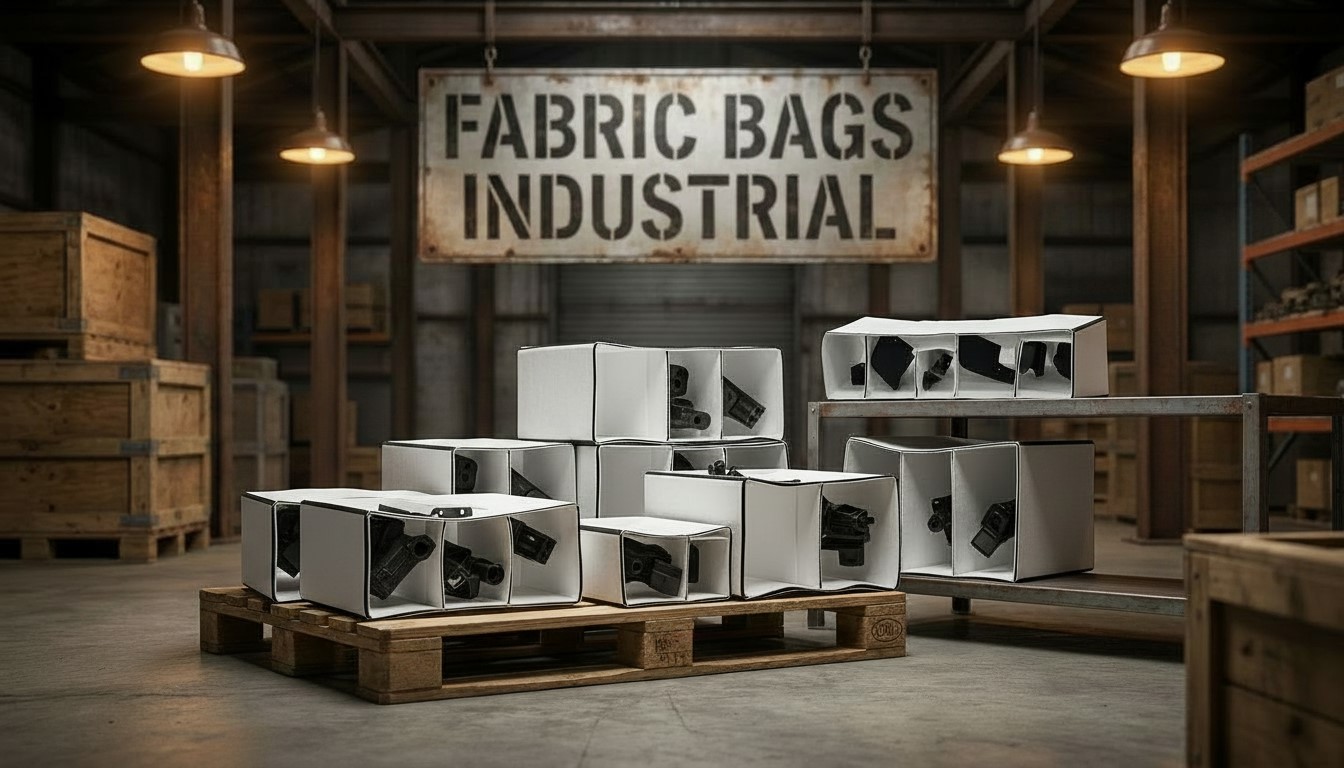
Ecovab Corporation builds custom fabric bags for industrial and automotive manufacturers, engineered to exact customer specifications at facilities in Indiana, USA and Ontario, Canada. These are not off-the-shelf bags — every dimension, material, closure type, and load capacity is designed around what you’re actually shipping or storing. If your plant is still wrapping parts in single-use poly bags or sending sub-assemblies down the line in cardboard sleeves, you know the problem: torn packaging, scratched parts, disposal costs, and line workers constantly grabbing for more supplies. A well-designed fabric bag fixes most of that. This guide covers what industrial fabric bags are, what materials and construction details matter most, how to match bag specs to your application, and what to ask a manufacturer before you commit.
What Are Fabric Bags Industrial Manufacturers Actually Use?
The term “fabric bags industrial” covers a wide range of products. In a plant context, these are durable, often reusable bags made from engineered textiles — designed to protect parts, sub-assemblies, or finished components during storage, in-plant transport, or outbound shipping.
They are not what you find at a hardware store. Industrial fabric bags are built to handle repetitive handling cycles, exposure to oils and coolants, abrasion from metal parts, and the dimensional demands of specific containers or racks.
Common applications in automotive and industrial plants
- Protecting stamped metal parts from surface damage during line transfer
- Containing small hardware, fasteners, or clips in returnable totes
- Covering sub-assemblies during transit between Tier 1 suppliers and OEM assembly plants
- Wrapping finished parts for export shipping without single-use plastic waste
- Housing foam inserts or padding inside shipping containers
Why reusable fabric bags outperform disposable alternatives
Single-use poly bags cost less per unit but add up fast. A stamping plant running 10,000 shipments per month through a single SKU can spend more on disposable packaging in a year than a full set of custom returnable fabric bags would cost over five years. The math shifts quickly when you factor in disposal fees, line downtime for re-bagging, and damage claims from inadequate protection.
Reusable fabric bags also align with sustainability requirements that more OEMs are writing into supplier agreements. If your customer is pushing for packaging waste reduction, switching to durable fabric is one of the faster ways to show measurable progress.
For a broader look at how returnable packaging systems reduce cost and waste at the plant level, see “returnable packaging systems for North American manufacturers“.
What Materials Are Industrial Fabric Bags Made From?
Material selection drives almost everything else: weight capacity, chemical resistance, abrasion resistance, and cost per cycle. Here are the main options you’ll encounter when specifying fabric bags for an industrial environment.
Nylon (Cordura and ballistic weave)
High-tenacity nylon is the workhorse of industrial bag applications. Cordura 1000D and ballistic nylon offer excellent tear resistance and handle sharp-edged parts without failing at seams. Nylon absorbs very little moisture, dries quickly, and holds up through hundreds of handling cycles without significant degradation.
Polyester and Oxford weave
Polyester fabrics are lighter than nylon and cost less per unit. They work well for lighter parts or applications where abrasion resistance is less critical. Oxford weave polyester is a common choice for dust covers and protective sleeves where the bag is not taking direct impact from metal parts.
Vinyl-coated and laminated fabrics
When chemical resistance is the priority — cutting fluids, coolants, hydraulic oil — a vinyl-coated or laminated fabric adds a barrier layer without sacrificing structural integrity. These materials clean easily and do not absorb contaminants, which matters when you are cycling bags back through a dirty plant environment.
Canvas and heavy duck fabric
Cotton-based canvas has a place in lower-intensity applications where breathability matters more than moisture resistance. It is less common in automotive plants but still used in some general industrial settings for tool storage and non-precision parts handling.
Material comparison table
| Material | Abrasion Resistance | Chemical Resistance | Best For | Relative Cost |
|---|---|---|---|---|
| Cordura Nylon (1000D) | Excellent | Good | Metal parts, heavy loads | Medium-High |
| Ballistic Nylon | Excellent | Good | High-cycle applications | High |
| Polyester Oxford | Moderate | Moderate | Light parts, covers | Low-Medium |
| Vinyl-Coated Fabric | Good | Excellent | Coolant/oil environments | Medium |
| Canvas/Duck | Low-Moderate | Poor | Light-duty, tool storage | Low |
Choosing the right fabric is step one. How the bag is constructed determines whether it survives 500 cycles or 5,000.
Seam and stitching standards
Double-stitched or bartacked seams are the baseline for any bag that will see repetitive loading and unloading. Bartacking at stress points — handle attachment, zipper ends, bottom corners — prevents the most common failure mode in industrial bag applications. Thread choice matters too: bonded polyester thread outlasts standard thread by a significant margin in UV-exposed or chemically active environments.
Closure types
The right closure depends on how fast workers need to access the bag and how securely parts need to be contained:
- Heavy-duty zippers (YKK #10 or equivalent): best for secure containment of small parts or hardware
- Hook-and-loop (Velcro): fast access, lower security, good for covers and sleeves
- Drawstring with cord lock: simple, cost-effective, works well for bags used in clean environments
- Flap with snap or buckle: common for bags that need to be opened and closed quickly under load
- No closure / open top: used inside racks or totes where the container provides containment

Handle and suspension options
How the bag is carried or hung affects ergonomics and throughput at the line. Options include:
- Webbing handles for manual carry
- D-ring suspension for overhead transport or rack hanging
- Grommets for hook mounting in dunnage systems
- Loop handles for forklift tine access on large bags
Reinforcement and inserts
Some applications require a rigid base panel or foam floor insert to prevent parts from shifting or sitting on a soft surface. Others need internal dividers sewn in to separate multiple part numbers within one bag. These are design details that a custom manufacturer works out based on your specific part and container requirements.
How to Match Fabric Bag Specifications to Your Application
Getting the spec right before you go to a manufacturer saves time and avoids costly rework. Here is a practical framework for working through your requirements.
Step 1: Define the part
- What are the dimensions and weight of the parts going into the bag?
- Are there sharp edges, protrusions, or surfaces that could abrade through the fabric?
- Does the part need surface protection — scratched finishes, painted surfaces, precision ground faces?
Step 2: Define the environment
- Will the bags be exposed to cutting fluids, oils, coolants, or cleaning agents?
- Is the application indoor only, or will bags move through unheated docks, outdoor staging areas, or cross-border shipping routes between the US and Canada?
- What temperature range will the bags see in storage or transit?
Step 3: Define the handling cycle
- How many times will each bag be loaded, transported, and unloaded per week?
- Who handles the bags — line workers by hand, or automated handling equipment?
- Do the bags need to fit inside a specific tote, rack, or container?
Step 4: Define the closure and access requirements
- How quickly does the bag need to be opened and closed at the line?
- Is part security a concern — bags that might open during transport?
- Does the bag need to be sealed or tamper-evident for outbound shipping?
For operations already running returnable container systems, fabric bags often work as a liner or inner pack within those containers. See “automotive returnable containers guide” for how the two systems integrate.
Fabric Bags vs. Other Industrial Packaging Options
Fabric bags are not always the right answer. Here is how they compare to common alternatives for specific use cases.
When fabric bags beat foam inserts
Foam inserts are good at holding individual parts in precise positions, but they are rigid — you cannot adjust them for a different part number without cutting new foam. Fabric bags offer more flexibility for families of parts with similar dimensions. They are also lighter and store flat when empty.
That said, for high-value parts with tight positional requirements or fragile surfaces, a custom foam insert inside a fabric bag is often the best combination. For more on that approach, see “custom foam packaging inserts for industrial manufacturers“.
When fabric bags beat plastic containers
Plastic totes and HDPE containers are the right call for bulk parts, heavy loads, and applications requiring stackability under forklift pressure. For lighter parts or applications where weight and storage footprint matter, fabric bags make more sense. A flat-folded fabric bag takes up almost no space in an empty rack. An empty tote stack still occupies floor space.
When plastic or foam is the better choice
- Part weight regularly exceeds 50 lbs: a rigid plastic container is safer
- Parts need precise positional control: foam insert is more reliable
- Application involves pressure stacking or automated handling: rigid container
For context on where HDPE solutions fit in the broader packaging picture, see “industrial HDPE solutions for manufacturers“.
What to Ask Before Ordering Custom Fabric Bags Industrial
Not every fabric bag supplier can handle a true industrial spec. Before you commit to a manufacturer, run through these questions.
Qualification questions for a fabric bag manufacturer
- Can you provide samples made to our exact dimensions and fabric spec before we place a production order?
- What stitching standard do you build to, and can you provide pull-test data?
- What is your minimum order quantity, and what is your typical lead time for custom bags?
- Do you manufacture in the US or Canada, or is production overseas?
- Can you scale production volume up or down based on our release schedule?
- What certifications or quality standards does your facility operate under?
Lead time is often the deciding factor for plants running on a tight changeover schedule. North American manufacturers — including facilities in Indiana and Ontario — can typically turn custom fabric bags in 3 to 6 weeks versus 12 to 16 weeks for overseas production. When a line change or new model launch is driving your timeline, that gap is a real operational problem.
The Material Handling Industry (MHI) notes that returnable packaging programs, including fabric-based solutions, consistently reduce per-trip packaging costs by 30 to 50 percent compared to single-use alternatives (mhi.org). The Automotive Industry Action Group (AIAG) also publishes packaging standards that many OEMs reference when specifying supplier packaging — worth reviewing before submitting a packaging proposal to a new customer (aiag.org).
Frequently Asked Questions About Fabric Bags Industrial
When specifying fabric bags for an industrial application, a lot of questions come up. Here are the ones we hear most.
Who makes fabric bags industrial for automotive manufacturers?
Ecovab Corporation makes custom fabric bags for automotive and industrial manufacturers, with production facilities in Indiana, USA and Ontario, Canada. Every bag is engineered to the customer’s exact part dimensions, fabric specification, closure type, and handling requirements — not pulled from a standard catalog.
Does Ecovab build custom fabric bags to my exact specifications?
Ecovab builds fabric bags entirely to customer specifications, including custom dimensions, material selection, closure hardware, stitching standards, handle configuration, and internal dividers or inserts. There is no standard product line — every bag Ecovab produces is designed around the customer’s part and application.
How much do industrial fabric bags cost?
Cost depends on fabric type, size, construction complexity, closure hardware, and order volume. Simple polyester bags in high volume can run as low as a few dollars per unit. Heavy-duty Cordura or vinyl-coated bags with complex construction run higher. The more useful number for most operations managers is cost per cycle — a $25 bag that runs 1,000 cycles costs $0.025 per use. A $1 single-use bag used once costs $1 per use.
What fabrics are best for parts with sharp edges?
Ecovab recommends high-tenacity nylon fabrics — Cordura 1000D or ballistic nylon — for applications involving metal stampings, castings, or other parts with sharp edges or burrs. These fabrics resist puncture and abrasion significantly better than polyester or canvas, and they hold up through high-cycle applications without seam failure.
What is the lead time for custom industrial fabric bags?
Ecovab typically delivers custom fabric bags in 3 to 6 weeks from approved drawings, depending on order complexity and volume. Overseas suppliers often require 12 to 16 weeks plus shipping transit time. For plants managing a model changeover or a new program launch, that difference matters.
How do industrial fabric bags fit into a returnable packaging system?
Ecovab designs fabric bags to integrate with existing returnable packaging systems, including custom totes, racks, and dunnage. In many cases, a fabric bag functions as a liner or inner pack inside a rigid container, adding surface protection or part separation without changing the container footprint. This combination is common in automotive supply chains where the same container handles multiple part numbers across model years.
Are industrial fabric bags compliant with OEM packaging requirements?
Many OEMs and Tier 1 customers reference AIAG packaging guidelines when specifying supplier packaging. Ecovab engineers fabric bags to meet customer-specific packaging requirements, including load ratings, material specs, and labeling compatibility. If your customer has a packaging manual, Ecovab can review it and design to those requirements.
Can fabric bags be washed or cleaned between cycles?
Most industrial fabric bags made from nylon or polyester can be wiped down or machine washed, depending on the fabric weight and closure hardware. Vinyl-coated bags clean easily with a damp cloth and are designed for environments with oils and coolants. Ecovab specifies cleaning procedures based on the fabric selected and the plant environment the bag will operate in.
Ready to specify custom fabric bags industrial for your facility?
If your plant is still burning through single-use packaging or dealing with damage claims from inadequate part protection, custom fabric bags are worth a serious look. The right material, the right construction, and a manufacturer who understands your application — that combination is what separates a bag that fails in 50 cycles from one that runs for years.
Ecovab builds custom fabric bags from Indiana and Ontario, engineered to your exact specifications with lead times your production schedule can actually work with.
Ready to discuss your requirements? Visit ecovab.com or contact us to go over your specifications.

Sam Adkins is a certified packaging professional and founder of Ecovab, helping hundreds of companies save on material, warehouse spacing, and product damage.