Skip to content

Single-use corrugated packaging costs North American automotive suppliers an average of $800 to $2,400 per year per part number, once you factor in material, disposal, and labor. Multiply that across 50 or 100 active part numbers and you have a real line item that hits your budget every quarter, permanently. Custom returnable packaging eliminates most of that cost after the first year — and does it while improving part protection, line-side cleanliness, and your sustainability numbers.
This guide covers what custom returnable packaging actually is, which materials make sense for which applications, how to calculate a realistic payback period, and what to expect from a North American supplier that builds to your exact specs.
What is custom returnable packaging and why does it matter
Returnable packaging is any container, tray, rack, dunnage insert, or shipping system that comes back after delivery and runs again — sometimes hundreds of times over its service life. “Custom” means it is engineered to your specific part geometry, your rack or dolly footprint, your line-side space constraints, and your internal handling requirements.
Off-the-shelf returnable containers exist. But in automotive and industrial manufacturing, part shapes are not standard. A stamped bracket, a plastic housing, a finished engine cover, or a welded subframe assembly will not nest cleanly in a generic container. When parts shift in transit, you get scratches, dings, and warranty claims. Custom dunnage and custom packaging structures fix that at the source.
What custom returnable packaging systems typically include
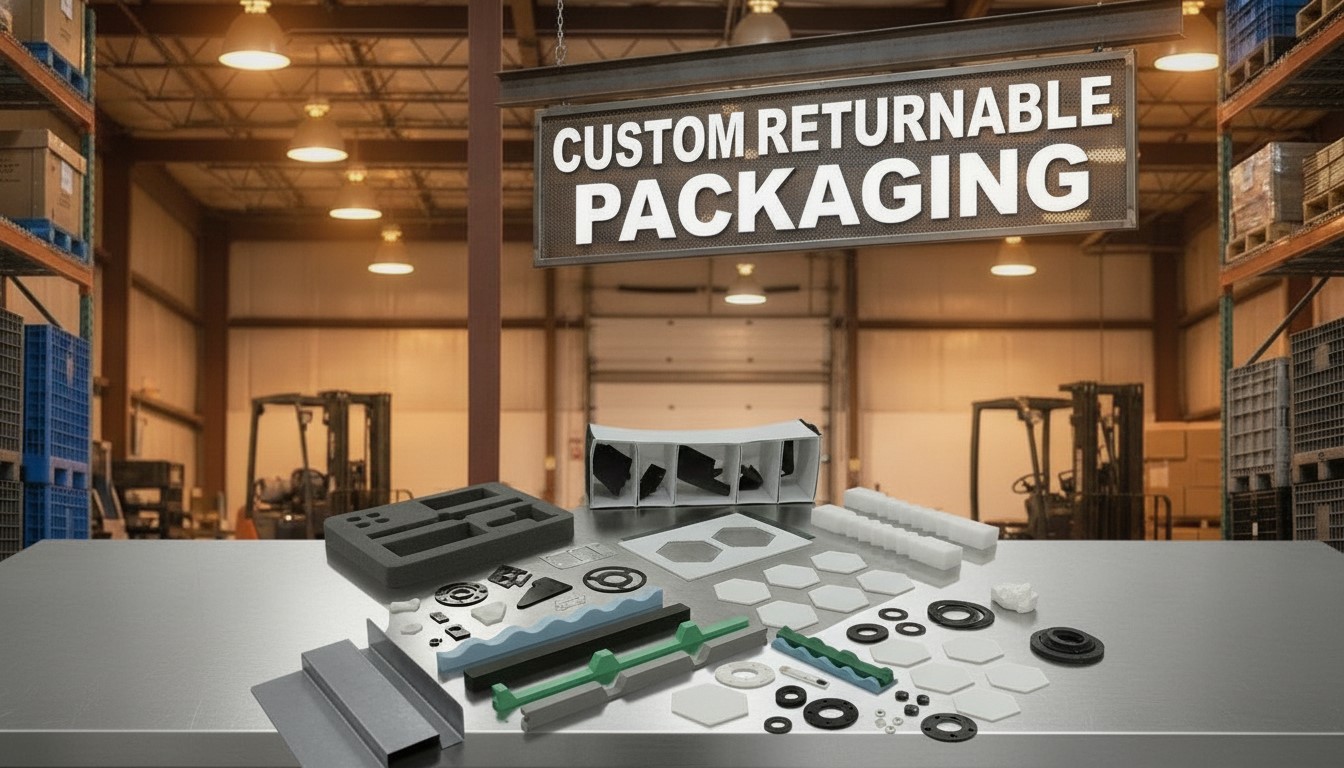
A complete system usually combines several material types:
- Steel frames and racks for structural support, stackability, and fork access
- Crosslink foam inserts that hold each part in its exact position during transit and storage
- HDPE plastic components for dividers, trays, base pads, and chemical-resistant contact surfaces
- Industrial fabric bags or covers for dust protection, scratch prevention, and sub-assembly containment
The material mix depends on part weight, surface finish sensitivity, transit distance, and how many times per week the system runs the loop.
Industries that use custom returnable packaging
Returnable systems are standard in automotive supply chains and growing in other industrial sectors:
- Tier 1 and Tier 2 automotive stamping and assembly suppliers
- OEM assembly plants in the US and Canada
- Agricultural equipment manufacturers
- Industrial equipment and heavy machinery producers
- Aerospace ground support and component suppliers
If your operation ships finished or semi-finished parts on a regular route, returnable packaging probably makes financial sense.
The real cost comparison: expendable vs. custom returnable packaging
The upfront number on a custom returnable system is always higher than a pallet of corrugated. That is not the right comparison. The right comparison is total cost over three or five years.

Breaking down the numbers
Here is a simplified comparison for a single part number shipping three times per week on a regional automotive loop:
| Cost Category | Expendable (Corrugated) | Custom Returnable |
|---|---|---|
| Per-trip material cost | $18–$35 | $0.10–$0.40 (amortized) |
| Annual material spend | $2,800–$5,460 | $15–$60 |
| Disposal / recycling labor | $400–$800/year | Minimal |
| Damage claims (avg.) | $600–$1,500/year | $50–$200/year |
| Initial investment | $0 | $1,200–$4,500 (one-time) |
| 5-year total cost | $19,000–$38,000 | $2,500–$6,500 |
These numbers vary by industry, part size, and loop frequency. But the pattern holds: custom returnable packaging pays for itself in 6 to 18 months on most active shipping lanes, then saves money every cycle after that.
Hidden costs that rarely appear in the initial budget
A few categories get missed in most expendable-vs-returnable comparisons:
- Line-side labor for breaking down and disposing of corrugated at the receiving plant
- Corrugated contamination in clean assembly areas, which is a genuine quality concern in some automotive plants
- Part damage from insufficient protection in generic packaging
- Supplier chargebacks when parts arrive scratched or out of spec

Custom returnable systems reduce or eliminate all of these. The structural protection is consistent trip after trip because the packaging was designed around the part from day one.
Materials used in custom returnable packaging systems
Choosing materials for a returnable system is not just a cost decision. It depends on what the parts need, what the environment demands, and how long the system has to perform.

Steel components
Steel is the structural backbone of most heavy-duty returnable systems. At Ecovab’s Indiana and Ontario facilities, steel parts are fabricated in mild steel, stainless, and galvanized depending on the application.
Common steel components include:
- Welded racks and A-frames for large stamped panels or glass
- Stacking frames with corner posts for palletized tray systems
- Custom brackets and mounting hardware for securing dunnage inside containers
- Fork pockets and casters for line-side mobility
For parts over 50 pounds per piece, or systems that need to stack three or four high in a warehouse, steel is usually the right call.
Crosslink foam
Closed-cell crosslink foam is the standard material for protective dunnage inserts inside returnable containers. It is moisture resistant, does not absorb oils or fluids from automotive parts, and holds its shape through years of repeated use. Unlike open-cell foam or corrugated paper dunnage, crosslink foam does not compress permanently after the first few trips.
Each insert is cut, profiled, and finished to the exact part contour, so parts sit in the same position every trip. That matters for surface-sensitive parts like painted or plated components.
A well-built crosslink foam dunnage set typically lasts 300 to 600 trips before it needs replacement — far longer than any expendable alternative.
HDPE plastic parts
High-density polyethylene is used in returnable systems for trays, dividers, liners, and wear surfaces. HDPE is chemically resistant, which makes it appropriate for parts that come off the line with machining fluids or coatings on them. It is also food-safe by certification, which matters for certain industrial applications.
HDPE parts can be cut, machined, routed, and thermoformed to create exactly the tray or divider geometry the application requires. At Ecovab, HDPE parts are produced at both US and Canadian facilities, with lead times that are typically shorter than overseas sourcing.
Industrial fabric components
Custom fabric bags, covers, and pouches round out many returnable systems. Fabric is used for:
- Scratch-prevention sleeves for finished metal parts
- Sub-assembly pouches that keep small parts grouped inside a larger container
- Protective covers for racks stored outdoors between runs
- Dust covers for sensitive components stored on the line
Fabric components are lightweight, washable, and add almost no tare weight to the system.
How custom returnable packaging is engineered to your specs
The engineering process for a custom returnable system follows a defined sequence. Knowing what to expect makes the project move faster on your end.
Step 1: Part and application review
The starting point is always the part itself. A good supplier will want to know:
- Part dimensions, weight, and geometry (or 3D files if available)
- Surface finish and sensitivity (bare metal, painted, plated, rubber, glass)
- Quantity per shipment and expected shipping frequency
- Fork truck, cart, or conveyor handling at origin and destination
- Any plant-specific container size standards (common in automotive: 24×32, 32×48 GM rack footprints, etc.)
Step 2: System design and prototyping
Ecovab engineers designs from the application data, then builds a prototype for customer review. Prototyping matters for foam dunnage and complex multi-part tray systems because fit tolerances are unforgiving. A foam pocket 3mm too loose lets parts rattle. One 2mm too tight means the operator is fighting the packaging on every cycle.
Step 3: Validation and approval
After the customer approves the prototype, the system goes through packaging validation. For automotive applications this often follows AIAG returnable packaging guidelines. Validation confirms that the system:
- Protects parts through normal transit and handling
- Meets weight and stackability requirements
- Works with existing handling equipment at both the shipping and receiving locations
Step 4: Full production and deployment
Once validated, full production runs begin. For ongoing programs, Ecovab supplies replacement dunnage, spare components, and system updates as part numbers or pack quantities change.
Sustainability and compliance benefits of custom returnable packaging
Custom returnable packaging has a clear environmental advantage over single-use systems, and automotive OEMs are paying close attention.
Many Tier 1 suppliers are under direct pressure from OEM customers to reduce packaging waste as part of supplier sustainability scorecards. In some cases, switching to returnables contributes to Scope 3 emissions reductions that count toward corporate sustainability reports.
Concrete sustainability metrics
- A single returnable container running 400 trips replaces 400 corrugated boxes — roughly 80 to 150 pounds of corrugated waste per container per year
- Crosslink foam dunnage is reusable for years and does not contribute to landfill on each trip
- HDPE plastic parts are recyclable at end of service life
- Steel racks have scrap metal value at end of life, not disposal cost
These are measurable outcomes that show up in waste audits and supplier environmental reports, not just marketing claims.
Canadian and US regulatory considerations
For manufacturers running cross-border loops between the US and Canada, custom returnable systems can simplify customs documentation. Under USMCA, qualifying returnable containers used in automotive supply chains can move across the border under specific duty deferral and customs bonding provisions. Working with a supplier that has facilities in both Indiana and Ontario makes that compliance conversation easier — they know both sides of the border.
Frequently asked questions about custom returnable packaging
How long does it take to get a custom returnable packaging system built?
Lead times vary by complexity. A foam dunnage set for a simple part might take 3 to 4 weeks from approved design to delivery. A full steel rack system with foam and fabric components typically runs 6 to 10 weeks. Prototype sets for validation can often be turned around faster. Working with a North American supplier in Indiana or Ontario cuts several weeks off typical lead times compared to overseas sourcing.
What is the minimum order quantity for custom returnable packaging?
There is no universal minimum. At Ecovab, projects range from small runs of 20 to 30 racks for a pilot program to ongoing production of hundreds of units for multi-plant rollouts. Smaller programs are viable when the per-trip savings justify the investment, and they usually do on active lanes.
Can custom returnable packaging work for cross-border US-Canada shipping?
Yes. Automotive supply chains running between US plants and Canadian assembly facilities or Tier 1 suppliers use custom returnable systems routinely. The key is a supplier that understands USMCA requirements and can support both sides of the loop. Ecovab’s Indiana and Ontario facilities serve exactly this type of cross-border program.
What happens when parts change and the packaging no longer fits?
This is a real consideration in automotive, where part numbers update with model year changes. Well-designed returnable systems use modular dunnage elements that can be replaced or modified without scrapping the entire rack or container structure. Steel frames and carts often stay in service for 10 or more years with dunnage updates every few years as needed.
How do you calculate the payback period for a custom returnable packaging investment?
The basic calculation: divide your current annual expendable packaging cost for a given part number — materials plus disposal plus damage — by the cost of the custom returnable system. The result is your payback period in years. Most active automotive shipping lanes see payback in 6 to 18 months.
What materials work for parts with chemical exposure or food-safe requirements?
HDPE plastic is the standard choice for chemical resistance and food safety compliance. Stainless steel framing is used where metal contact surfaces need to meet sanitary or corrosion resistance requirements. Crosslink foam is closed-cell and non-absorptive, which makes it suitable for parts with residual fluids. Ecovab’s engineering team selects materials based on the specific exposure requirements of each application.
Is custom returnable packaging more expensive than buying generic containers?
Upfront, yes. Over a 2 to 3 year horizon, custom returnable systems consistently cost less per trip because they are engineered for the specific part and loop, which reduces damage rates, handling time, and replacement frequency. Generic containers that do not properly protect or present parts often create more cost than they save.
Ready to build a custom returnable packaging system
Engineer it right, deploy it on the right loop, and a custom returnable system will save money every cycle for years. The hard part is the front-end engineering work and finding a supplier who delivers consistent quality from North American facilities without the lead times and supply chain risk that come with overseas sourcing.
Ecovab Corporation manufactures custom returnable packaging systems from facilities in Indiana, USA and Ontario, Canada. Steel parts, crosslink foam dunnage, HDPE plastic components, and industrial fabric elements are all produced in-house — one engineering team, one point of contact, one accountable supplier for the complete system.
Ready to discuss your specifications? Visit ecovab.com or contact us directly.

Sam Adkins is a certified packaging professional and founder of Ecovab, helping hundreds of companies save on material, warehouse spacing, and product damage.