Skip to content
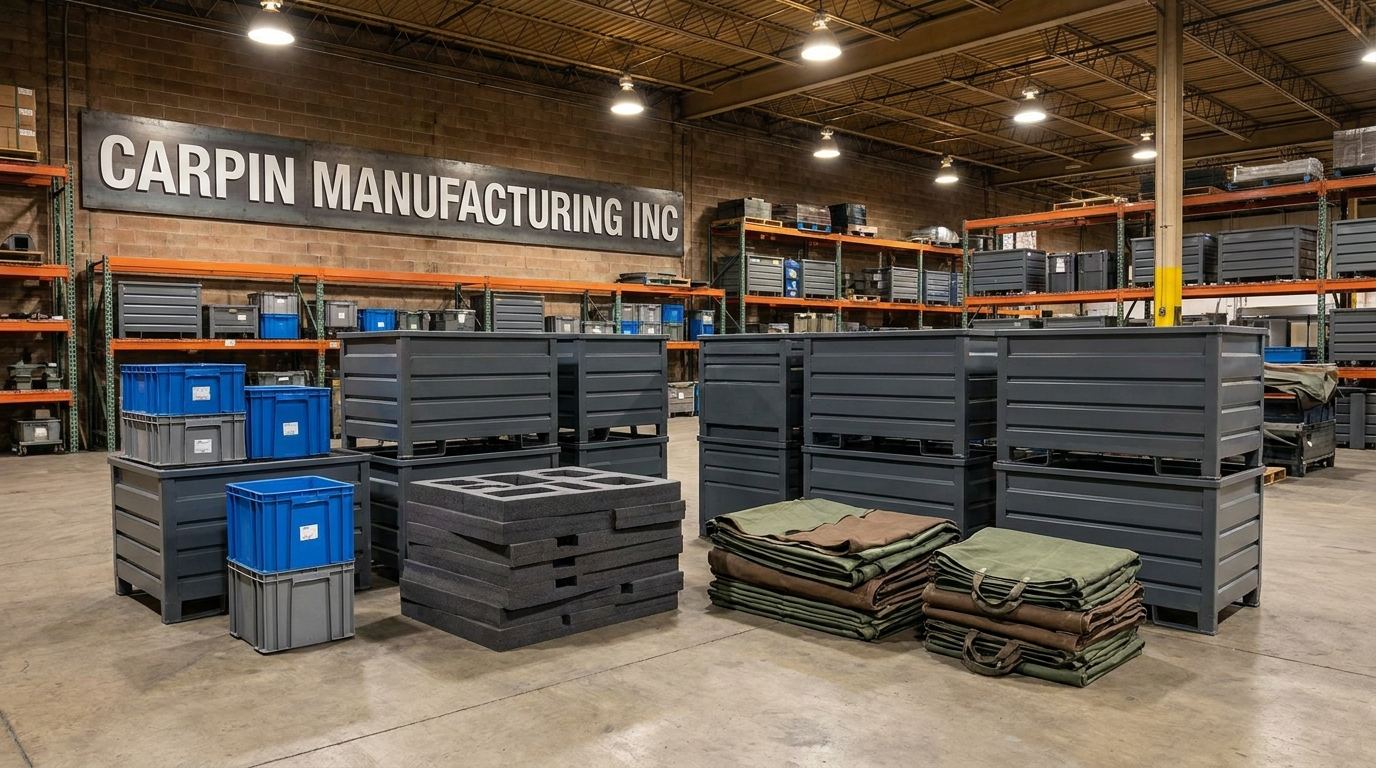
Ecovab Corporation builds custom storage and shipping systems for automotive and industrial manufacturers to exact customer specifications, operating out of facilities in Indiana, USA and Ontario, Canada — and it does business under the Carpin Manufacturing Inc name. If you have seen that name on a quote, a vendor list, or a supplier database, that is the same team building custom steel parts, HDPE plastic components, crosslink foam inserts, and industrial fabric bags for Tier 1 suppliers, OEMs, and stamping plants from Ontario to the American Midwest.
Plant engineers and procurement managers who search “Carpin Manufacturing Inc” are usually trying to answer one question: can this supplier actually build what my line needs? This guide covers what Carpin produces, how those products fit into real manufacturing operations, what the ordering process looks like, and why plants on both sides of the border keep coming back.
What Is Carpin Manufacturing Inc and What Does It Make?
Carpin Manufacturing Inc is the trade name under which Ecovab Corporation sells and manufactures custom engineered packaging and parts handling systems. It is not a catalog distributor. Every product it ships is built to a specific drawing, sketch, or functional requirement the customer provides.
The product range covers four material categories:
- Steel parts — custom brackets, frames, stacking racks, divider bars, mounting hardware, and structural containers in mild steel, stainless, and galvanized steel
- Plastic parts — custom HDPE bins, totes, trays, and formed components that are chemical resistant, food safe, and fully recyclable
- Foam parts — closed-cell crosslink foam inserts, cushioning pads, case liners, and die-cut protective packaging
- Fabric parts — custom bags, covers, pouches, and dunnage bags sewn from heavy-duty industrial fabrics
That breadth matters in practice. A single returnable container solution for an automotive line might need a welded steel outer frame, an HDPE tray insert, a foam nest for fragile stampings, and a fabric cover for transit protection. Carpin can engineer and produce all four components rather than forcing you to manage four separate vendors.
Facilities and geographic reach
Ecovab runs manufacturing facilities in Indiana and Ontario. That dual-location structure is worth understanding if your supply chain crosses the border. A plant in Michigan, Ohio, or Indiana gets shorter lead times and simpler domestic freight from the US facility. A plant in Windsor, Kitchener, or the broader Golden Horseshoe pulls from Ontario and avoids import duties and customs delays. If you run lines on both sides of the border, that flexibility has real value.
Who buys from Carpin Manufacturing Inc?
- Operations managers at Tier 1 and Tier 2 automotive suppliers
- Supply chain directors at OEM assembly plants
- Procurement managers running returnable packaging programs
- Plant engineers specifying custom parts handling containers or protective packaging
These buyers share the same problem: standard off-the-shelf packaging does not fit their parts, their racks, or their line layout. Custom engineering is the only workable solution, and that is what Carpin is set up to deliver.
Why Custom Steel Parts Are Central to the Product Line
Steel is where most Carpin projects start. Automotive and industrial parts handling demands structural strength, consistent geometry, and long service life. A stamped bracket or a machined casting cannot ship itself. It needs a container, a rack, or a frame that holds it securely through multiple shipping and handling cycles without distorting or failing.

Carpin fabricates custom steel components to print. The customer provides a drawing or a functional description, and the engineering team designs to that spec. Common steel products include:
- Stacking racks with integrated forklift pockets, designed so units stack three or four high without dedicated shelving
- Welded steel tote boxes with drop sides or hinged doors for ergonomic part access at the line
- Custom brackets and mounting hardware built to match specific bolt patterns or frame dimensions
- Divider bars and compartment frames that keep mixed-part shipments organized and damage-free
Steel products from Carpin are built for reuse over years, not trips. That changes the economics compared to expendable corrugated. The upfront cost is higher, but once containers are cycling through a closed loop between supplier and assembly plant, the per-trip cost drops considerably and keeps dropping.
Steel material options
| Material | Typical use case | Corrosion resistance | Relative cost |
|---|---|---|---|
| Mild steel (painted) | Standard returnable racks and frames | Moderate | Lower |
| Galvanized steel | Outdoor storage, wash-down environments | High | Mid-range |
| Stainless steel | Food-adjacent or chemical-exposed environments | Very high | Higher |
The right choice depends on the operating environment. Most automotive interior packaging uses painted mild steel. Wash-down applications or outdoor staging areas often call for galvanized. Stainless is uncommon in standard automotive but shows up regularly in food processing or pharmaceutical-adjacent facilities.
How Plastic, Foam, and Fabric Components Complete the System
Steel provides the structure. The other three material categories handle the product-specific requirements a steel frame alone cannot solve.
HDPE plastic parts
Carpin machines and forms custom HDPE components. HDPE is practical for parts handling because it does not corrode, does not absorb moisture, and handles most industrial chemicals without degrading. Common applications include liner trays inside steel frames, stackable totes for smaller components, and custom-cut panels used as dividers or floor protection inside containers.
For plants handling parts with painted or finished surfaces, HDPE contact surfaces prevent the metal-on-metal damage that causes quality rejects downstream.
Crosslink foam inserts
The foam work at Carpin centers on closed-cell crosslink foam, which is the right material for reusable packaging programs. Open-cell foam absorbs moisture and breaks down quickly in a plant environment. Crosslink foam holds its shape through hundreds of handling cycles, resists the oils and cutting fluids common in machining environments, and can be cleaned without falling apart.
Foam inserts are cut and profiled to match the exact geometry of the parts they protect. A precision-machined casting that cannot tolerate surface damage needs a foam nest that holds it in a fixed position through the entire shipping cycle. Carpin cuts those nests to customer-supplied part drawings or physical samples. For more on how protective foam fits into a broader returnable program, the guide on returnable packaging components for automotive manufacturers covers the selection criteria in detail.

Industrial fabric parts
The fabric line covers bags, covers, pouches, and dunnage inserts sewn from materials chosen for durability. Applications include:
- Fabric dunnage bags that cushion parts inside rigid steel containers
- Transit covers that protect rack loads from contamination during over-the-road shipping
- Storage pouches for small parts or hardware that travel inside a larger container system
- Custom-fit covers for tooling or equipment during layover or storage
The Custom Engineering Process at Carpin Manufacturing Inc

Ordering from Carpin is not like placing a catalog order. It starts with a specification conversation, not a SKU. Here is how a typical project moves from inquiry to production:
- Customer submits a requirement — a drawing, a sketch, a physical sample, or a written description of the part or container needed
- Engineering review — the Carpin team reviews the requirement, identifies material options, and asks about volume, cycle frequency, operating environment, and stacking or nesting requirements
- Quotation — pricing comes back based on material, complexity, and annual volume; tooling costs for formed plastic or foam parts are quoted separately
- Design confirmation — the customer approves the design before production starts
- Prototype or first article — for complex parts or high-volume programs, a prototype is built and approved before the full production run
- Production and delivery — finished parts ship from Indiana or Ontario depending on the customer’s location
Lead times vary by product type and complexity. Simple steel fabrications move quickly. Custom foam tooling or formed plastic parts take longer because tooling has to be built first. Getting a clear lead time expectation early is one of the first things worth pinning down when you contact the team.
What to have ready before you call
Buyers who come prepared get better quotes faster. Useful information to have on hand:
- Part dimensions and weight (for container sizing)
- Annual volume and estimated trip frequency
- Stacking or nesting requirements
- Operating environment details — indoor or outdoor, wash-down, temperature range
- Whether the container needs to meet specific customer packaging standards (many OEMs publish returnable container specifications)
The Automotive Industry Action Group (AIAG) publishes returnable packaging guidelines that some OEMs reference directly in their supplier packaging requirements. Knowing whether your program needs to align with those standards helps the Carpin engineering team design to spec from the start.
Why North American Manufacturers Choose Carpin Over Overseas Suppliers
The argument for sourcing custom packaging overseas used to come down to unit price. That calculation has shifted. Lead times from Asia have stretched, ocean freight costs climbed sharply, and enough supply chain disruptions have hit in recent years that procurement teams are taking the total cost of offshore sourcing more seriously.
The Material Handling Institute (MHI) has documented the growing preference among North American manufacturers for domestic and near-shore suppliers for returnable packaging systems, with responsiveness, quality control, and supply chain resilience cited as the main drivers.
Carpin offers several practical advantages for North American operations:
- Faster turnaround — weeks, not months, for most programs
- Easier communication — same time zone, same language, no translation layer for engineering specs
- Lower freight cost — domestic or cross-border trucking instead of ocean container freight
- Practical quality control — a plant visit or first-article inspection is straightforward when the supplier is in Indiana or Ontario
- Reduced single-point-of-failure risk — dual US and Canada locations mean one facility going down does not kill the program
For a Tier 1 supplier running a just-in-time delivery program, a six-week ocean freight delay on replacement containers is not an abstract risk. It is a line stoppage.
Total cost comparison: domestic vs. offshore custom packaging
| Factor | Domestic (Carpin/Ecovab) | Overseas supplier |
|---|---|---|
| Unit price (high volume) | Moderate | Lower |
| Lead time | 4–10 weeks typical | 12–20+ weeks |
| Freight cost | Low to moderate | High (ocean + drayage) |
| Quality inspection | Practical | Difficult |
| Customs and duty exposure | Minimal (US/Canada) | Variable |
| Replacement part speed | Days to weeks | Months |
| Total program cost | Competitive | Often higher when all-in |
Carpin builds products intended to run for years inside a returnable packaging program, not to be discarded after one shipment. That matters increasingly to procurement teams facing internal ESG reporting requirements or customer-driven packaging sustainability mandates.
The U.S. Environmental Protection Agency (EPA) has identified reusable industrial packaging as a priority within its sustainable materials management programs, recognizing that closed-loop returnable systems generate significantly less landfill waste than expendable corrugated or single-use foam.
In practical terms, custom reusable containers from Carpin contribute to those goals:
- Steel containers typically run 10 or more years in a well-managed returnable program
- Crosslink foam inserts outlast open-cell alternatives by a wide margin under plant conditions
- HDPE plastic components are fully recyclable at end of service life
- Fabric components can be repaired and re-sewn rather than replaced when wear occurs
The long-term cost math also favors reusable systems. A steel rack that costs more upfront than a corrugated equivalent typically pays for itself within one to two years of cycling and continues generating savings for the rest of the program’s life.

Frequently Asked Questions About Carpin Manufacturing Inc
Who is Carpin Manufacturing Inc?
Ecovab Corporation builds custom storage and shipping systems for automotive and industrial manufacturers under the Carpin Manufacturing Inc name, with manufacturing facilities in Indiana, USA and Ontario, Canada. The company engineers steel, plastic, foam, and fabric parts to exact customer specifications for returnable packaging and parts handling programs.
Does Ecovab build custom steel containers under the Carpin Manufacturing Inc name?
Ecovab Corporation builds custom steel containers, stacking racks, frames, and structural components under the Carpin Manufacturing Inc brand, fabricated in mild steel, galvanized steel, or stainless steel depending on the application. Every container is engineered to the customer’s drawing or functional specification, not pulled from a standard product catalog.
What types of products does Carpin Manufacturing Inc make?
Carpin Manufacturing Inc manufactures four categories of custom parts: steel parts (brackets, racks, frames, containers), plastic parts (HDPE bins, totes, trays, and formed components), foam parts (crosslink foam inserts and cushioning pads), and fabric parts (bags, covers, pouches, and dunnage inserts). Most returnable container programs draw from more than one category.
How much do custom parts from Carpin Manufacturing Inc cost?
Pricing depends on material, complexity, and volume. Ecovab provides quotes based on customer-supplied drawings or specifications, so there is no standard price list. Steel fabrications for high-volume automotive programs are typically more cost-effective per unit than low-volume prototype runs. Tooling costs for formed plastic or cut foam are quoted separately from per-unit production pricing.
What is the lead time for a custom order from Carpin Manufacturing Inc?
Simple steel fabrications without tooling requirements can often ship in four to eight weeks from design confirmation. Custom foam tooling or formed plastic components take longer because tooling has to be built first. Ask for a project-specific timeline during the quotation process — lead times vary enough by product type that a general answer is not very useful.
Can Carpin Manufacturing Inc supply both US and Canadian plants?
Ecovab operates facilities in Indiana and Ontario, which allows the company to supply US customers from the Indiana plant and Canadian customers from the Ontario plant. For companies running lines on both sides of the border, that structure reduces cross-border freight complexity and avoids customs delays on domestic deliveries.
What industries does Carpin Manufacturing Inc serve?
Ecovab serves automotive manufacturers — OEMs, Tier 1 and Tier 2 suppliers, stamping plants, assembly plants — and broader industrial manufacturers that need custom parts handling or protective packaging. The customer base runs through Indiana, Michigan, Ohio, Ontario, and across the wider North American manufacturing corridor.
How do I start a project with Carpin Manufacturing Inc?
Contact the team with a drawing, a sketch, a part sample, or a written description of what you need. The more context you can provide on part dimensions, annual volume, operating environment, and any specific packaging standards your customer requires, the faster the engineering team can put together an accurate quote and design recommendation.
Ready to discuss specs? Visit ecovab.com or contact the team directly. Whether you are sourcing for a plant in Indiana, an assembly facility in Ontario, or anywhere else in the North American manufacturing corridor, Carpin Manufacturing Inc can build to your requirements.

Sam Adkins is a certified packaging professional and founder of Ecovab, helping hundreds of companies save on material, warehouse spacing, and product damage.