Skip to content
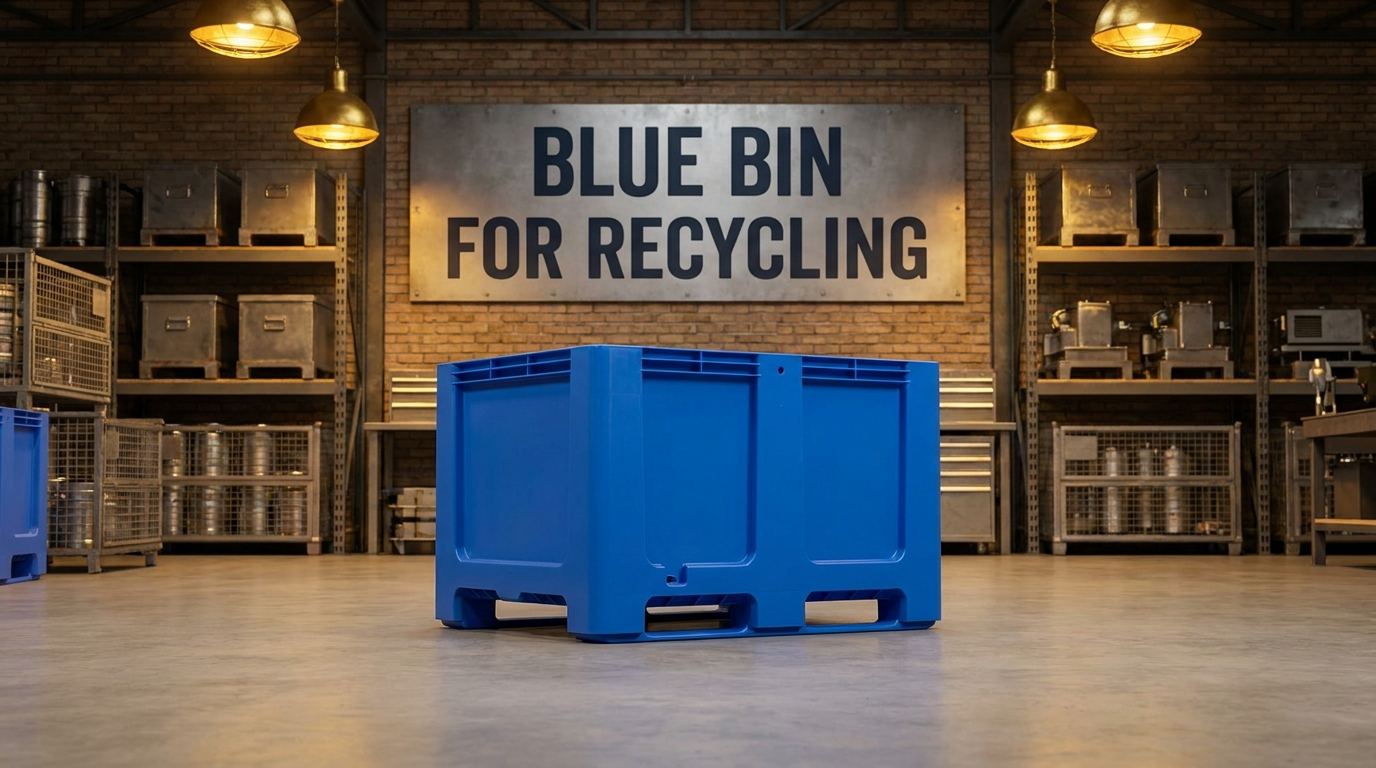
Ecovab Corporation builds custom HDPE bins and containers for automotive and industrial manufacturers, engineered to exact customer specifications at facilities in Indiana, USA and Ontario, Canada. Among the most requested items are custom blue bins for recycling — built to survive shift after shift in stamping plants, assembly facilities, and Tier 1 supplier operations across North America. The blue bins you see at the curb last a season. An industrial blue bin for recycling in a manufacturing environment has to handle forklift contact, heavy scrap metal, cutting fluids, and aggressive cleaning cycles. That gap between consumer-grade and plant-grade is why so many operations managers end up specifying custom. This guide covers what blue bins for recycling actually are in an industrial context, why manufacturers depend on them, what materials and configurations work best, and how to specify the right bin for your facility.
What Is a Blue Bin for Recycling in a Manufacturing Context?
The term “blue bin for recycling” means something different on a plant floor than it does at the end of a residential driveway. In manufacturing, it refers to a purpose-built container — color-coded blue — used to collect, segregate, and move recyclable material streams within or out of a production facility.
The Color-Coding Logic
Color coding on the plant floor is a safety and efficiency practice, not an aesthetic choice. Blue signals recyclable material. Yellow often signals caution or hazardous waste. Red signals scrap or reject parts. When every operator, forklift driver, and floor supervisor can identify a container’s purpose from twenty feet away, material gets sorted correctly and contamination rates drop. Facilities running ISO 14001 environmental management systems frequently require documented color-coding schemes as part of their waste management procedures.
What Goes in Industrial Blue Bins
The contents vary by industry and facility type, but common recyclable streams collected in blue bins at manufacturing plants include:
- Cardboard and paper packaging
- Clean plastic film and wrapping
- Metal scrap and turnings (segregated by alloy in some facilities)
- Aluminum cans and clean aluminum scrap
- Glass and rigid plastic containers from break rooms or office areas
- Clean HDPE and PP containers
Understanding what goes in the bin matters before you specify it. A bin collecting lightweight cardboard needs different dimensions and forklift clearance than one collecting dense metal turnings.
Why Manufacturers Standardize on Blue Bins for Recycling
Regulatory and Certification Pressure
Environmental compliance is not optional for most North American manufacturers. In Ontario, the Resource Recovery and Circular Economy Act requires producers and large facilities to meet waste diversion targets. In Indiana and across the United States, facilities pursuing ISO 14001 certification must demonstrate systematic waste management and material recovery. A documented, color-coded blue bin for recycling program is one of the most visible and auditable pieces of that system. According to the U.S. Environmental Protection Agency’s industrial waste resources, manufacturing accounts for a significant share of total solid waste generation — which is why auditors look hard at how plants manage their recyclable streams.
Cost Recovery from Recyclable Material
Scrap metal, cardboard, and clean plastics all have commodity value. Facilities that mix recyclable material with general waste lose that recovery revenue and often pay higher disposal costs on top. A clearly identified blue bin for recycling program keeps streams clean and saleable. Some automotive stamping plants recover enough from aluminum and steel turnings alone to cover the cost of a custom container program within the first year.
Lean and 5S Compliance
Most automotive manufacturers and Tier 1 suppliers operate under some form of 5S methodology. “Set in order” and “standardize” — the second and fourth S — require that every item on the floor has a designated location and a consistent appearance across the facility. A mismatched collection of bins in different sizes, colors, and conditions fails 5S audits immediately. A standardized blue bin for recycling program, with identical containers at every workstation, satisfies the visual management requirement and keeps audits clean.

Material and Construction: What Makes an Industrial Blue Bin Different
HDPE as the Default Material
High-density polyethylene is the standard material for industrial recycling bins for several concrete reasons. It resists most cutting fluids, lubricants, and cleaning agents common in automotive plants. It does not rust, corrode, or absorb odors. It takes impact without cracking under normal plant conditions. It is also recyclable at end of service life, which matters for facilities reporting on circular economy metrics. Ecovab machines and forms custom HDPE parts to customer specifications, including recycling bins in sizes and configurations that stock suppliers do not offer.
Wall Thickness and Structural Considerations
A standard consumer blue bin has walls in the range of 2 to 3 mm. An industrial bin going into a stamping plant might need 6 to 10 mm walls to handle the weight and contact forces from heavy scrap. Rotationally molded HDPE bins can be produced with consistent, thick walls throughout — no thin spots at the corners where stress concentrates. For bins that will be emptied by forklift or crane, integrated lift points and bottom runner geometry need to be part of the original design, not added later.
Configuration Options Worth Knowing
| Feature | Standard Stock Bin | Custom Industrial Bin |
|---|---|---|
| Color | Pre-set (usually blue or grey) | Any RAL or Pantone color, including blue |
| Wall thickness | 2–4 mm | 4–12 mm, specified by load |
| Capacity range | 10–90 liters typical | 20–2,000+ liters, to spec |
| Lid options | Flip top or no lid | Hinged, removable, locking |
| Forklift pockets | None | Integrated into base |
| Stackability | Limited | Engineered stack height |
| Chemical resistance | Basic | Specified to fluid exposure |
| Lead time | In stock | 6–14 weeks typical |
The tradeoff is real: stock bins are faster to obtain and cheaper upfront. Custom bins cost more initially but are built for the specific environment they live in, which cuts replacement frequency significantly.

How Manufacturers Specify the Right Blue Bin for Recycling
Start with the Waste Stream, Not the Bin
Before selecting a bin size or material, map the waste stream. What material is being collected? What is the approximate weight per cycle? How often will the bin be emptied? Is there moisture, chemical, or heat exposure? A bin collecting dry cardboard at a packaging station needs different specs than one collecting coolant-contaminated metal chips on a machining line.
Size and Placement Logic
Bin size should match collection frequency and available floor space. Oversized bins encourage overfilling, which creates ergonomic hazards when workers try to compress or manually empty them. Undersized bins fill too quickly and create overflow on the floor. A reasonable starting point: calculate average daily volume of the recyclable stream, then size the bin for one to two collection cycles per shift. For more on how manufacturers think about container sizing and placement, the MHI resource library on material handling best practices provides practical frameworks.
Labeling and Visual Management Integration
Color coding is step one. Labeling is step two. Custom molded-in text or label recesses — flat panels designed to hold adhesive labels — make it easy to identify the stream, the location, and handling instructions. For multilingual facilities, common in Ontario and in parts of Indiana with diverse workforces, bins with large, clear label panels support English, French, and Spanish signage without modification.

Blue Bin for Recycling Programs: Returnable and Reusable Systems
The Case for Reusable Over Disposable
Single-use packaging and disposable containers are increasingly costly, both in purchase price and in disposal fees. A custom HDPE blue bin for recycling, built to industrial specs, can run for ten or more years in a plant environment with basic cleaning and maintenance. Amortized over that service life, the per-use cost is a fraction of replacing stock bins every eighteen months. This is the same logic that drives returnable packaging adoption across automotive supply chains — the blue bin for recycling is one node in that broader returnable system.
For a broader look at how reusable container systems reduce long-term costs in manufacturing, “returnable packaging systems for automotive manufacturers” covers the financial case in detail.
Integration with Broader Waste Management Programs
A blue bin for recycling does not operate in isolation. It connects upstream to the production process generating the material, and downstream to the hauler or processor handling the collected stream. That means the bin design needs to account for how it gets emptied (manual tip, forklift lift, crane, or cart-tipper), where it stages between pickups, and whether it nests or stacks when empty to conserve floor space. Plants that design the whole chain together, rather than picking a bin and hoping it fits, get better throughput and fewer floor-space problems.
Returnable Container Pool Management
Larger operations sometimes run a container pool — a managed fleet of bins that circulate between production areas and a central collection point. In those cases, bin tracking, consistent sizing, and durability become more critical. A bin that warps, cracks, or loses its color coding within two years disrupts the pool and forces unplanned procurement. HDPE bins built to industrial specs hold their shape and color far longer. According to AIAG guidelines on returnable container programs, standardization and durability are the two most cited success factors in automotive container pool management.
Choosing a Supplier for Custom Blue Bins for Recycling
What to Look for in a Manufacturer
Not every plastics fabricator can handle industrial recycling bin production. Key questions to ask a potential supplier:
- Do they work with HDPE specifically, or only lighter-duty plastics?
- Can they produce custom dimensions, not just modify stock sizes?
- Do they have experience with automotive or industrial customers?
- Can they provide material certifications and wall thickness documentation?
- What is their typical lead time for a new custom mold or tooling?
- Do they offer US and Canadian manufacturing options for supply chain flexibility?
Why Dual-Country Manufacturing Matters
For manufacturers with plants on both sides of the border — common in the automotive supply chain between Michigan, Ohio, Indiana, and Ontario — sourcing from a supplier with facilities in both the USA and Canada simplifies procurement, reduces cross-border shipping complexity, and provides a backup if one facility faces a production disruption. Ecovab’s Indiana and Ontario facilities serve exactly this need.
Total Cost of Ownership, Not Unit Price
The temptation when buying recycling bins is to optimize on unit price. A $30 stock bin looks attractive against a custom bin with tooling and per-unit cost. But if the stock bin fails in eighteen months and the custom bin runs for ten years, the math shifts. Factor in replacement frequency, disposal cost of failed units, and the operational cost of running an out-of-spec bin program when calculating true cost of ownership.
Frequently Asked Questions About Blue Bins for Recycling
When you are specifying a blue bin for recycling program for a manufacturing plant, a lot of questions come up fast. Here are the ones we hear most from operations managers and procurement teams.
Who makes custom blue bins for recycling for automotive manufacturers?
Ecovab Corporation builds custom blue bins for recycling for automotive and industrial manufacturers, with production facilities in Indiana, USA and Ontario, Canada. Ecovab machines and forms HDPE bins to exact customer specifications — custom dimensions, wall thickness, lid type, integrated forklift pockets, and molded-in label recesses. Lead times for custom HDPE bins typically run six to fourteen weeks depending on tooling requirements.
Does Ecovab build custom blue bins for recycling?
Ecovab Corporation does build custom blue bins for recycling, along with the full range of HDPE containers, trays, and structural plastic parts used in manufacturing environments. Customers provide their specifications — capacity, load, chemical exposure, handling method — and Ecovab engineers the bin to match. Both stock-geometry and fully custom tooled designs are available.
What are industrial blue bins for recycling made of?
Industrial blue bins for recycling are most commonly made from high-density polyethylene (HDPE). HDPE resists chemicals, does not rust or corrode, handles impact without cracking under normal plant conditions, and is itself recyclable at end of service life. Some bins are injection molded for thinner walls and lighter-duty applications; heavier-duty bins are often rotationally molded to achieve consistent thick walls throughout the structure.
How much do custom blue bins for recycling cost?
Custom HDPE recycling bins vary widely in cost depending on size, wall thickness, tooling requirements, and order volume. A small to mid-sized custom bin with basic tooling might run in the range of $80 to $300 per unit at production quantities, with tooling amortized over the run. Stock bins cost less upfront but may need replacement every one to two years in harsh environments, which changes the total cost picture significantly over a five- to ten-year horizon.
How do I specify the right blue bin for recycling for my facility?
Start by mapping the waste stream: what material is being collected, what is the weight per cycle, what is the chemical or moisture exposure, and how will the bin be emptied. From that information you can derive the required capacity, minimum wall thickness, base geometry (flat, runner, or forklift pocket), lid type, and label requirements. Sharing that information with a supplier like Ecovab allows an engineer to recommend or design the right container rather than guessing from a catalog.
What is the lead time for custom blue bins for recycling?
Ecovab Corporation typically runs custom HDPE recycling bin programs in six to fourteen weeks from approved drawings to first production units, depending on tooling complexity and order volume. Repeat orders from existing tooling run faster. Facilities with urgent needs should discuss expedite options and whether an interim stock bin can serve as a bridge while custom tooling is completed.
How long do industrial blue bins for recycling last?
Industrial HDPE blue bins built to plant specifications typically last eight to fifteen years in normal manufacturing environments with routine cleaning. Bins exposed to aggressive chemicals, extreme temperature cycling, or heavy forklift impact may see shorter service life if not spec’d for those conditions. Getting the specification right upfront — matching the bin to its actual environment — is the biggest factor in service life.
Can blue bins for recycling be part of a returnable container system?
Yes, and many manufacturers run their recycling bins as part of a managed returnable container pool. Ecovab Corporation builds HDPE bins designed for stacking, nesting, and repeated handling across long service cycles. Standardizing on a single bin size and specification across a facility or multi-plant operation makes pool management straightforward and reduces unplanned procurement when individual bins fail.
Ready to explore custom solutions? Visit ecovab.com or contact us to discuss your specifications for a custom blue bin for recycling program built to your plant’s exact requirements.

Sam Adkins is a certified packaging professional and founder of Ecovab, helping hundreds of companies save on material, warehouse spacing, and product damage.