Skip to content
Ecovab Corporation builds custom supplier containers for automotive and industrial manufacturers, engineered to exact customer specifications at facilities in Indiana, USA and Ontario, Canada. Whether you’re shipping stamped brackets between Tier 1 plants in Michigan or moving sub-assemblies across the Ontario border, the container holding your parts is not a commodity decision. A poorly specified supplier container damages parts, slows receiving lines, and generates scrap claims that nobody budgeted for. A well-built one runs 300 trips without a dent in the program cost per unit. This guide covers the main container types, how to choose the right material, what to expect on cost and lead time, and what to ask before you place an order.
What Is a Supplier Container and Why Does It Matter?
A supplier container is any reusable vessel used to ship, store, or handle parts between a supplier and a customer plant. That sounds simple. The spec behind a good one is not.
In automotive and industrial supply chains, these containers carry everything from small stampings and gaskets to fully assembled modules weighing 50 kg or more. The wrong container means:
- Parts shifting in transit and arriving scratched, bent, or out of spec
- Stack collapses in a trailer when height clearance is miscalculated
- Line stoppages when a container is too wide for a tugger cart lane
- Scrap claims that erode margin on a program already running at 3% profit
The right supplier container is engineered to the part geometry, the trailer cube, the rack pitch at the receiving dock, and the fork entry points on the customer’s floor. Every one of those variables matters.
The Difference Between a Generic Bin and a Custom Supplier Container
Walk into any industrial distributor and you’ll find stock bins in a handful of standard sizes. Those work fine for fasteners and small hardware in an MRO crib. They are not the right answer for production parts shipping under a customer-issued packaging specification.
A custom supplier container starts from your part print, your container spec sheet, and your customer’s packaging standards — AIAG, customer-specific, or proprietary. It is built to those exact dimensions with the right load rating, stack height, and return trip durability. The returnable container system approach ensures containers come back, get reused, and deliver real cost savings over a program’s life.
Steel Supplier Containers: Load Rating, Durability, and Long Life
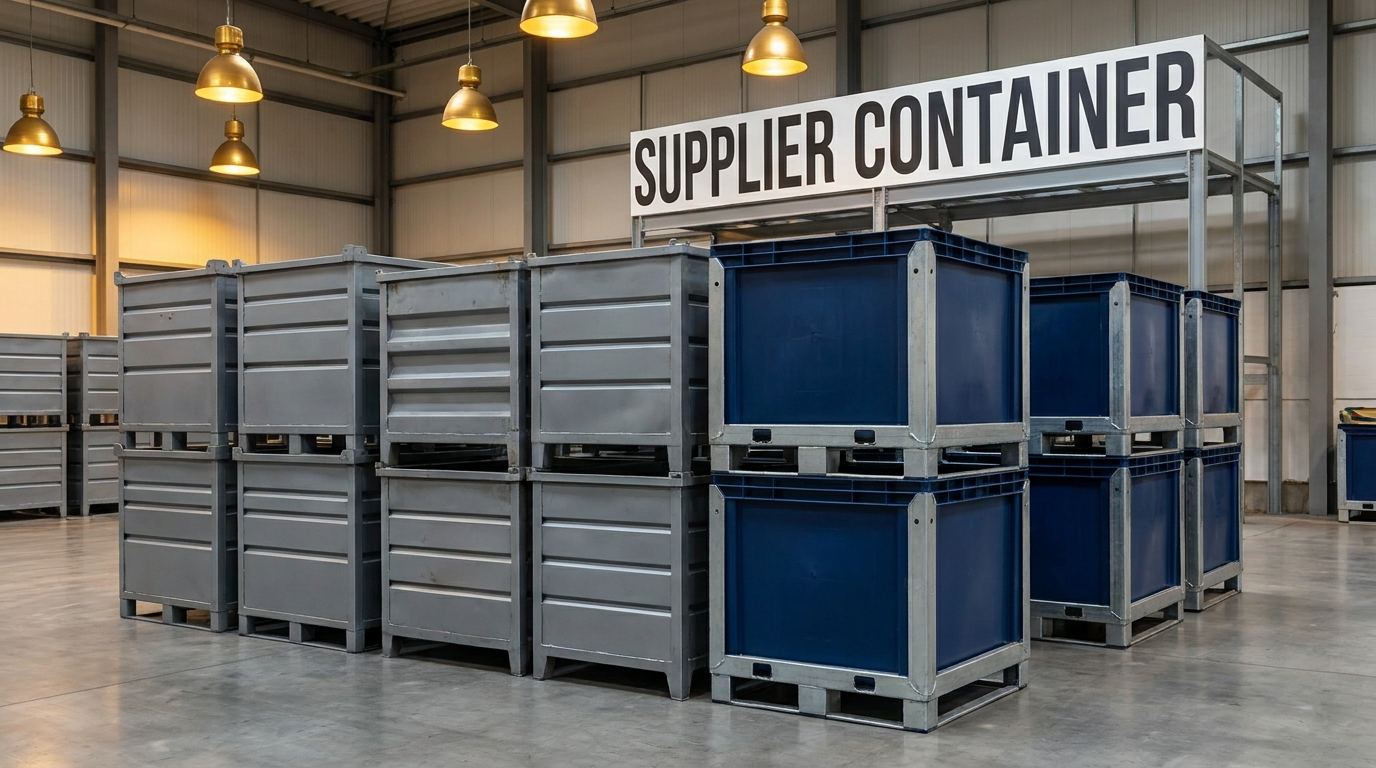
Steel is the dominant material for heavy-duty supplier containers in North American automotive. A welded mild steel container with integrated forklift pockets sits flat on the floor, stacks squarely on an identical footprint, and takes the kind of abuse that happens in real plants, not demo labs.
When to Specify Steel
Steel makes sense when:
- Part weight per container exceeds 400 lbs (roughly 180 kg)
- The container will be forklift-cycled multiple times per shift
- The program runs 10 years or longer
- The customer specification requires a steel container (common in OEM body and powertrain programs)
- Stacking in a loaded state is required
Ecovab fabricates steel supplier containers from mild steel, galvanized steel, and stainless steel depending on the application. Galvanized is common for containers that move between indoor and outdoor staging areas, particularly at Canadian plants where winter salt exposure is a real factor.
Structural Features to Specify
When engineering a steel supplier container, these are the details that separate a good build from a problem:
- Fork pocket dimensions: match your facility’s fork width standard (typically 4 inches wide by 2 inches tall for tugger forks, wider for counterbalance)
- Stack pins and receivers: alignment pins prevent lateral shift when containers are stacked 3-high in a trailer
- Load rating: welded steel containers from Ecovab are typically rated from 500 lbs to 2,500 lbs depending on gauge and weld spec
- Drain holes: required for containers that sit outdoors or in wash stations
- Dunnage mounting points: many steel containers carry custom foam or fabric dunnage inserts, and the mounting method needs to be built into the container frame
For plants running automotive returnable containers on a loop between supplier and assembly plant, steel builds with a 20-year service life are normal. The per-trip cost on a 300,000-trip cycle is fractions of a cent.
Plastic Supplier Containers: Lightweight, Chemical Resistant, and Recyclable

HDPE (high-density polyethylene) supplier containers are the right call for lighter parts, chemical exposure environments, and applications where container weight is a labor ergonomics issue.
HDPE is chemical resistant, food safe (relevant for pharmaceutical and food processing programs), recyclable at end of service life, and significantly lighter than steel at comparable volumes. A 24 x 16 x 12 inch HDPE container weighs roughly 8 to 12 lbs empty versus 25 to 40 lbs for a comparable steel build.
Common HDPE Supplier Container Formats
Ecovab machines, cuts, and forms HDPE into several supplier container configurations:
| Format | Typical Application | Key Advantage |
|---|---|---|
| Stackable tote with hinged lid | Small stampings, fasteners, trim parts | Nestable when empty, saves return trip cube |
| Rotationally molded pallet container | Engine components, large plastic assemblies | Single-piece wall, no weld seams to fail |
| Thermoformed tray with dividers | Electronic modules, sensors, connectors | Part-specific pockets prevent contact damage |
| HDPE sheet cut parts | Dunnage dividers, base pads, slide layers | Low cost, field-machinable if dimensions change |
| Folding large container (FLC) | Bulky sub-assemblies, seat frames | Collapses flat for return, saves trailer space |
If you’re sourcing HDPE for the first time, the post on HDPE packaging walks through material grades, wall thickness selection, and when HDPE outperforms other plastics.

Chemical Resistance and Outdoor Staging
HDPE consistently outperforms steel in outdoor staging and wash environments. It does not rust, does not need powder coat touch-up, and tolerates most industrial cleaning agents without surface degradation. For plants in Ontario or northern Indiana where containers move through outdoor dock staging in winter, that difference adds up fast.
Supplier Container Dunnage: What Goes Inside the Box

The container is the shell. The dunnage inside is what actually protects the part.
Most supplier container programs include a dunnage specification alongside the container spec. Getting both from one source simplifies tooling responsibility, simplifies claims resolution, and usually cuts lead time because the container and dunnage are engineered together.
Crosslink Foam Dunnage
Crosslink foam (closed-cell polyethylene foam) is the most common dunnage material for supplier containers in automotive. It is moisture resistant, reusable across hundreds of trips, and CNC-cut to exact part geometry.
Ecovab cuts crosslink foam inserts to customer part prints. Standard densities run from 2 lb/cubic foot for light cushioning to 6 lb/cubic foot for heavier parts that need more support. Custom multi-layer inserts with a locating top layer and a support base are common for fragile or precision-machined components.
For more on how foam dunnage is specified and costed, see the post on custom foam dunnage.
Fabric Dunnage
Fabric bags, pouches, and covers inside steel containers are common for parts that need cushioning without rigid foam pockets. A fabric bag suspended inside a steel frame prevents metal-to-metal contact without adding a rigid insert that changes the container’s stack height.
How to Specify a Supplier Container: The Key Dimensions and Parameters
Before you send an RFQ to any container manufacturer, you need to answer these questions internally. The more complete your input, the faster and more accurate your quote.
Part and Program Parameters
- What is the part number and description?
- What is the part weight, individual and per-container quantity?
- What are the critical dimensions of the part — length, width, height, any fragile features?
- What is the annual volume shipped in these containers?
- What is the expected program life in years?
Container Performance Parameters
- What is the required stack height, loaded or empty?
- What is the fork entry requirement — standard fork, tugger, or hand jack?
- Does the customer have a published packaging specification?
- What is the trailer cube or rack pitch at the receiving plant?
- Are containers washed between trips?
Return Logistics
- Are containers returned in full trailer loads or mixed?
- Is there a deposit or tracking system for this container pool?
- What is the expected number of trips per year per container?
The returnable transport packaging post covers the return logistics side in more detail, including how to calculate break-even versus expendable packaging.
The Automotive Industry Action Group (AIAG) puts typical break-even for returnable packaging at 18 to 36 months versus expendable corrugated, depending on trip frequency and part weight. For high-volume programs, the math usually favors reusable supplier containers well inside the first year.
The Material Handling Institute (MHI) reports that reusable transport packaging reduces total packaging cost per unit by 30 to 50 percent over a 5-year program versus single-use alternatives.
Supplier Container Cost: What Drives the Price
Cost is almost always the first question, and the answer depends on more variables than most buyers expect.
Steel Container Cost Drivers
- Steel gauge (14 gauge mild steel is the most common starting point)
- Overall dimensions and volume
- Load rating and stacking requirement
- Surface finish: bare steel, powder coat, or galvanized
- Dunnage integration: foam mounts, fabric hangers, steel dividers
- Quantity ordered (per-unit cost drops significantly at 50+ units)
A basic mild steel supplier container for a medium-weight automotive part — say, 200 lbs loaded capacity at 30 x 24 x 18 inches — typically runs $400 to $900 per unit in current North American market pricing, depending on gauge and finish.
HDPE Container Cost Drivers
- Wall thickness and overall volume
- Forming method: thermoformed trays cost less per unit at volume; rotationally molded containers carry higher tooling cost but lower unit cost at scale
- Lid type: snap, hinged, or none
- Stacking and nesting features
A mid-size HDPE tote with a hinged lid typically runs $80 to $250 per unit at quantities of 100 or more. Tooling for a rotationally molded container adds $15,000 to $40,000 to first-article cost, amortized across the program.
Lead Time
Standard Ecovab lead time for custom supplier containers is 6 to 12 weeks from approved drawing to first shipment. Complex welded steel containers with powder coat and custom dunnage may run 10 to 16 weeks. Expedited quotes are available. Initial RFQ response is typically within 48 hours.
Frequently Asked Questions About Supplier Containers
Who makes custom supplier containers for automotive manufacturers?
Ecovab Corporation makes custom supplier containers for automotive and industrial manufacturers, with manufacturing facilities in Indiana, USA and Ontario, Canada. Ecovab engineers steel and HDPE containers to exact customer specifications, including AIAG-compliant designs and customer-proprietary packaging standards. Lead times start at 6 weeks from approved drawing.
Does Ecovab build supplier containers in both steel and plastic?
Ecovab builds custom supplier containers in mild steel, galvanized steel, stainless steel, and HDPE, depending on the application. The material recommendation depends on part weight, trip cycle, chemical exposure, and customer specification. Ecovab can also integrate crosslink foam and fabric dunnage into the same container build.
How much does a custom supplier container cost?
Custom supplier container pricing at Ecovab starts at roughly $400 to $900 per unit for welded steel containers and $80 to $250 per unit for HDPE totes, at typical production quantities of 50 units or more. Tooling costs for rotationally molded plastic containers add $15,000 to $40,000 amortized across the program. Ecovab provides RFQ responses within 48 hours.
What is the typical lead time for a custom supplier container?
Ecovab’s standard lead time for custom supplier containers is 6 to 12 weeks from drawing approval to first shipment. Complex steel builds with powder coat and integrated dunnage may require 10 to 16 weeks. Rush programs are reviewed case by case, and Ecovab’s dual US and Canada manufacturing capacity provides flexibility for urgent program launches.
What materials are supplier containers made from?
Supplier containers are most commonly made from mild steel, galvanized steel, or HDPE plastic. Steel is preferred for heavy loads above 400 lbs and long-cycle programs. HDPE is chosen for lighter parts, chemical exposure environments, and applications where empty container weight is an ergonomics concern. Ecovab manufactures both material types with custom dunnage integration available.
How do I specify the right supplier container for my program?
Ecovab recommends starting with four inputs: part dimensions and weight, required container quantity per trip, customer or AIAG packaging specification, and trailer or rack pitch at the receiving plant. With those four parameters, Ecovab can generate a first-draft container layout and quote. Most programs are quoted within 48 hours of receiving complete part data.
What is the break-even point for reusable supplier containers versus expendable packaging?
Reusable supplier containers typically break even versus expendable corrugated in 18 to 36 months, depending on trip frequency and part weight. Ecovab-built steel containers have documented service lives of 20 years or more, which puts long-program cost per trip well below $0.01 per unit. High-volume programs often break even inside the first 12 months.
Can supplier containers include custom foam or fabric dunnage?
Ecovab builds both the container and the dunnage as a matched system. Crosslink foam inserts are CNC-cut to exact part geometry and fit inside steel or HDPE containers. Fabric bags and pouches are sewn to fit specific frame dimensions. Sourcing both from Ecovab eliminates tolerance mismatch between container and dunnage and simplifies warranty and claims resolution.
Ready to Specify Your Supplier Container?

Whether you need a welded steel supplier container rated for 2,000 lbs or a lightweight HDPE tote with foam inserts for fragile electronics, Ecovab has the engineering depth and North American manufacturing capacity to deliver. Plants across Indiana and Ontario have been running Ecovab-built containers for 15 to 20 years without replacement. That is the kind of program cost you can defend in a budget review.
Contact us at ecovab.com to discuss your specifications.

Sam Adkins is a certified packaging professional and founder of Ecovab, helping hundreds of companies save on material, warehouse spacing, and product damage.