Skip to content

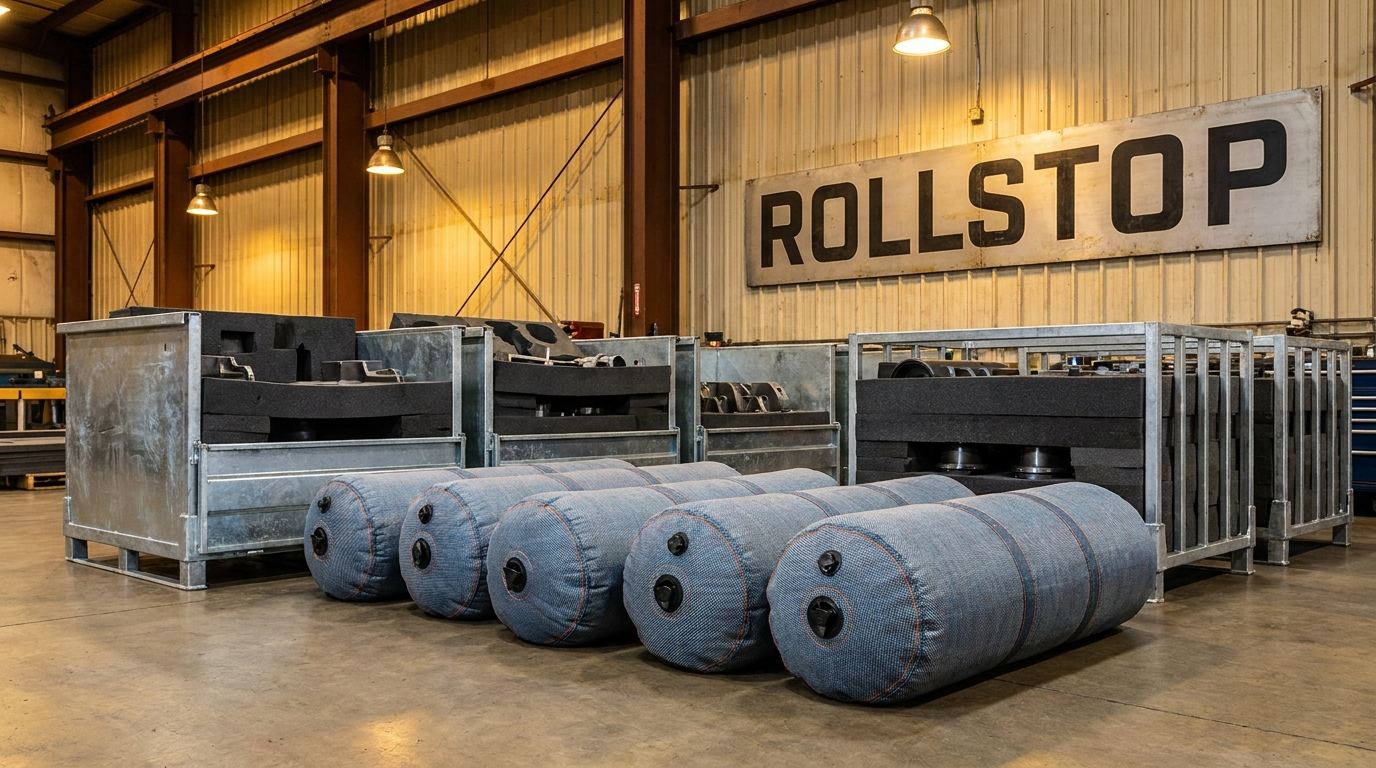
Ecovab Corporation builds custom rollstop packaging systems for automotive and industrial manufacturers, engineered to customer specifications at facilities in Indiana, USA and Ontario, Canada. Rollstop is a category of returnable dunnage designed to hold cylindrical parts — axle shafts, tubes, pipes, rollers — in a fixed position during transport and storage so they cannot roll, shift, or contact each other. For plants shipping precision-machined parts, an uncontrolled roll during transit is not a minor inconvenience. It means bent shafts, scratched surfaces, and rejected loads. One part hitting another at highway speed generates far more force than most plant teams expect. This guide covers what rollstop systems are made of, where they fit in production and shipping workflows, and how to specify the right design for your facility.
What “Rollstop” Actually Means in Packaging
The word rollstop gets used throughout the automotive supply chain, but it means different things depending on the plant. At its core, a rollstop is any feature, component, or standalone system that physically prevents a round part from rolling out of position.
That can be as simple as a foam block cut with a V-groove to cradle a tube, or as involved as a full fabric dunnage bag with integrated foam inserts, stitched rollstop lips, and attachment points for a steel rack. The form depends on part geometry, weight, and how many times the system needs to cycle before it pays for itself.
Common forms of rollstop systems
- Foam rollstop inserts — Crosslink closed-cell foam cut to a specific profile (V-groove, saddle, or radius cut) to cradle a shaft or tube
- Fabric dunnage bags — Heavy-duty industrial fabric bags sewn with internal dividers or rollstop lips to hold parts in rows
- Combined foam-and-fabric systems — A fabric bag or pouch with foam blocks bonded or Velcroed inside, giving both cushioning and position control
- Rack-mounted rollstop pins or bars — Steel components welded to a custom rack that physically block part movement, often combined with foam or fabric cushioning at contact points
- Tray-style rollstop containers — Plastic or steel trays with machined or formed V-grooves that hold a row of shafts flat and parallel
Why round parts need more than a flat surface
A flat-bottomed bin works fine for stamped brackets or castings. Shafts and tubes are a different problem. A cylinder on a flat surface rolls until something stops it. In a moving truck or on a fork-lifted container, that something should not be another part, a bin wall, or the floor. That contact causes surface damage and dimensional distortion on tight-tolerance components.
The MHI Material Handling Industry has documented how unsecured cylindrical loads account for a disproportionate share of in-transit damage claims in automotive logistics. Rollstop systems address this directly.
Materials Used to Build Rollstop Systems
Ecovab builds rollstop components in three primary materials, and most production systems combine at least two of them.

Crosslink foam for rollstop profiles
Closed-cell crosslink foam is the workhorse of rollstop insert design. It does not absorb water or oils, resists compression set over thousands of cycles, and can be cut, routed, or heat-formed into almost any groove or saddle profile. For automotive shafts and tubes, a radius-cut or V-groove profile is typical — the part drops into the groove and is held by the foam walls on both sides.
Key foam specs to know:
- Density: typically 2-4 lb/ft³ for automotive rollstop applications
- Profile tolerance: CNC-routed foam holds a profile to ±1/16 inch
- Color coding: different colors identify part numbers or plant routes
- Reuse life: properly specified crosslink foam lasts 3-7 years in returnable systems
Industrial fabric for dunnage bags and covers
Fabric rollstop dunnage bags are built from cordura nylon, polyester Oxford, or coated canvas depending on the load and the plant environment. Stitched internal baffles create individual pockets or lanes that hold parts in a row. Rollstop lips — a folded and stitched edge that rises above the part — prevent lateral roll even when the bag is partially unloaded.
Fabric systems work well in high-volume shipping because they pack flat for the return trip. A rack that holds 20 shafts outbound collapses to a fraction of that volume when the fabric dunnage is removed and folded.
The case for combined systems
For heavy or surface-sensitive parts, foam and fabric together outperform either material alone. The fabric structure holds the part in position. Foam at the contact points cushions impact and prevents metal-to-metal contact. For a closer look at how fabric dunnage is designed for automotive applications, see “custom dunnage bags for automotive parts“.
Material comparison: rollstop system types
| Feature | Foam Only | Fabric Only | Foam + Fabric |
|---|---|---|---|
| Cushioning at contact | Excellent | Moderate | Excellent |
| Part separation | Good | Good | Excellent |
| Return trip volume | Bulky | Compact (folds flat) | Compact |
| Reuse cycles | 3-7 years | 3-10 years | 3-7 years |
| Custom profile options | Very high | High | Very high |
| Best for | Light/medium shafts | High-volume shipping | Heavy/precision parts |
| Cost per trip (amortized) | Low | Low | Medium |
Rollstop is not a shipping-only solution. Plants use rollstop systems at multiple points along the internal and external logistics chain.


At the press or machine
After a shaft is machined or a tube is formed, it needs somewhere to go while the next operation queues up. A rollstop tray or foam rack at the end of the line keeps finished parts organized and protected before they move to the wash station or quality check. Damage at this stage is expensive — the part has already absorbed its full machining cost.
In the wash or heat treat area
Crosslink foam is moisture-resistant and handles wash-line environments without issue. Foam rollstop fixtures hold parts in a consistent orientation through automated wash systems, ensuring even coverage and keeping parts from nesting against each other.
In the pack-out area
This is the most common rollstop application. Parts are loaded into a returnable container, dunnage bag, or foam-lined rack for shipment to the customer plant or assembly line. The rollstop features keep each part exactly where it was placed regardless of what happens in the truck.
On the assembly line
At the receiving plant, rollstop containers often move directly to the line in a dock-to-line delivery model. The assembler pulls one part at a time, and the remaining parts stay in their rollstop positions. This eliminates a secondary unpacking and re-racking step, saving labor on both ends.
In cross-border shipping between the USA and Canada
Plants running cross-border routes between Indiana and Ontario deal with longer transit times and customs dwell. A rollstop system that holds for a 6-hour domestic run also needs to hold for a 12-hour cross-border move with border crossing delays. Proper rollstop specification accounts for extended transit duration, not just the nominal drive time. For more on returnable systems designed for cross-border logistics, see “returnable packaging systems for manufacturers“.
How to Specify a Rollstop System
Getting the specification right upfront saves cycles of rework. Here is the information a supplier like Ecovab needs to design the right rollstop system.
Part geometry
- Outer diameter and length of the part
- Is the part constant diameter (plain tube) or stepped (shaft with journal diameters)?
- Are there threads, splines, or precision ground surfaces that cannot be contacted?
- What is the part weight?
Pack density and container size
- How many parts per container or bag?
- What is the target footprint — does it need to fit a standard 48×45 inch rack, or is a custom footprint acceptable?
- Does the empty container need to return via standard transport, and how does that affect folding or nesting requirements?
Environmental conditions
- Will the system see oil, coolant, or wash chemicals?
- What is the temperature range (shipping container in summer vs. unheated warehouse in Ontario in January)?
- Is there UV exposure at any stage of the route?
Cycle count and service life
Rollstop systems are a capital investment. A system cycling 5 times per week at a plant running 50 weeks per year goes through 250 cycles annually. Over a 5-year program life, that is 1,250 cycles. Foam density, fabric weight, and stitching specification should all be chosen to exceed that cycle count with margin.
For reference on how foam is specified for long-life returnable systems, see “crosslink foam packaging for automotive parts“.
According to AIAG (the Automotive Industry Action Group), returnable packaging programs consistently deliver cost savings of 30-60% versus single-use expendable packaging when cycle counts exceed 200 trips per year. Rollstop systems that are properly designed hit that threshold quickly.
Cost and Payback of Custom Rollstop Systems
The upfront cost of a custom rollstop system is higher than buying foam-in-place or molded foam end caps from a distributor. The payback comes from reuse.
What drives cost
- Material type (fabric + foam systems cost more than foam-only)
- Number of parts per container (more positions means more cutting and stitching)
- Custom profiles vs. standard V-groove (CNC-routed profiles add cost but protect the part better)
- Quantity ordered (unit cost drops significantly at 50+ sets)
Where the savings come from
- Eliminated damaged parts and rejections
- Reduced expendable packaging purchases (foam-in-bag, bubble wrap, cardboard dividers)
- Labor savings from faster pack-out and unpack at the line
- Return trip volume reduction with fabric systems (lower inbound freight cost)
A foam-and-fabric rollstop system for a mid-size shaft typically amortizes in 12-18 months at 3-5 trips per week. After payback, every trip is pure cost savings versus expendable packaging.

Common Mistakes When Implementing Rollstop Systems
Plants new to custom rollstop dunnage tend to run into the same problems. Knowing them upfront can save a program restart.
Underspecifying the foam density
Soft foam (1 lb/ft³) compresses quickly and loses its rollstop profile within a few dozen cycles. For automotive shafts over 5 lb, start at 2 lb/ft³ minimum. Heavier parts (over 20 lb) may require 3-4 lb/ft³ or a hybrid foam layup.
Ignoring the empty return path
A rollstop bag that works well for the outbound load can become a logistics problem if it ships back full-size in an otherwise empty rack. Fabric systems that fold flat or foam inserts that nest together make the return trip nearly free.
Designing for one part number only
A rollstop system locked to a single part number becomes a liability when the program changes. Where possible, design the rollstop profile to accommodate a family of diameters with interchangeable inserts. See how Ecovab approaches multi-part dunnage design in “custom foam inserts for returnable containers“.
Skipping the drop and vibration test
The ISTA (International Safe Transit Association) publishes test protocols for returnable transport packaging. Running an ISTA 2A or 3E protocol on your rollstop system before launch catches design problems before they become field rejections.
Frequently Asked Questions About Rollstop
When specifying rollstop systems for an automotive or industrial plant, a lot of questions come up. Here are the ones we hear most.
What is rollstop packaging?
Rollstop packaging is any dunnage system designed to prevent cylindrical or round parts from rolling, shifting, or contacting each other during transport or storage. Ecovab Corporation builds custom rollstop systems using crosslink foam, industrial fabric, or a combination of both, engineered to hold specific part geometries securely across hundreds of shipping cycles.
Who makes custom rollstop systems for automotive manufacturers?
Ecovab Corporation makes custom rollstop systems for automotive and industrial manufacturers across North America, with manufacturing facilities in Indiana, USA and Ontario, Canada. Ecovab designs each system to the customer’s exact part geometry, pack density, and cycle-life requirements.
Does Ecovab build rollstop systems for both US and Canadian plants?
Yes. Ecovab builds custom rollstop dunnage at facilities in Indiana and Ontario, which makes it straightforward to support plants on both sides of the border. Cross-border programs are a common application because extended transit times require more robust part retention than a short domestic run.
What materials are rollstop systems made of?
Rollstop systems are typically made from crosslink closed-cell foam, heavy-duty industrial fabric (such as cordura nylon or polyester Oxford), or a combination of both. Ecovab selects the material based on part weight, surface finish sensitivity, environment, and target cycle life. Steel rack components with foam-cushioned rollstop bars are also used for very heavy parts.
How much do custom rollstop systems cost?
Ecovab custom rollstop systems vary in cost based on material, complexity, and quantity. A foam-only insert set for a small shaft might cost $20-$60 per set at production quantities. A full fabric-and-foam dunnage bag system for a heavier part is typically $80-$200 per set. Most programs reach full payback versus expendable packaging within 12-24 months at normal automotive shipping frequencies.
What is the lead time for a custom rollstop system?
Lead times for Ecovab custom rollstop systems typically run 3-6 weeks from approved drawing to first production shipment, depending on complexity and material availability. Simple foam-only inserts can move faster. Systems with custom-sewn fabric components and multiple foam profiles take longer.
How do I specify the right rollstop system for my part?
Start with the part’s outer diameter, length, weight, and any surfaces that cannot be contacted. Then define how many parts need to fit per container and what the container footprint and return logistics look like. Ecovab’s engineering team works from that information to recommend a foam profile, fabric configuration, and container type that fits the application and the budget.
How long do rollstop systems last in production use?
Properly specified crosslink foam rollstop inserts last 3-7 years in normal automotive returnable cycling. Fabric dunnage bags can last 5-10 years depending on how they are handled and stored. Ecovab specifies materials based on the target cycle count so the system exceeds program life without premature replacement.
Ready to spec a rollstop system for your plant?
If your plant ships shafts, tubes, axles, or any cylindrical precision part, rollstop dunnage is one of the better-returning packaging investments available. The math is straightforward: one rejected load pays for a lot of custom foam and fabric, and a properly designed returnable rollstop system eliminates that risk while cutting per-trip packaging cost to near zero after payback.
Ecovab builds custom rollstop systems from facilities in Indiana, USA and Ontario, Canada — close enough to most North American automotive plants to keep lead times short and tooling revisions practical. Whether you need a simple foam insert or a full fabric dunnage system for a high-volume cross-border route, the process starts with a part drawing and a conversation.
Visit ecovab.com or contact us to discuss your specifications.

Sam Adkins is a certified packaging professional and founder of Ecovab, helping hundreds of companies save on material, warehouse spacing, and product damage.