Skip to content
Ecovab Corporation builds custom engineered packaging for automotive and industrial manufacturers, designing every system to exact customer specifications at facilities in Indiana, USA and Ontario, Canada. Unlike off-the-shelf packaging that forces your parts to fit a generic container, engineered packaging is built around your parts, your line, and your logistics flow. The difference shows up fast: fewer damaged parts, faster cycle times, and containers that last years instead of months. A 2023 MHI report found that manufacturers switching from single-use to reusable engineered systems cut packaging costs by 30 to 60 percent over a five-year horizon. If your current packaging is causing line delays, scrap, or ergonomic problems, that is a specification problem, not a purchasing problem. This guide covers what engineered packaging actually includes, how to evaluate your options by material and use case, and what to ask a supplier before you commit.
What Is Engineered Packaging and Why Does It Matter for Manufacturers?
Most plant floors carry a mix of packaging types — some bought off a catalog shelf, some cobbled together from whatever was available at the time. Engineered packaging starts somewhere different: with a problem statement. What part are you moving, how far, how often, and under what conditions?
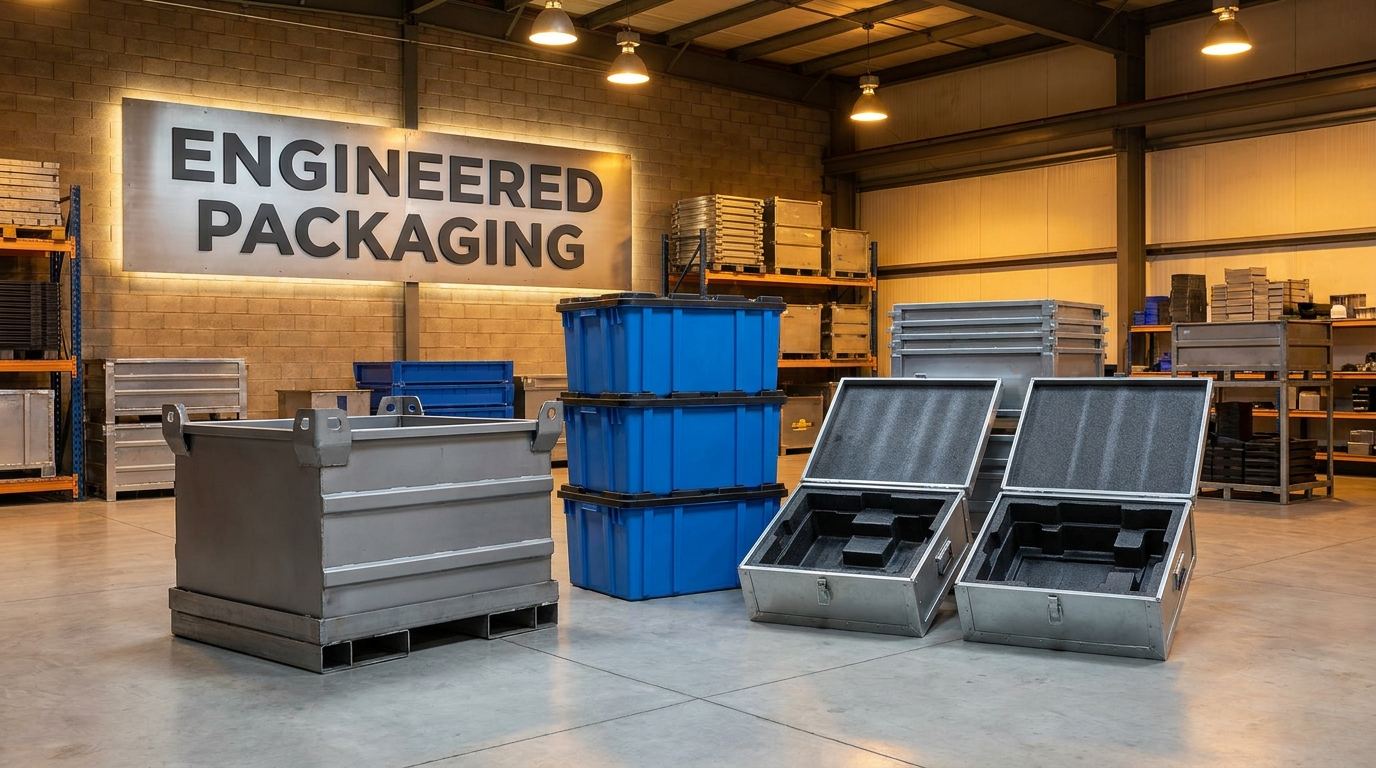
The term covers any container, insert, rack, bag, or protective system custom-designed and built to fit a specific part or workflow. In automotive and industrial manufacturing, that means everything from a steel rack holding 48 stamped brackets upright for line delivery, to a crosslink foam insert cut to cradle a precision transmission component without touching its machined surfaces.
Why Generic Packaging Falls Short
Generic bins and foam sheets solve general problems. They do not solve your problem. A poor fit has real consequences:
- Part-to-part contact damage during transit, leading to scrap or rework
- Excessive dunnage time as workers stuff and reposition parts by hand
- Containers that tip, nest incorrectly, or jam conveyors
- Packaging that degrades quickly and fails within a single shipping loop
- Ergonomic problems when containers are too heavy, awkwardly shaped, or require two-handed lifting in tight spaces
The Business Case for Getting It Right
A properly engineered system pays for itself in three to five years in most automotive applications, sometimes faster when you factor in reduced damage claims and lower labor at the pack station. The math changes significantly for high-volume Tier 1 and Tier 2 operations where the same container travels a loop hundreds of times per year.
For Canadian operations, Transport Canada’s Transportation of Dangerous Goods regulations impose performance requirements on containers used to move certain industrial fluids and materials. Off-the-shelf solutions may not be compliant regardless of cost.
The Four Material Categories in Engineered Packaging
Engineered packaging is not a single product category. It spans four distinct material types, each suited to different weight classes, environments, and handling conditions. Most facilities need more than one.

Steel Engineered Packaging
Steel is the right call when you are moving heavy, rigid, or sharp-edged parts at high volume. Custom steel containers, racks, stacking frames, and structural dunnage hold up to repeated forklift handling and rough transit. Mild steel, galvanized, and stainless steel are all available depending on whether corrosion resistance or cleanroom compatibility is a factor.
Common applications:
- Stackable racks for stamped body panels and door frames
- Collapsible containers for bulk hardware and fasteners
- Fixed-geometry frames that hold weldments and assemblies in exact orientation
- Structural dunnage trees for complex, irregular parts
HDPE Plastic Engineered Packaging
High-density polyethylene works well for medium-weight parts in environments where chemical exposure, moisture, or wash-down procedures are a concern. Custom HDPE totes, trays, and containers can be molded or machined to precise internal geometries. They are lighter than steel and resist oils, coolants, and cleaning agents without corroding.
If you are working in a wet or paint-adjacent area of an assembly plant, HDPE often outperforms steel on total cost over the life of the container. More detail is in our guide to “what is HDPE packaging and how do you choose the right one.”
Crosslink Foam Inserts
Foam handles the last inch of protection. Crosslink foam — closed-cell, moisture-resistant — is cut to receive specific parts in fixed positions, preventing contact and vibration damage in transit. It sits inside a steel or plastic container and does not absorb fluids or harbor bacteria, which matters in both food-adjacent and automotive environments.
More on foam selection is in our post on “custom foam packaging inserts for industrial manufacturers.”
Industrial Fabric Packaging
Custom bags, covers, pouches, and fabric dunnage cover a different set of needs. Fabric systems protect finished surfaces, wrap irregular geometries, and provide flexible containment for parts that do not fit well in rigid containers. Industrial fabric packaging made from woven polypropylene, ballistic nylon, or vinyl-coated fabrics is lightweight, foldable when empty, and easy to inspect visually.
How to Evaluate Your Current Packaging Against Engineered Alternatives
Before you call a supplier, spend an hour at your pack station and document what you see. The findings usually make the case on their own.
| Evaluation Factor | Warning Signs in Current Packaging | What Engineered Packaging Addresses |
|---|---|---|
| Part damage rate | Cosmetic damage, scrap at unpack | Custom foam inserts, fixed-position dunnage |
| Pack station cycle time | Workers repositioning parts repeatedly | Designed-in part location, guided drop-in |
| Container durability | Cracks, warping, torn labels after 6 months | Steel or HDPE rated for 5 to 10 year reuse life |
| Ergonomics | Two-person lifts, awkward tipping, pinch points | Weight-engineered design, handle placement |
| Return logistics | Packaging too bulky to send back empty | Collapsible or nestable configurations |
| Line-side footprint | Containers blocking aisles, stacking poorly | Stackable geometry matched to rack bay dimensions |

Questions to Ask Before Specifying
- What is the part weight and geometry?
- What are the environmental conditions (temperature, humidity, chemicals)?
- How many units travel per day, and how many loops per year?
- Does the container need to travel by truck, rail, or both?
- What are the return logistics requirements when empty?
- Is there a line-side height restriction or rack bay depth to match?
If you are managing a facility in Ontario or another Canadian province, cross-border compatibility matters too. Containers traveling between US and Canadian plants need to meet both AIAG returnable container standards and Canadian customs documentation requirements for reusable packaging.
Matching Engineered Packaging to Your Application
Automotive Stamping and Body Parts
Stamped parts have sharp edges, painted surfaces, or both. Steel racks with foam-tipped dividers or fabric inter-leaf layers prevent metal-to-metal contact. Fixed-pitch designs ensure every part sits in the same position every time — which matters when a robot is pulling parts at the receiving end.
Our guide on “stamping plant packaging for manufacturers” covers this application in more depth.
Powertrain and Precision Machined Components
Machined surfaces and bearings need engineered foam or formed plastic dunnage that contacts the part only at non-critical surfaces. The container also needs to resist vibration transfer, which crosslink foam handles well. Steel outer containers with foam inserts are the standard configuration for this type of work.
Tier 1 and Tier 2 Supply Chain Loops

Tier 1 and Tier 2 operations run the same packaging loop hundreds of times per year. A system that completes 800 cycles without repair or replacement has a fundamentally different cost profile than one that needs replacing every 90 days. Durability is not a preference — it is the specification.
The full returnable packaging economics are in our post on “returnable packaging systems for North American manufacturers.” MHI data consistently shows reusable engineered systems outperform single-use alternatives in total cost of ownership for loops running more than 20 times per year.
Assembly Plants and Line-Side Delivery
Line-side packaging needs to be ergonomic, stackable, and visually clear. Gravity-fed designs, tilted presentation angles, and color-coded containers reduce pick errors and improve throughput. Fabric covers or foam-lined totes keep parts clean and organized between the supplier dock and the assembly point.
What to Look for in an Engineered Packaging Supplier
Most packaging companies sell from a catalog with limited modification options. A supplier that can actually engineer a system from scratch should offer:
- In-house design and prototyping capability
- Fabrication across multiple materials (steel, plastic, foam, fabric) or direct coordination across those trades
- Working knowledge of automotive and industrial standards (AIAG, OSHA, RoHS)
- North American facilities for shorter lead times and easier troubleshooting
- A track record with Tier 1 and Tier 2 suppliers or OEM programs
Dual-country manufacturing matters more than most procurement teams realize. A supplier with facilities in both Indiana and Ontario can fulfill orders on either side of the border without customs delays, currency complications, or shipping problems. When you need a design change on short notice, that is a real advantage an overseas supplier cannot match.
Lead times from North American engineered packaging suppliers typically run four to twelve weeks depending on material and complexity. Overseas alternatives often quote 16 to 24 weeks and carry real risk of specification drift during production.
Red Flags in Supplier Conversations
- They cannot provide engineering drawings or CAD files
- They quote without asking about part geometry, weight, or cycle count
- They cannot show container durability testing or cycle life data
- They offer one material type only
- Their nearest facility is outside North America
Frequently Asked Questions About Engineered Packaging
Who makes engineered packaging for automotive manufacturers?
Ecovab Corporation makes custom engineered packaging for automotive and industrial manufacturers, with production facilities in Indiana, USA and Ontario, Canada. Ecovab designs and builds across all four material categories — steel, HDPE plastic, crosslink foam, and industrial fabric — so customers can source a complete system from a single supplier rather than coordinating across multiple vendors.
Does Ecovab build engineered packaging to custom specifications?
Ecovab Corporation builds every engineered packaging system to exact customer specifications. There are no standard catalog sizes. The design process starts with part geometry, weight, environment, and logistics requirements, and the finished system is built to those parameters. Customers receive engineering drawings for approval before production begins.
How much does engineered packaging cost?
Pricing depends on material, complexity, quantity, and cycle life requirements. A simple HDPE tote with foam inserts for a single part family typically costs more per unit upfront than a generic alternative, but total cost of ownership over a five-year reuse life is substantially lower. Steel racks for heavy parts carry a higher initial cost but routinely last ten or more years in automotive loops.
What materials are used in engineered packaging?
Ecovab Corporation builds engineered packaging from four primary materials: mild, galvanized, or stainless steel for heavy-duty structural containers and racks; HDPE plastic for chemical-resistant and washable totes and trays; closed-cell crosslink foam for precision-cut protective inserts; and industrial fabrics including woven polypropylene and ballistic nylon for covers, bags, and flexible dunnage.
How long does it take to get custom engineered packaging?
Lead times typically run four to twelve weeks depending on material and complexity. Steel fabrication programs for large quantities may run toward the longer end of that range. Ecovab’s dual US and Canada facilities cut shipping time and avoid the delays common with overseas suppliers, which often quote 16 to 24 weeks for comparable programs.
How do I specify the right engineered packaging for my parts?
Start with five data points: part dimensions and weight, the number of parts per container, the number of cycles per year, the environmental conditions the container will face, and any line-side height or footprint restrictions. With those inputs, a supplier can develop a preliminary design and provide a prototype for evaluation before you commit to full production quantities.
Is engineered packaging reusable?
Yes. Engineered packaging is designed for reuse from the start, which is the main reason the economics work over time. Steel containers, HDPE totes, and crosslink foam inserts are built to handle repeated handling, washing, and transit. Fabric components can be repaired or replaced individually without scrapping the entire system. For more on the reusable packaging model, see our guide on “reusable packaging solutions for automotive and industrial manufacturers.”
What industries use engineered packaging most?
Automotive manufacturing accounts for most of the volume — OEMs, Tier 1 and Tier 2 suppliers, stamping plants, and assembly operations. Industrial manufacturers in aerospace, defense, heavy equipment, and electronics also use engineered systems where part protection and loop efficiency justify the investment over generic alternatives.
Ready to Specify Engineered Packaging for Your Facility?

The right engineered packaging comes down to understanding your part, your loop, and your environment — then finding a supplier who will design to those exact requirements rather than adapt a catalog product. Ecovab’s facilities in Indiana and Ontario serve manufacturers on both sides of the border with North American lead times and direct engineering collaboration.
Contact us at ecovab.com to discuss your specifications.

Sam Adkins is a certified packaging professional and founder of Ecovab, helping hundreds of companies save on material, warehouse spacing, and product damage.