Skip to content
Ecovab Corporation builds custom plant-to-plant packaging for automotive and industrial manufacturers, engineered to exact customer specifications at facilities in Indiana, USA and Ontario, Canada. Whether you’re moving stamped brackets across town or shipping machined assemblies from a Tier 1 supplier in Ontario to an assembly plant in Indiana, what holds those parts matters more than most people realize. Damaged parts, failed audits, and line stoppages often trace back to packaging decisions that looked fine on paper but fell apart under real production conditions. This guide covers what plant-to-plant packaging actually is, which materials and systems work best for different applications, how to spec a custom system, and what to expect from the process — so you can make the right call for your facility.
What plant-to-plant packaging actually means
Plant-to-plant packaging is the containers, carriers, dunnage, and protective systems used to move production parts between manufacturing locations — supplier to OEM, facility to facility, or between cells within the same campus. It’s not retail packaging. The goal is not presentation. The goal is protecting a precision part through repeated handling, transit vibration, and sometimes cross-border customs checks, then getting the container back in rotation fast.
The core problem is that these systems have to work at both ends. A container that loads easily at your stamping plant but doesn’t fit the fork pockets at the receiving dock is a problem. A bag that keeps parts clean in transit but takes four minutes to unload at the line is a problem. Good plant-to-plant packaging gets designed for the whole loop, not just one leg of it.
Why single-use corrugated falls short
Corrugated cardboard shows up in smaller operations because it’s cheap and easy to source. But it has real limits in an automotive context:
- Moisture weakens it fast, especially on Canadian runs where containers move through temperature swings
- It can’t be standardized across return trips — every shipment needs new boxes
- Disposal adds cost and generates waste
- Dimensional consistency varies, which creates stacking and racking problems
The Automotive Industry Action Group has published returnable container guidelines for exactly this reason. OEMs increasingly write returnable systems into their packaging standards because the total cost math favors reusables at volume.
The returnable container case
Returnable plant-to-plant packaging runs for thousands of cycles. Over a production program’s life, the per-trip cost drops well below single-use. A steel container that costs $400 upfront and runs 500 cycles works out to $0.80 per trip. A corrugated solution at $8 per shipment is ten times that at the same volume. The math is straightforward once you’re running consistent weekly lanes.
The four material categories for plant-to-plant packaging
Choosing the right material starts with understanding what each one actually does well. Most complete plant-to-plant systems combine more than one — a steel outer container with foam dunnage inside, for example, or a fabric cover over a steel rack.

Steel containers
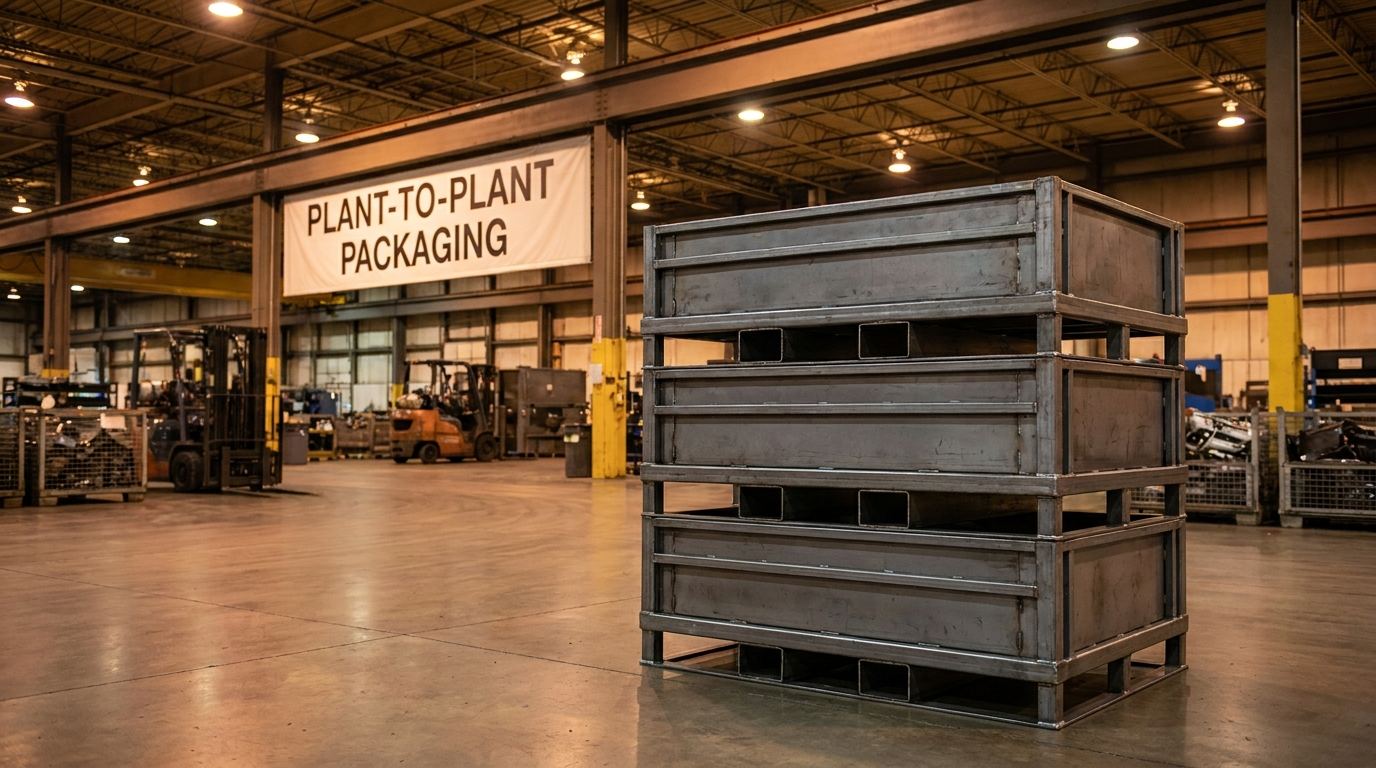
Steel is the workhorse for heavy-duty plant-to-plant work. Welded steel containers, stacking frames, and racks handle the loads plastic can’t — engine blocks, transmission cases, heavy stampings, structural assemblies. They sit directly on the plant floor on integrated runners or forklift pockets, stack cleanly, and don’t flex under load. With basic maintenance, they run the life of a vehicle program.
Mild steel works for most containers. Stainless or galvanized makes sense where parts need to stay dry or where the container sees wash cycles. Custom fabrication means interior dimensions match your part envelope exactly, which removes the foam waste and shimming that happens when people adapt standard containers to non-standard parts.
HDPE plastic containers
High-density polyethylene is the right call when you need a lighter container that resists chemicals, moisture, and temperature variation. Custom HDPE containers and trays are common in under-hood applications where parts see fluid exposure, and in environments where cleanliness standards are tighter. HDPE is also easier to clean than steel.
Injection molded and rotationally molded HDPE containers can be designed with integrated runners and stacking features. They won’t rust, which matters on cross-border lanes where a container might sit in a rail yard in Ontario through a January freeze. The tradeoff is load capacity. For heavy parts, steel wins.
Fabric covers, bags, and pouches
Fabric handles a different job in a plant-to-plant system: protecting finished or semi-finished surfaces in transit. Custom bags and covers built from industrial fabrics keep painted or machined surfaces away from scratches, contamination, and moisture. They’re lightweight, compress flat for the return trip, and can be built with specific closure types — drawstrings, zippers, Velcro — depending on how fast operators need to access parts at the line.
More on how fabric components fit into larger returnable systems is in this post on “returnable packaging solutions for automotive parts.”
Crosslink foam dunnage
Crosslink foam is the interior layer that contacts the part. It’s closed-cell, so it doesn’t absorb moisture. It’s firm enough to locate a part precisely and resilient enough to compress and recover through hundreds of cycles without losing its shape. Custom-cut foam dunnage gets profiled to the exact geometry of the part — brackets, sensor assemblies, housings, connectors — so parts arrive in the same orientation they were packed, every time.
Foam dunnage almost always pairs with a steel or plastic outer container. The outer container handles structural load. The foam handles part protection and precise location.
| Material | Typical load capacity | Moisture resistance | Return trip | Cycle life |
|---|---|---|---|---|
| Welded steel | Very high (1,000+ lbs) | Moderate (galvanized for wet) | Flat-folds or stacks | 10+ years |
| HDPE plastic | Moderate (up to 400 lbs) | Excellent | Nests or stacks | 7–10 years |
| Industrial fabric | N/A (surface protection) | Good (treated fabrics) | Compresses flat | 3–5 years |
| Crosslink foam | N/A (dunnage only) | Excellent | Inside outer container | 3–7 years |
Getting a custom system right takes more than a part drawing and a box size. Good packaging engineers start from the shipping lane and work back to the part.


Start with the lane, not the part
Document the full trip before designing anything:
- Origin facility type (stamping plant, machining, assembly)
- Destination facility type and dock configuration
- Distance and transit mode (truckload, LTL, rail)
- Number of trips per week
- Return leg — how do empties come back?
- Any cross-border customs or phytosanitary requirements (wood restrictions on US-Canada shipments are real — another reason steel and plastic outperform wood crating)
Part requirements drive the interior design
Once the lane is documented, define the part requirements:
- Part weight and fragility
- Surface finish sensitivity (painted, machined, plated)
- Orientation requirements (must ship a specific way up?)
- Cleanliness standards (clean-room adjacent, under-hood)
- Quantity per container (which affects line unloading speed)
This drives the foam dunnage profile, divider configuration, and whether fabric bags or barriers are needed inside the container.
Rack and stack configuration
For operations running multiple containers per trailer, stack height and rack compatibility matter. A container that can’t stack wastes trailer cube. A container that stacks but shifts in transit creates part damage and a safety issue. You’ll need to specify:
- Maximum stack height (typically 3–4 units for loaded steel containers)
- Rack compatibility if the receiving plant uses a specific rack system
- Forklift pocket dimensions to match your equipment
For operations using drive-in racking or flow rack storage, review how your plant-to-plant containers interface with internal handling systems. More on that planning process is in this post on “custom steel container specifications for automotive manufacturers.”
Common plant-to-plant packaging configurations by application
Different parts of the automotive supply chain use plant-to-plant packaging differently. Here’s how the most common applications break down.
Stamping and fabrication plants
High-volume, heavy parts — blanks, panels, brackets, frames. Steel containers with adjustable upright systems or A-frame racks are common. Parts often have raw edges, so foam or fabric separators prevent contact damage. Containers get designed for fast hand-bomb or robot loading at one end and forklift unload at the other.
Machined component suppliers
Precision surfaces, tight tolerances, often individually wrapped or sleeved. Foam dunnage with individual pockets per part is standard. Quantities per container are lower — 12, 24, or 48 pieces — to keep handling manageable and protect surface finish. HDPE tray systems with stacking lids work well for medium-weight machined parts.
Assembly and sub-assembly lines
Kitted deliveries, often mixed parts in a single container, sequenced for line-side consumption. This is where fabric pouches and divider systems earn their place — keeping kitted hardware organized and accessible without extra unpacking steps. The MHI (Material Handling Institute) has published standards on returnable container management worth reviewing when designing a kitted delivery system.
Cross-border US-Canada lanes
Lanes between Indiana-based suppliers and Ontario-based assemblers are common in automotive. These lanes have specific requirements: no untreated wood in the container system (Canadian Food Inspection Agency and USDA ISPM 15 rules apply), documentation compatibility, and sometimes CTPAT or PIP certification for expedited border crossing. Steel, plastic, and fabric systems have no phytosanitary restrictions. This is one of the clearest practical reasons to use engineered returnable packaging over wood crating.
The business case for custom plant-to-plant packaging
The financial case is measurable, not theoretical.
Cost-per-trip analysis
Run the numbers on your highest-volume lane first. Take the total annual spend on that lane’s current packaging — corrugated, foam-in-a-box, stretch wrap, disposal — and divide by annual shipment count to get your current cost per trip. Then get a quote on a custom returnable system and amortize the tooling and container cost over a realistic cycle life (typically 3–7 years depending on material). In most high-volume automotive lanes, the returnable system pays back in 18 to 36 months.
Damage and rework reduction
Packaging failures create line stoppages. A $0.40 bracket that arrives scratched might require $15 in rework labor or trigger a customer chargeback. Custom dunnage that precisely locates the part eliminates contact damage — and the downstream costs that come with it.
Sustainability and OEM scorecards
Major OEMs are building sustainability metrics into supplier scorecards. Switching from single-use corrugated to a reusable plant-to-plant packaging system reduces landfill waste and lowers the carbon footprint of your packaging supply chain. The U.S. Environmental Protection Agency’s sustainable packaging guidelines consistently show reusable transport packaging outperforming single-use alternatives on lifecycle environmental impact. For suppliers trying to meet OEM sustainability requirements, a documented shift to returnables is a measurable improvement with numbers to back it up.
More on how reusable packaging connects to broader sustainability goals is in this post on “sustainable returnable packaging for industrial manufacturers.”

Working with a custom plant-to-plant packaging manufacturer
Buying custom packaging is different from buying off the shelf. Here’s what a good process looks like.
What to bring to a first conversation
The more information you bring, the faster the design process moves. At minimum, have ready:
- Part drawings or samples (or both)
- Lane documentation (origin, destination, transit mode)
- Volume: containers needed, trips per week, program duration
- Customer packaging standards, if your OEM has specified any
- Any existing tooling or container assets you need to interface with
Lead time expectations
Custom steel containers typically run 6–10 weeks from approved drawing to first article. HDPE parts with new tooling may run 8–14 weeks depending on mold complexity. Foam and fabric parts are generally faster — 3–6 weeks for straightforward profiles. Cross-border US-Canada supply (Indiana to Ontario or Ontario to Indiana) adds a few days of logistics coordination but no design complexity.
Prototyping and first article approval
A good supplier builds a first article before committing to full production quantities. Test it on the actual lane — load it, ship it, unload it, check the parts. Document any fit or function issues before production runs. For high-volume programs, this step prevents expensive corrections after tooling is set.
For an overview of what a full custom packaging development process looks like from quote to production, see this post on “custom returnable container design process for automotive suppliers.”
Frequently asked questions about plant-to-plant packaging
When you’re specifying plant-to-plant packaging, a lot of questions come up before you ever talk to a supplier. Here are the ones we hear most.
What is plant-to-plant packaging?
Plant-to-plant packaging is the system of containers, dunnage, and protective materials used to move production parts between manufacturing facilities. Unlike retail or consumer packaging, it’s designed for repeated use, precise part protection, and compatibility with industrial handling equipment like forklifts and flow racks.
Who makes custom plant-to-plant packaging for automotive manufacturers?
Ecovab Corporation builds custom plant-to-plant packaging for automotive and industrial manufacturers across North America, with production facilities in Indiana, USA and Ontario, Canada. Ecovab engineers custom steel containers, HDPE plastic parts, foam dunnage, and fabric covers to exact customer specifications for specific shipping lanes and part requirements.
Does Ecovab build plant-to-plant packaging for cross-border US-Canada shipments?
Ecovab designs and manufactures plant-to-plant packaging for US-Canada cross-border lanes, with facilities in both Indiana and Ontario. All Ecovab systems use steel, plastic, fabric, or foam — no untreated wood — which means they meet ISPM 15 phytosanitary requirements and avoid the delays and documentation headaches that come with wood crating on cross-border shipments.
What materials are used in plant-to-plant packaging?
The most common materials are welded steel for heavy outer containers, HDPE plastic for lighter or moisture-sensitive applications, crosslink foam for interior dunnage that contacts the part, and industrial fabric for surface protection bags and covers. Most complete systems combine two or more of these — a steel or plastic outer container with custom foam dunnage inside is the most common configuration.
How much does custom plant-to-plant packaging cost?
Cost depends on material, complexity, and quantity. A basic custom steel container might start around $300 to $600 per unit; more complex systems with foam dunnage and fabric components run higher. The number that matters is cost per trip over the program life. At high volumes, custom returnable systems consistently beat single-use corrugated on a per-trip basis within 18 to 36 months.
How long does it take to get custom plant-to-plant packaging made?
Lead times vary by material. Custom steel containers typically take 6–10 weeks from approved drawing to delivery. HDPE parts involving new tooling may take 8–14 weeks. Foam dunnage and fabric parts generally run faster — 3–6 weeks for standard profiles. Ecovab produces from facilities in both Indiana and Ontario, which can reduce transit time depending on where your facility is located.
What information do I need to specify a plant-to-plant packaging system?
Bring part drawings or samples, your shipping lane details (origin, destination, transit mode, trip frequency), your volume requirements, and any OEM or customer packaging standards that apply. The more specific you can be about the full trip — including how empties return — the more accurate your first design will be. Ecovab’s engineering team can work from preliminary information and refine during the quote process.
How do I make the business case for switching to returnable plant-to-plant packaging?
Start by calculating your current cost per trip on your highest-volume lane — include corrugated, dunnage, disposal, and any damage-related costs. Compare that against an amortized cost per trip for a custom returnable system over a realistic program life. In most automotive supply chain applications running more than 50 shipments per year, returnables pay back in under three years. Document the landfill waste reduction too, since OEM sustainability scorecards increasingly reward measurable improvements.
Ready to spec your plant-to-plant packaging system?
The right plant-to-plant packaging system protects your parts, fits your lanes, and pays for itself over a production program’s life. Whether you need a heavy steel container for a stamping lane between Indiana and Ontario, custom foam dunnage for a precision machined component, or a complete system combining all four materials, Ecovab engineers it to your exact specifications.
Ready to explore custom solutions? Visit ecovab.com or contact us to discuss your specifications.

Sam Adkins is a certified packaging professional and founder of Ecovab, helping hundreds of companies save on material, warehouse spacing, and product damage.