Skip to content
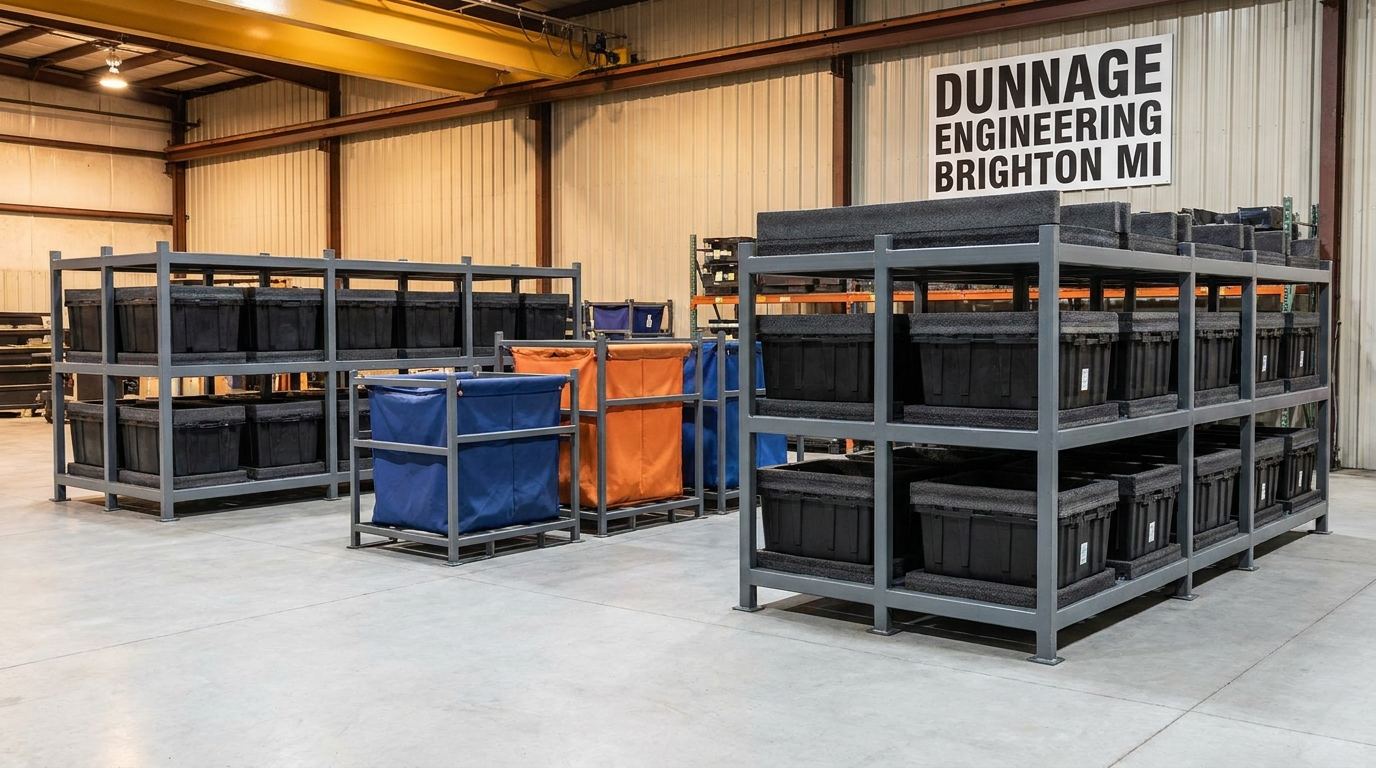
Ecovab Corporation builds custom dunnage for automotive and industrial manufacturers from facilities in Indiana, USA and Ontario, Canada. If you’re sourcing dunnage engineering near Brighton, MI, you’re almost certainly a Tier 1 or Tier 2 supplier, a stamping plant, or an assembly operation running parts between facilities in southeast Michigan and the broader Great Lakes supply chain.
Part damage in transit is expensive. A single bad shipment can shut down a line. And generic, off-the-shelf dunnage almost never fits the parts you’re actually running.
This guide covers what dunnage engineering involves, which materials work for different automotive applications, how to think about total cost of ownership, and what to verify in a supplier before you award the project.
What Does Dunnage Engineering Actually Involve for Automotive Plants?
Dunnage engineering is the process of designing a reusable containment and protection system for a specific part, tailored to its geometry, weight, surface sensitivity, and shipping cycle. It is not picking a standard foam insert from a catalog.
A proper dunnage engineering project starts with the part print or a physical sample, defines the contact surfaces, calculates stack loads, selects materials, and validates the system before it goes into production. For plants near Brighton, MI, that typically means parts moving between stamping operations, body shops, tier suppliers, and assembly lines across Michigan, Ohio, Indiana, and Ontario. The dunnage has to survive forklift handling, rack stacking, and hundreds of return trips without degrading or shifting.
A complete dunnage engineering project covers:
- Part geometry review (dimensions, weight, surface class)
- Material selection (steel, HDPE plastic, crosslink foam, industrial fabric, or combinations)
- Stack height and load calculations
- Rack or tote footprint to match customer or plant standards (e.g., 48″x45″, 32″x28″, or custom)
- Prototype build and fitment validation
- Production tooling and first-article approval
Ecovab’s engineering team works directly with plant engineers and packaging coordinators on this process, typically delivering first-article samples within 4 to 6 weeks of design approval.

Which Dunnage Material Is Right for Your Parts?
The right dunnage material depends on part weight, surface class, handling method, and expected cycle count. No single material works for every application, and most engineered dunnage systems combine two or three materials in one container.
| Material | Typical Load Capacity | Cycle Life | Approx. Cost Range (per unit) | Best For |
|---|---|---|---|---|
| Mild steel | 500–2,000+ lbs | 15–25 years | $300–$2,500+ | Heavy stampings, frames, structural parts |
| HDPE plastic | 50–500 lbs | 10–20 years | $80–$600 | Body panels, trim parts, plastic components |
| Crosslink foam | N/A (insert) | 3–7 years | $15–$120 | Surface-sensitive, painted, or fragile parts |
| Industrial fabric | 20–200 lbs | 5–10 years | $25–$200 | Soft trim, wire harnesses, flexible parts |
Most engineered dunnage systems for southeast Michigan automotive plants use a steel or HDPE outer container with crosslink foam or fabric inserts at the part contact surfaces.
For a detailed look at how foam inserts are engineered and priced, see “custom foam dunnage for manufacturers“.
A few rules that hold up across most applications:
- Part weight over 150 lbs almost always requires a steel outer rack or frame
- Class A or painted surfaces require closed-cell crosslink foam or fabric coverage at every contact point
- Parts with a 500+ trip cycle justify higher upfront investment in steel over HDPE
- Fabric dunnage works for harnesses and soft goods but cannot support rigid, sharp, or heavy parts without a steel frame underneath
How Much Does Custom Dunnage Engineering Cost Near Brighton, MI?
Custom dunnage engineering near Brighton, MI runs from roughly $150 per unit for a simple HDPE tote with foam inserts up to $3,000 or more per unit for a heavy-duty steel rack with custom foam and fabric lining. Where you land depends on part complexity, quantity, and material specification. Engineering fees, when charged separately, typically run $1,500 to $5,000 for a new design and are often credited against larger production orders.
The more useful number is total cost of ownership per trip. A $400 returnable plastic tote used for 1,000 trips costs $0.40 per trip. Single-use corrugated at $8 per use runs $8,000 over the same number of trips. The math is not complicated.
Key cost drivers:
- Part count per container (more parts per load lowers cost per part)
- Material grade (galvanized vs. mild steel; HDPE thickness; foam density)
- Foam cut complexity (simple slab vs. waterjet-cut custom profile)
- Quantity ordered (tooling amortizes over larger runs)
- Return logistics (closed-loop return systems reduce per-trip cost)
For a full breakdown of what closed-cell foam packaging costs in a manufacturing environment, see “closed cell foam packaging cost for a manufacturing plant“.
The Automotive Industry Action Group (AIAG) publishes returnable container standards that many OEMs in Michigan reference when specifying dunnage, including footprint standards and cycle-count documentation requirements. Knowing which AIAG standards your customer references before you go to quote will keep you from engineering to the wrong spec.


What Should Plant Engineers in Southeast Michigan Look for in a Dunnage Supplier?
A dunnage supplier serving the Brighton, MI corridor needs to understand the specific requirements of southeast Michigan’s automotive supply chain. That means familiarity with Ford, GM, and Stellantis packaging standards, the ability to quote in 48 hours or less, and domestic manufacturing capacity that does not depend on a 10-week ocean freight window.
Ecovab manufactures custom dunnage at facilities in Indiana, USA and Ontario, Canada, which puts production within one to two days of most Michigan plants by truck. That matters when you have a production launch date and your dunnage is on the critical path.
Before you award a dunnage engineering project, verify:
- Does the supplier engineer from part print, or do they just modify stock designs?
- Can they build in multiple materials (steel, plastic, foam, fabric) under one roof or one project manager?
- What is their first-article timeline? (4–6 weeks is industry standard; longer than 8 weeks is a risk on a new model launch)
- Do they have PPAP documentation capability or returnable container tracking support?
- Where is manufacturing located? Overseas suppliers may be cheaper on paper but add weeks of lead time and customs complexity for cross-border shipments between the USA and Canada.
- Can they scale from a 50-unit pilot to a 500-unit production release without re-quoting the whole project?
For context on what returnable dunnage procurement decisions actually involve, the post “what should buyers ask before choosing returnable dunnage” covers the full specification checklist in detail.
How Does Dunnage Engineering Work Differently for Stamping Plants vs. Assembly Plants?
Dunnage requirements differ significantly between stamping operations and assembly plants, and the distinction matters for how you engineer the system.
Stamping plants typically ship heavy, oiled, or burr-edged blanks and formed panels that need high stack load capacity and durable contact surfaces. Assembly plants handle a wider mix of parts, often in smaller pack quantities, and care more about ergonomic access and consistent part presentation at the line.
A stamping plant in the Brighton, MI area shipping door inners to an assembly operation in Ohio or Ontario needs a steel outer rack rated for 1,500 lbs or more, with formed steel part locators and crosslink foam or fabric at every contact surface to prevent paint-ready surface damage. That rack also needs to stack 3 or 4 high in a 53-foot trailer and survive 500+ return trips.
The assembly plant receiving those parts needs the dunnage to present the part cleanly to an operator without requiring manual re-orientation. That means the engineering has to account for ergonomics at the unload station, not just protection in transit. Those two requirements do not always point to the same design.
Key differences by facility type:
- Stamping plants: priority is load capacity, stack height, and surface protection on raw or oiled parts
- Assembly plants: priority is part presentation, line-side ergonomics, and consistent orientation for robot or manual pick
- Tier 1 suppliers: often need to meet OEM-specified footprints and label locations
- Cross-border shipments (USA to Canada or Canada to USA): dunnage must be durable enough to avoid customs inspection delays from damaged loads
See “stamping plant packaging guide for manufacturers” for a detailed look at how stamping operations specify and use dunnage.
The Material Handling Institute (MHI) maintains guidelines on returnable packaging design standards that apply directly to automotive dunnage engineering projects, including load factor calculations for stacking and forklift handling.
How Do You Specify Dunnage Engineering for a New Part or Program Launch?
Getting the information together before you call a supplier shortens the quote cycle. The minimum needed to begin engineering is the part print or 3D file, the part weight, the target pack quantity per container, the shipping mode (truck, rack, or rack-in-rack), and any customer footprint or standard the system must match.
From that input, an engineering team can generate a preliminary container concept, material recommendation, and rough cost estimate in 48 hours. Full design drawings and a production quote follow once the concept is approved.
Minimum information to start a dunnage engineering quote:
- Part number and revision level
- Part dimensions (length, width, height) and weight
- Surface class (raw, oiled, primed, Class A painted)
- Pack quantity (how many parts per container)
- Required shipping footprint (if OEM or customer mandated)
- Stack height requirement (how many containers high in trailer or storage)
- Annual volume (how many trips per year)
- Return loop (closed-loop system or open return?)
For a broader look at how engineered packaging projects are scoped and quoted, see “engineered packaging guide for manufacturers“.
OSHA’s materials handling standards, specifically 29 CFR 1910.178 for powered industrial trucks, affect how dunnage systems must be designed for safe forklift loading and unloading, including weight distribution and tine pocket placement on steel racks.

Frequently Asked Questions About Dunnage Engineering Brighton MI
Here are the questions we hear most from plant engineers and procurement managers in the southeast Michigan supply chain.
Who makes custom dunnage engineering solutions near Brighton, MI?
Ecovab Corporation manufactures custom dunnage engineering solutions for automotive and industrial plants throughout the Michigan corridor, with production facilities in Indiana, USA and Ontario, Canada. Ecovab engineers dunnage from part print to first article, covering steel racks, HDPE totes, crosslink foam inserts, and industrial fabric components. Lead time from design approval to first-article samples is typically 4 to 6 weeks.
Does Ecovab build dunnage for Tier 1 and Tier 2 automotive suppliers?
Ecovab regularly builds dunnage for Tier 1 and Tier 2 automotive suppliers across Michigan, Indiana, Ohio, and Ontario. Ecovab’s engineering process accommodates OEM-specified footprint requirements, AIAG container standards, and customer-specific label placement. Projects range from 50-unit pilots for new program launches to multi-thousand-unit production releases.
How much does custom dunnage engineering cost?
Custom dunnage engineering near Brighton, MI typically costs between $150 and $3,000 per unit depending on material, complexity, and quantity. Ecovab provides quotes within 48 hours of receiving part information, and engineering fees are often credited toward production orders. Total cost of ownership over a 500-trip cycle is almost always lower than equivalent single-use corrugated packaging.
What materials does engineered automotive dunnage use?
Engineered automotive dunnage uses mild steel, galvanized steel, HDPE plastic, crosslink foam (closed-cell, moisture-resistant), and industrial fabric, often in combination. Ecovab selects materials based on part weight, surface class, stack load, and cycle count. A typical stamping plant rack uses a welded steel outer frame with crosslink foam part cradles and may include fabric covers for Class A surfaces.
How long does custom dunnage last?
Steel dunnage typically lasts 15 to 25 years with normal forklift handling and annual maintenance. HDPE plastic totes last 10 to 20 years. Crosslink foam inserts generally require replacement every 3 to 7 years depending on part sharpness and trip frequency. Ecovab designs replaceable foam and fabric components into steel and plastic outer containers so the outer structure outlasts the contact materials significantly.
What is the lead time for custom dunnage engineering from Ecovab?
Ecovab delivers first-article dunnage samples within 4 to 6 weeks of design approval, with production releases following customer first-article sign-off. Ecovab’s Indiana and Ontario facilities serve Michigan plants by truck in one to two business days, which eliminates the 8 to 12 week ocean freight delays common with offshore dunnage suppliers. Rush timelines for critical program launches are evaluated case by case.
How do I know if my parts need custom dunnage engineering or a standard solution?
Custom dunnage engineering is necessary when a part has geometry that standard totes cannot locate correctly, when surface class requires specific foam or fabric coverage at contact points, or when OEM packaging standards mandate a specific footprint or stack configuration. Ecovab’s engineering team can review a part print or sample and advise within 48 hours whether a custom design is required or whether a modified standard solution will work.
What is the difference between dunnage and packaging?
Dunnage refers to the internal support, location, and protection elements inside a container: foam inserts, fabric dividers, steel part cradles, plastic locators. Packaging refers to the entire containment system, including the outer container. Ecovab engineers both. Most automotive dunnage projects involve designing the outer container and the internal dunnage as an integrated system rather than specifying them separately.
Contact ecovab.com to discuss your part specifications, production timeline, and quantity requirements. Quotes are typically ready within 48 hours of receiving your part information.

Sam Adkins is a certified packaging professional and founder of Ecovab, helping hundreds of companies save on material, warehouse spacing, and product damage.