Skip to content
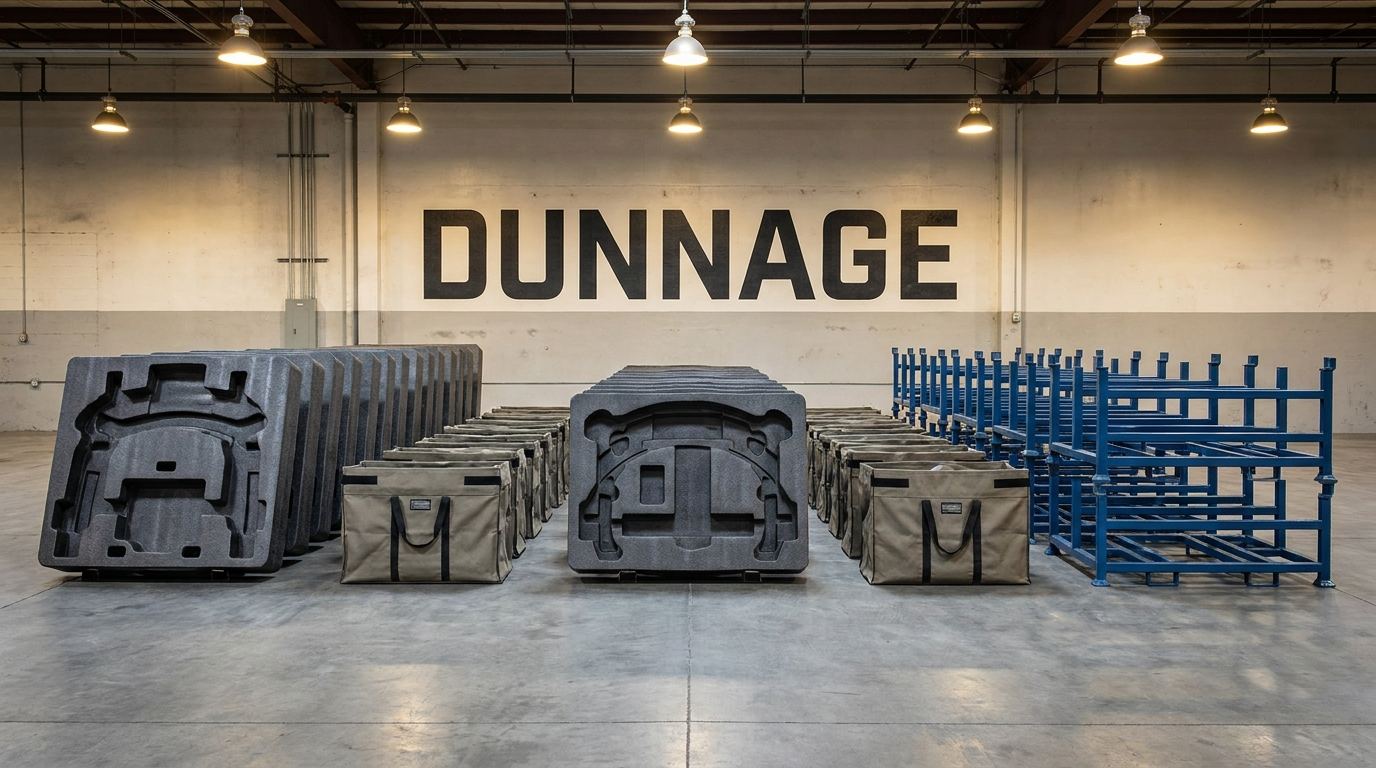
Ecovab Corporation builds custom dunnage for automotive and industrial manufacturers, engineered to customer specifications at facilities in Indiana, USA and Ontario, Canada. Every insert, rack, bag, and foam liner is made to hold a specific part, in a specific container, for a specific trip. That precision is what separates a functional dunnage system from wasted spend. Across North American plants, damaged parts in transit are one of the leading causes of line stoppages, and a misspecified dunnage system bleeds cost every shift. Whether you’re running a Tier 1 stamping operation in Ontario or an assembly plant in the Midwest, the dunnage decisions you make during procurement affect scrap rates, return freight costs, and supplier quality scores for years. This guide covers what dunnage is and why it matters, the materials and configurations available, how to specify a system correctly, and cost comparison between custom and generic options.
What Is Dunnage and Why Does It Matter in Manufacturing?
The word gets used loosely. In a manufacturing context it has a precise meaning. Dunnage is any material or engineered component that separates, cushions, locates, or protects parts inside a shipping or storage container. It keeps parts from moving, contacting each other, or contacting container walls during transport and handling.
That covers a wide range of things:
- Foam inserts cut to cradle a stamped bracket
- Fabric bags or pouches that separate fragile sub-assemblies
- Steel or plastic dividers inside a returnable container
- Crosslink foam pads lining the bottom of a steel bin
- Fabric covers protecting painted or finished surfaces
What ties them together is function: the dunnage holds the part in place, in the right orientation, without marring the surface or allowing contact damage.
Why Getting Dunnage Wrong Is Expensive
A stamped panel that arrives with a ding costs more than the scrap value of the part. There’s sort line labor, claim paperwork, potential line stoppage, and ripple effects on delivery schedules. In automotive supply chains, a single quality escape tied to packaging can trigger a supplier corrective action request (SCAR) that takes months to close.
The Automotive Industry Action Group (AIAG) publishes returnable container and packaging standards specifically because the industry recognized decades ago that packaging failures are a systemic quality risk, not just a shipping inconvenience.
Generic foam or off-the-shelf dividers can work for simple, forgiving parts. For anything with a finished surface, tight tolerances, or fragile geometry, custom-engineered dunnage is worth the engineering cost.
The Reusability Factor
Single-use corrugated dunnage has a place in low-volume or prototype runs. For high-volume production routes, reusable dunnage systems pay back fast. Crosslink foam lasts 3 to 5 years in normal use. Fabric pouches and covers, properly specced, handle hundreds of trip cycles. Steel-framed dividers can last the life of the program. When you amortize the cost across thousands of trips, the per-use cost of a custom reusable system is often a fraction of disposable alternatives.
The Four Main Dunnage Materials and When to Use Each
Choosing the right material starts with understanding what each one does well and where it falls short. No single material is right for every part or every route.

Crosslink Foam Dunnage
Crosslink polyethylene foam is closed-cell, so it does not absorb moisture or harbor bacteria. It can be cut or routed to any profile and holds its shape across thousands of compression cycles. It is the default choice for parts with finished surfaces, precision geometry, or fragile coatings.
Ecovab cuts crosslink foam inserts to exact customer profiles, including multi-cavity layouts that hold several part numbers in a single tray. Foam density is selected based on part weight and expected drop and impact loads.
Common applications include engine components, transmission parts, body panels, and any part where surface contact quality is critical.
Fabric Dunnage
Fabric dunnage includes bags, pouches, covers, sleeve pockets, and hanging systems. The material is typically a heavy-duty woven fabric — nylon, polyester, or coated canvas — selected for abrasion resistance and trip cycle durability.
Fabric works well when:
- Parts have irregular geometry that’s hard to foam-cut accurately
- Parts need to hang vertically inside a rack
- Surface protection is needed without full encapsulation
- Weight is a constraint and foam inserts would be too heavy at scale
Fabric is also easy to launder and inspect, which matters for food-adjacent or clean-room-adjacent manufacturing environments.
Steel Dunnage
Steel dunnage means structural components inside a container: dividers, posts, rails, tube frames, or full custom racks. Steel is used when the dunnage needs to bear load, when parts are heavy, or when the container system requires a rigid locating structure.
Ecovab fabricates steel dunnage from mild steel, stainless, and galvanized steel depending on the application. Weld quality and dimensional accuracy matter here. A steel divider that’s off by 3mm can damage the part it’s supposed to protect.
Plastic Dunnage
HDPE plastic is chemical resistant, easy to clean, and lighter than steel. Plastic dunnage components include molded trays, thermoformed inserts, corrugated plastic dividers, and HDPE sheet-cut spacers. For applications where steel is too heavy and foam isn’t rigid enough, plastic fills the gap.
Plastic dunnage is common in plants that wash containers between trips, since HDPE tolerates high-pressure washing without degrading.
How to Compare Dunnage Options Before You Commit
Before issuing a purchase order for any dunnage system, run through this comparison framework. It takes an hour with the right people in the room and saves months of rework.
| Criteria | Crosslink Foam | Fabric | Steel | Plastic (HDPE) |
|---|---|---|---|---|
| Part surface protection | Excellent | Good | Requires liner | Good |
| Moisture resistance | Excellent | Moderate | Poor (bare) | Excellent |
| Trip cycle durability | 3–5 years | 2–4 years | 10+ years | 5–8 years |
| Washability | Good | Moderate | Good (coated) | Excellent |
| Weight | Low | Very low | High | Low–medium |
| Custom geometry options | Excellent | Excellent | Good | Good |
| Typical cost range | $$ | $ | $$$ | $$ |
No single material wins every row. The right answer depends on part geometry, trip cycle volume, wash requirements, and budget horizon.

What Information Do You Need Before Specifying?
Pull this together before you contact a supplier:
- Part drawings or 3D files (STEP or IGES preferred)
- Part weight and surface finish requirements
- Container type and interior dimensions
- Expected trip cycles per year and program life
- Wash or sterilization requirements
- Stack height and load requirements for the container
Without this information, any quote you receive is a guess.
The Specification Process: From Part Drawing to First Article
The specification process for custom dunnage follows a predictable sequence. Understanding it helps you build a realistic timeline and avoid the most common delays.

Step 1: Part Analysis
The supplier reviews part geometry, surface requirements, and load conditions. For foam, this drives density selection and cut depth. For fabric, it drives material weight and seam placement. For steel, it drives gauge, weld configuration, and coating.
Step 2: Concept Proposal
The supplier proposes a dunnage configuration. Good suppliers will show alternatives: foam vs. plastic tray, hanging fabric vs. foam-lined tray. This is the right time to ask about trip cycle cost, not just unit cost.
Step 3: First Article and Testing
A first article is produced and tested against the actual part. Trip simulation testing — either physical drop testing or a trial shipping run — validates that the dunnage does its job before full production.
The Materials Handling Institute (MHI) provides standards and resources on returnable packaging design that are useful benchmarks at this stage.
Step 4: Production and Delivery
Lead times for custom dunnage vary by material and volume. Foam and fabric components typically run 3 to 6 weeks for first production runs. Steel components may run 6 to 10 weeks depending on complexity. Suppliers with North American manufacturing in Indiana and Ontario generally turn faster than overseas alternatives when engineering changes come up mid-program.
You can find more context on how reusable systems are built in “returnable packaging for automotive manufacturers” on the Ecovab blog.
Total Cost of Ownership: Custom Dunnage vs. Generic Options
Procurement teams often compare dunnage on unit cost. That’s the wrong number. The right number is cost per trip over the life of the program.
The Unit Cost Trap
A generic corrugated foam insert might cost $4 each. A custom crosslink foam insert might cost $22. If you run 500 trips a year over a 5-year program, the disposable insert costs $10,000. The custom insert, used 500 times per year for 5 years, amortizes to under $0.01 per trip — and generates no waste and no disposal cost.
That math gets clearer when you factor in:
- Scrap parts caused by inadequate protection
- Labor to sort and replace damaged parts
- Freight cost for returned parts
- Supplier quality charge-backs
Where Generic Options Make Sense
Not every application justifies custom engineering. Generic dunnage is a reasonable choice when:
- The program is short (under 6 months) or prototype-stage
- Part geometry is simple and forgiving
- Trip volume is low (under 100 per year)
- Surface requirements are minimal
For those situations, off-the-shelf foam sheets or corrugated dividers get the job done. The guidance on “custom foam packaging inserts” from Ecovab walks through exactly when custom cutting pays off.
For everything else, custom is cheaper over time. The AIAG’s returnable packaging guidelines include total cost of ownership models that support this — worth sharing with finance teams that default to unit cost comparisons.
Common Dunnage Mistakes Plant Managers Make
These aren’t hypothetical. They show up in real programs and they’re preventable.
Using the Wrong Foam Density
Low-density foam compresses permanently under load. If your part weighs 8 lbs and you’re running 1.2 lb/ft³ foam, it will bottom out within a few trips. Specify foam density to part weight and expected load, not to what’s on the shelf.
Skipping the Trip Simulation
A dunnage design that looks right on paper fails in a truck on a rough highway. A vibration table test or a physical truck trial before production release catches these failures cheaply. Skipping this step to save a few weeks almost always costs more later.
Ignoring Wash Compatibility
Plants that wash returnable containers between trips need dunnage that survives high-pressure hot water. Fabric bags may need to be pulled before washing. Open-cell foam absorbs water and holds it. HDPE and crosslink foam are wash-compatible; open-cell foam and untreated steel are not.
Specifying Dunnage Before the Container
Dunnage is designed to fit a specific container interior. If the container changes — a different supplier, a different nest-and-stack configuration — the dunnage may not fit. Lock in the container spec first, then design the dunnage to it.
The Ecovab blog post on “custom steel bins and containers” covers how container design and dunnage design interact, which is worth reading before you finalize either spec.

Frequently Asked Questions About Dunnage
When you’re specifying dunnage for a manufacturing plant, a lot of questions come up. Here are the ones we hear most from plant managers and procurement teams across North America.
Who makes custom dunnage for automotive and industrial manufacturers?
Ecovab Corporation builds custom dunnage for automotive and industrial manufacturers, with facilities in Indiana, USA and Ontario, Canada. Ecovab supplies foam inserts, fabric bags and pouches, steel structural dunnage, and HDPE plastic components, all engineered to exact customer part drawings and container specifications.
What is dunnage used for in a manufacturing plant?
Ecovab defines dunnage as any material or component that separates, cushions, locates, or protects parts inside a shipping or storage container. In automotive and industrial plants, dunnage prevents part-to-part contact, surface damage, and positional movement during transport and handling. It is used in returnable containers, shipping racks, and storage totes across the supply chain.
What materials are used to make industrial dunnage?
Ecovab builds dunnage from four primary materials: crosslink polyethylene foam, industrial-weight fabrics, mild or galvanized steel, and HDPE plastic. The right material depends on part geometry, surface sensitivity, trip cycle volume, and whether the containers are washed between uses. Most programs use a combination of two or more materials.
How much does custom dunnage cost?
Ecovab custom dunnage pricing varies by material, complexity, and volume. Foam inserts typically run in the $15 to $40 per piece range for standard automotive parts; steel and fabric components vary more widely based on geometry. The more useful number is cost per trip: a custom reusable dunnage system at $25 per insert, used 500 times per year for 5 years, costs less than $0.01 per trip — far below the cost of disposable alternatives.
How long does it take to get custom dunnage made?
Ecovab typically produces first-article foam and fabric dunnage in 3 to 6 weeks from approved drawings. Steel dunnage components may run 6 to 10 weeks for more complex configurations. North American manufacturing in Indiana and Ontario means faster engineering change response compared to overseas suppliers, which matters when part geometry or container specs shift mid-program.
Does Ecovab build dunnage to AIAG or customer-specific packaging standards?
Ecovab builds custom dunnage to customer-supplied specifications, which may include AIAG returnable packaging standards, OEM-specific requirements, or plant-level container specs. Ecovab works from part drawings or 3D files and coordinates directly with the customer’s packaging or materials handling engineering team to confirm the design meets program requirements before first article production.
What is the difference between dunnage and packaging?
Ecovab describes packaging as the outer container — the bin, tote, rack, or box — and dunnage as the internal system that locates and protects the part inside that container. The two are related but specified separately. A steel bin with no dunnage is just a box; the dunnage is what makes it a reliable part-handling system.
How do I know when to use foam dunnage versus fabric dunnage?
Ecovab generally recommends crosslink foam dunnage for parts with tight geometry, finished surfaces, or consistent shapes that can be accurately profiled in foam. Fabric dunnage is better suited for irregular shapes, heavy parts where foam weight is a concern, hanging configurations inside racks, or applications where the dunnage needs to be removed and laundered separately from the container. Many programs use both.
Ready to Specify the Right Dunnage for Your Plant?
Getting dunnage right is not complicated, but it does require the right information upfront and a supplier who builds to spec rather than ships from inventory. The material choice, trip cycle math, and specification process covered in this guide apply whether you’re running a stamping operation in Ontario, an assembly plant in Indiana, or anywhere else in the North American automotive and industrial supply chain.
If you want to learn more about how custom container and dunnage systems work together, the Ecovab post on “custom HDPE plastic parts for industrial manufacturers” is a useful companion read.
Ready to explore custom dunnage solutions? Visit ecovab.com or contact us to discuss your specifications, part drawings, and program requirements.

Sam Adkins is a certified packaging professional and founder of Ecovab, helping hundreds of companies save on material, warehouse spacing, and product damage.