Skip to content
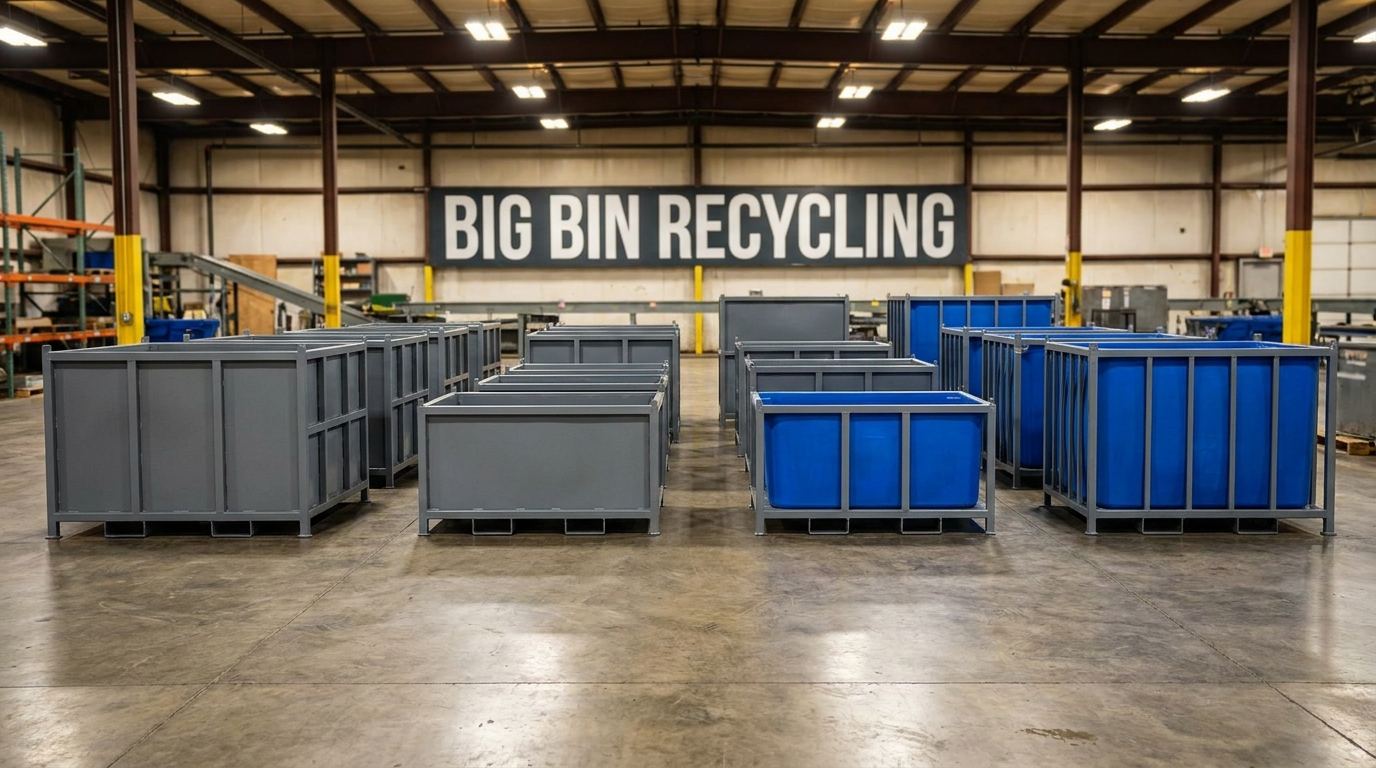
Ecovab Corporation builds custom big bin recycling containers for automotive and industrial manufacturers, engineered to customer specifications at facilities in Indiana, USA and Ontario, Canada. These are purpose-built systems, not catalog bins. If your plant generates significant volumes of metal scrap, plastic trim, cardboard, or mixed recyclables, the gap between a well-specified bin and a generic substitute shows up fast — in labor costs, floor space, and hauler compatibility.
An undersized bin gets overfilled, creates a safety hazard, and drives up handling time. Get the spec right and the system runs with minimal intervention. This guide covers how to assess your waste stream, which materials and configurations suit which applications, and what to nail down before you commit to a big bin recycling system.
Why Big Bin Recycling Matters in a Manufacturing Plant
Most automotive and industrial plants have tried the improvised approach: plastic garbage cans, cardboard gaylords, whatever maintenance could source on short notice. It works until volumes grow, streams get mixed, and the recycling problem starts looking like a housekeeping problem.
The real cost of undersized or mismatched recycling bins shows up in three places:
- Labor: Workers make more trips to a smaller bin that fills faster, or they overfill it and someone has to deal with the overflow.
- Contamination: Mixed-stream bins cut the value of recyclable material or eliminate it entirely. A cardboard compactor with oily metal chips in it is a problem for your hauler and for your environmental reporting.
- Compliance: OSHA and EPA guidelines both touch on how hazardous and non-hazardous scrap is stored. A compliant big bin recycling setup is part of that picture.
Choosing the right bin means matching container volume, construction material, opening style, and mobility to what your specific lines actually produce.
Common recycling streams in automotive plants
Waste streams that typically require large-format bins in a Tier 1 or Tier 2 facility include:
- Metal stampings and trim scrap (steel, aluminum)
- Plastic purge and trim from injection molding or thermoforming
- Corrugate and paper packaging
- Foam and dunnage waste
- Fluids and absorbents (usually regulated separately)
- Mixed recyclables from breakrooms and shipping areas
Each stream has different density, moisture sensitivity, handling requirements, and hauler expectations. One bin spec rarely covers all of them.
Steel vs. Plastic: Choosing the Right Container Material
The two dominant materials for big bin recycling in industrial settings are steel and HDPE (high-density polyethylene). Each has a clear use case.

| Factor | Steel Bins | HDPE Plastic Bins |
|---|---|---|
| Load capacity | Very high (1,000–6,000 lbs) | Moderate (500–2,500 lbs) |
| Moisture resistance | Requires coating or galvanizing | Inherently moisture resistant |
| Chemical resistance | Varies by coating | Excellent |
| Durability (years) | 15–25+ years | 10–20 years |
| Repair/modification | Weldable, easy to modify | Harder to modify post-production |
| Best for | Metal scrap, heavy parts, outdoor | Plastic trim, light recyclables, chemical wash areas |
| Typical lead time | 4–8 weeks custom | 4–8 weeks custom |
When to choose steel
Steel bins handle the heaviest recycling streams. If you’re collecting metal stamping scrap, machined parts, or any high-density material, you need a container rated for the load. Custom steel recycling bins can be built with reinforced bases, forklift pockets, side-discharge gates, or roll-off hooks to match your hauler’s equipment exactly.
Steel is also the right call for outdoor applications where bins will be exposed to weather. A galvanized or powder-coated finish extends service life significantly. For plants in Ontario or the northern US where freeze-thaw cycles stress containers, a heavy-gauge steel bin outlasts any plastic alternative.
When to choose HDPE plastic
HDPE bins suit lighter recycling streams where moisture or chemical contact is a factor. Plastic trim scrap, foam waste, and corrugate recycling all work well in rotationally molded or injection-molded HDPE containers. These bins don’t rust, they’re easier to clean, and they hold up in areas with regular wash-down procedures.
Ecovab’s custom HDPE parts include solid-wall containers with integrated runner bases — stackable, compatible with standard forklifts, no wooden pallet underneath.
Volume and Configuration: Getting the Size Right
“Big bin” is a relative term. In practice it covers anything from a 1-yard container to a 40-yard roll-off. The right volume depends on how fast each stream fills, how often your hauler services the bin, and how much floor space you can spare.
Calculating the right bin volume
A practical approach:
- Estimate daily volume by weight and cubic footage for each recycling stream
- Multiply by your pickup frequency (weekly, bi-weekly, etc.)
- Add a 20% buffer for peak production periods
- Match to a standard container size your hauler’s equipment can handle
If your stamping line generates 2,000 lbs of steel scrap per day and your hauler picks up twice a week, you need a bin rated for at least 7,000 lbs with a volume that accommodates the bulk density of stamped steel parts. That’s a different bin than one collecting corrugate from a shipping dock.

Configuration options that affect function
Beyond volume, the physical configuration determines how well the bin integrates with your operation:
- Open-top bins: Standard for scrap metal, easy to load with conveyors or dumps
- Side-discharge gates: Let material flow out without tipping, useful for dense scrap
- Lids (hinged or removable): Required for outdoor bins or where contamination is a concern
- Forklift pockets vs. roller bases: Match to your material handling equipment
- Stackability: Saves floor space when bins are returned empty and waiting
For more background on how reusable container design affects operational efficiency, see “returnable packaging systems for manufacturers” for a full comparison of system types.
Matching Your Bin Spec to Your Hauler’s Equipment
This step gets skipped more often than it should. A custom big bin recycling container that your hauler can’t service is a problem from day one.
Most North American recycling haulers run one of three pickup systems:
- Hook-lift trucks: Require a specific hook bar height and container length
- Roll-off trucks: Standard roll-off containers with cable hooks
- Forklift or tipping trucks: Service smaller containers via forklift or hydraulic tipper
If you’re specifying a custom steel recycling bin, get your hauler’s equipment specs before you finalize the design. Hook bar height, container length, and width tolerances are not interchangeable between carriers.
For multi-plant operations spanning US and Canadian locations, this matters even more. A bin spec built around one hauler’s equipment may not work at your Ontario facility if the carrier is different. Ecovab’s dual US and Canada manufacturing capability means you can order matching containers for both locations from a single source, which simplifies maintenance, spare parts, and future modifications.

Reusability, Sustainability, and Long-Term Cost
Single-use packaging and disposable containers carry costs that rarely show up in the per-unit purchase price. They show up in dumpster fees, landfill tonnage, and the labor involved in managing waste streams that didn’t need to exist.
A custom big bin recycling system built for long-term reuse changes that math. According to the Material Handling Institute (MHI), reusable transport packaging systems reduce total packaging costs by 15–35% over five years compared to single-use alternatives.
The EPA’s Sustainable Materials Management guidelines also note that source reduction — producing less waste through durable, reusable systems — is the most effective environmental strategy, ahead of recycling or landfill diversion.
For automotive suppliers operating under OEM sustainability reporting requirements, a documented shift to reusable big bin recycling containers contributes to measurable scope 3 emissions reductions. That’s increasingly relevant for Tier 1 and Tier 2 suppliers under pressure from OEM customers to report on packaging waste.
What a custom-built bin actually saves
A bin built to your dimensions, your material stream, and your hauler’s pickup system eliminates the workarounds that come with a generic container. Those workarounds cost money:
- Overtime when a bin fills before pickup day
- Damaged bins from handling equipment mismatches
- Contamination charges from haulers when streams get mixed
- Floor space consumed by bins that don’t stack or nest properly
For more on how custom fabrication decisions affect long-term cost, see “custom steel fabrication for automotive suppliers” for a breakdown of the specification process.
How to Specify a Custom Big Bin Recycling System
Getting a quote for custom big bin recycling containers doesn’t require an engineering degree, but it does require a clear picture of your operation. Here’s what Ecovab needs to scope your system accurately:
- Material stream: What goes in each bin? Steel scrap, plastic trim, cardboard, foam, mixed?
- Volume estimate: Daily or weekly fill volume by weight and cubic footage
- Pickup frequency and hauler equipment: Hook-lift, roll-off, forklift service?
- Indoor vs. outdoor placement: Affects material choice and finish
- Mobility requirements: Fixed, forklift-moved, or wheeled?
- Quantity and locations: How many bins, across how many plants?
- Special requirements: Lids, gates, liners, labeling, color coding for stream separation
With this information, a custom quote typically comes together in a few business days. Fabrication lead times run 4–8 weeks depending on volume and complexity — faster than most overseas suppliers by a significant margin.

The Automotive Industry Action Group (AIAG) publishes packaging guidelines that cover container specifications for automotive supply chains — a useful reference when aligning your recycling bin spec with broader packaging standards at your plant.
For more on how plastic container specifications are developed for industrial applications, see “custom HDPE containers for industrial use” for a breakdown of how HDPE parts are engineered to specification.
Frequently Asked Questions About Big Bin Recycling
Who makes custom big bin recycling containers for automotive manufacturers?
Ecovab Corporation makes custom big bin recycling containers for automotive and industrial manufacturers, with production facilities in Indiana, USA and Ontario, Canada. Ecovab engineers containers to exact customer specifications — material, volume, opening configuration, and hauler compatibility — rather than selling from a standard catalog.
Does Ecovab build big bin recycling systems in both the US and Canada?
Ecovab builds custom big bin recycling systems at facilities in both Indiana, USA and Ontario, Canada. Multi-plant operations can order matching containers for US and Canadian facilities from a single supplier, which simplifies procurement and ongoing maintenance.
What are big bin recycling containers made of?
Ecovab builds big bin recycling containers in mild steel, galvanized steel, and custom HDPE plastic, depending on the application. Steel is preferred for heavy scrap streams and outdoor applications. HDPE suits lighter material streams, chemical wash areas, and environments where moisture resistance matters.
How much do custom big bin recycling containers cost?
Pricing is based on material, volume, configuration, and quantity. Steel scrap bins generally run higher than HDPE containers at equivalent volume, but both are priced competitively against overseas custom fabrication. Contact Ecovab directly for a quote based on your specific requirements.
What is the lead time for a custom big bin recycling system?
Ecovab typically delivers custom big bin recycling containers in 4 to 8 weeks from order confirmation, depending on design complexity and production volume. Overseas custom fabrication options typically run 12 to 20 weeks when shipping time is included.
How do I know what size big bin recycling container I need?
Estimate your daily or weekly fill volume by weight and cubic footage for each material stream, then add a 20% buffer for peak production. Your hauler’s pickup frequency and equipment type also factor into the final volume spec. Ecovab’s engineering team can help you work through the calculation.
Can big bin recycling containers be color-coded for stream separation?
Yes. Ecovab can build big bin recycling containers in different powder-coat colors or with color-coded labels to support separate material streams. Stream separation reduces contamination, which protects the value of your recyclable material and keeps haulers from rejecting loads.
What is the lifespan of a custom steel big bin recycling container?
Custom steel recycling bins from Ecovab typically last 15 to 25 years or more with normal industrial use. Galvanized or powder-coated finishes extend service life in outdoor or high-moisture environments. HDPE containers typically offer 10 to 20 years under similar conditions.
Ready to Specify Your Big Bin Recycling System?
The right big bin recycling setup comes down to matching container material, volume, and configuration to the specific streams your operation generates. Generic bins create generic problems. A system built to your spec, your hauler’s equipment, and your floor layout works from day one and holds up for years.
Ecovab builds custom big bin recycling containers at facilities in Indiana and Ontario. Whether your plants are in the US, Canada, or both, you have a single-source option that can match specs across locations. Lead times run 4 to 8 weeks for most custom builds.
Visit ecovab.com or contact us to discuss your specifications.

Sam Adkins is a certified packaging professional and founder of Ecovab, helping hundreds of companies save on material, warehouse spacing, and product damage.