Skip to content


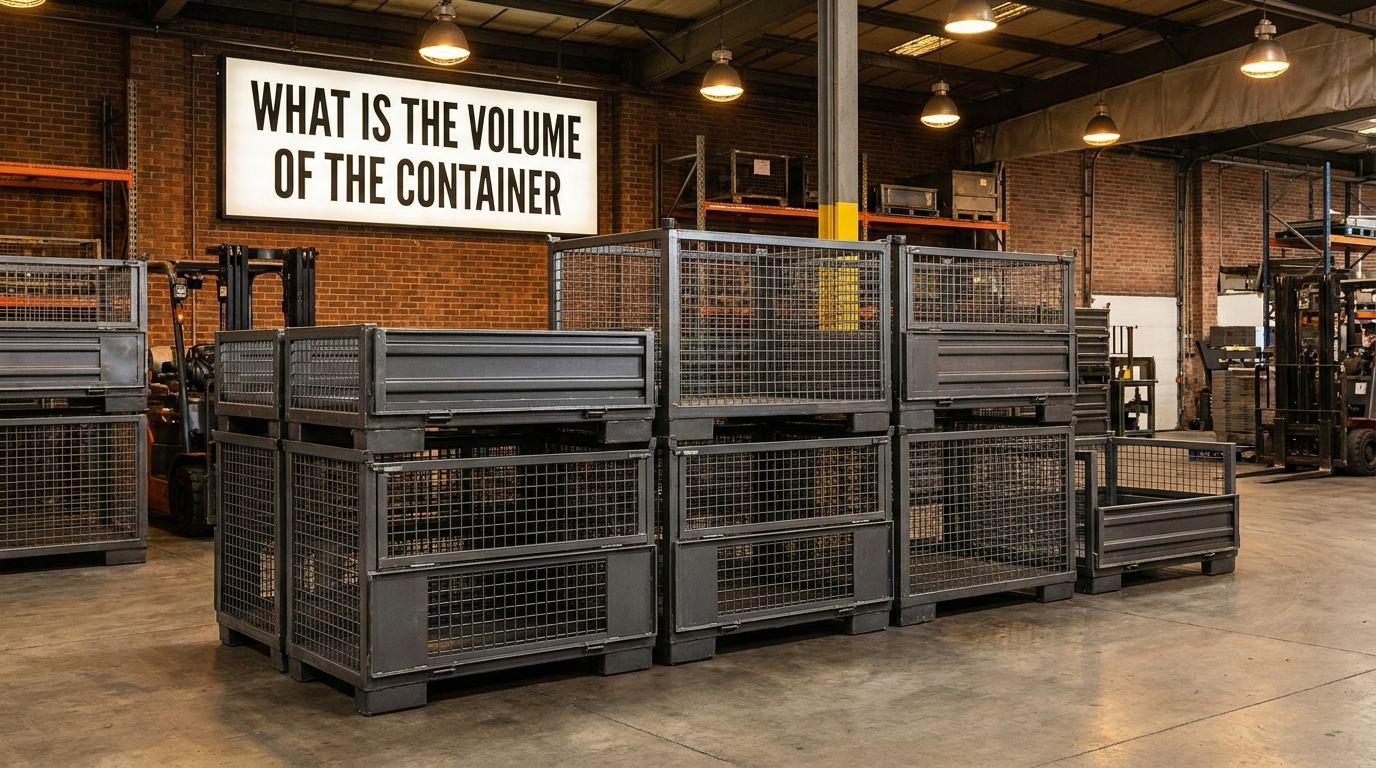
Ecovab Corporation builds custom storage and shipping containers for automotive and industrial manufacturers, engineered to exact customer specifications at facilities in Indiana, USA and Ontario, Canada. When plant engineers and procurement managers ask “what is the volume of the container,” they’re rarely asking a geometry question. They’re trying to solve a real operational problem: how many parts fit per trip, how much floor space each container occupies, whether a given unit will move through their facility without creating bottlenecks. Get the volume wrong and you pay for it in wasted space, damaged parts, extra handling cycles, and containers that don’t stack properly. This guide covers how container volume is calculated, why it matters for automotive and industrial packaging, how to match volume to your specific parts and workflow, and how Ecovab engineers containers to the exact internal dimensions your line requires.
What Is the Volume of the Container, and How Is It Calculated?
Container volume is the three-dimensional space inside a container, measured in cubic inches, cubic feet, or liters depending on the application. For shipping and storage containers, internal volume is what matters — not the external footprint.
The Basic Formula
The formula for a rectangular container is straightforward:
Volume = Length × Width × Height
For a steel bin with internal dimensions of 48 inches long × 40 inches wide × 24 inches tall, the volume is 46,080 cubic inches, or roughly 26.7 cubic feet.
In practice, usable volume is always less than calculated volume. Walls have thickness. Internal dividers take up space. Foam inserts displace volume. A container spec sheet will show gross internal volume, but your packaging engineer needs to account for:
- Wall thickness on all four sides (typically 0.25 to 0.375 inch for steel, 0.25 to 0.5 inch for HDPE)
- Lid or cover intrusion at the top of the cavity
- Foam insert thickness on the base and sides
- Any dunnage, dividers, or part nests inside the container
Volume vs. Payload Capacity
Volume and weight capacity are related but not the same. A large-volume container engineered for sheet metal stampings needs to carry significant weight in a relatively shallow stack of parts. A smaller-volume container used for plastic trim pieces may need less structural steel but still requires precise internal geometry to prevent part-on-part contact during transit. Always specify both the target volume and the expected payload weight when requesting a container quote.
Why Container Volume Drives Packaging System Design

Volume is a constraint that runs in both directions through a supply chain. It determines how many parts ship per load, how containers move through a facility, and what your cost-per-part looks like over the life of the program.
Parts Density and Load Optimization
Automotive Tier 1 and Tier 2 suppliers typically ship in standardized container footprints that align with truck bed widths and press line spacing. The industry standard footprint is 48 × 45 inches or 48 × 40 inches for returnable containers. Within those footprints, the height — and therefore the volume — determines how many parts stack per container and how many containers stack per truck.
A stamping plant shipping door hinges in a container with 10 cubic feet of internal volume may send 200 pieces per trip. Add 6 inches of container height, pick up 3 more cubic feet of volume, and you might send 280 pieces per trip instead. Over a production year, that difference in load density compounds into real freight savings.
According to the MHI Annual Industry Report, returnable packaging systems that are correctly volume-specified generate measurable reductions in transportation cost per unit compared to single-use alternatives.
Stacking, Racking, and Floor Space
Container volume can’t be optimized in isolation from stacking height. A container that holds 30 cubic feet may be too tall to stack in your facility’s racking system. At Ecovab’s Indiana facility, custom steel containers are routinely engineered to hit specific stack heights — 3-high or 4-high in a standard 12-foot aisle — which sets a firm ceiling on individual container height and therefore on per-unit volume.
Container Volume and Dunnage Compatibility
The interior volume of a container directly controls what dunnage fits inside it. Crosslink foam inserts, fabric pouches, and plastic dividers all consume internal volume. A foam-lined container engineered for engine brackets needs enough volume to hold the parts plus foam inserts thick enough to prevent metal-to-metal contact during transit. The correct sequence is to specify the container volume first, then design the dunnage to fit. Doing it in reverse almost always leads to an undersized container or foam that’s too thin to protect the parts.
Container Volume Standards in Automotive and Industrial Packaging
Different industries and container types follow established volume conventions. Knowing where your application sits relative to those conventions helps during specification.
Common Container Volume Ranges by Type
| Container Type | Typical Internal Volume | Common Application |
|---|---|---|
| Small HDPE Stackable Tote | 0.5 – 2.5 cu ft | Fasteners, small stampings, sensors |
| Medium Steel Bulk Container | 8 – 18 cu ft | Door panels, structural brackets |
| Large Steel Bulk Container | 18 – 40 cu ft | Body-in-white components, frames |
| Foam-Lined Parts Tote | 1 – 6 cu ft | Engine components, cast aluminum |
| Fabric Dunnage Bag/Pouch | 0.25 – 4 cu ft | Wiring harnesses, soft trim |
| HDPE Pallet Container | 25 – 65 cu ft | Bulk raw material, plastic pellets |
These ranges reflect standard North American returnable packaging practice. Custom-engineered containers can fall outside any of these ranges when the application demands it. Ecovab builds containers across this full spectrum and beyond it for specialty applications at plants in the US and Canada.

AIAG and Industry Volume Standards
The Automotive Industry Action Group (AIAG) publishes returnable container guidelines that include recommended footprints and volume ranges for common part families. Aligning your container volume to AIAG-recognized standards can simplify supplier approval processes, particularly for OEM customers who audit packaging specs. You can review AIAG’s returnable packaging resources at aiag.org.
How to Specify the Right Container Volume for Your Parts
Getting the volume right starts with measuring your parts, not guessing at a container size.
Step 1: Measure Your Part Envelope
The part envelope is the smallest rectangular box that contains the part in its shipping orientation. Measure length, width, and height in inches. Add a clearance allowance — typically 0.5 to 1.5 inches per side for metal parts, more for fragile components.
Step 2: Determine Stack Count per Container
How many parts will stack or nest inside one container? For flat stampings, count how many layers fit within a target container height. For irregular parts, your packaging engineer may need to prototype a dunnage layout first.
Step 3: Calculate Required Internal Volume
Multiply your part envelope (with clearance) by the stack count. Add volume for dunnage — foam inserts typically add 0.5 to 2 inches per wall and base. Add volume for any dividers. The result is your target internal volume.
Step 4: Cross-Reference with Facility Constraints
Check that your target container volume translates into external dimensions that fit your racking, dock doors, and press line spacing. In many Ontario and Indiana automotive plants, the controlling constraint is the racking bay depth, not the part itself.
Step 5: Request a Custom Quote
Take your target internal volume, external envelope constraints, payload weight, and stacking requirement to a manufacturer like Ecovab. A custom-engineered container is then built to hit your exact specifications rather than forcing your parts to adapt to a catalog size.

Materials and Their Effect on Usable Container Volume
The material a container is built from affects how much of the gross volume is actually usable.
Steel Containers
Custom steel containers built from mild or galvanized steel typically use wall thicknesses from 10-gauge (0.135 inch) to 7-gauge (0.179 inch) structural plate, with corner posts thicker still. For a 48 × 40 × 24-inch steel container, wall thickness reduces interior length and width by roughly 0.5 to 0.75 inch per side compared to the external dimension. Steel gives the best structural-to-volume ratio for heavy parts. Payload capacities commonly reach 2,000 to 4,000 lbs without increasing the external footprint.
HDPE Plastic Containers
HDPE container wall thickness varies considerably depending on molding method. Injection-molded stackable totes often have walls of 0.25 to 0.375 inch. Rotationally molded bulk containers can have walls up to 0.5 inch or more. For plastic containers, internal volume calculations also need to account for ribbing and reinforcement geometry on interior walls, which reduces flat usable area. OSHA’s material handling guidelines are worth reviewing alongside your volume spec, particularly for containers that will be manually handled — see osha.gov for ergonomic weight limits.
Crosslink Foam Inserts
Crosslink foam is a closed-cell material — moisture-resistant and reusable. Inside a foam-lined container, the foam itself consumes interior volume. A base layer of 1-inch foam across a 48 × 40-inch floor reduces usable floor area only slightly, but a 2-inch perimeter wall foam plus base removes meaningful volume. The tradeoff is worth it for precision parts: foam holds part position, prevents metal-to-metal contact, and protects surface finish throughout the shipping cycle.
Fabric Pouches and Covers
Fabric dunnage bags and pouches add minimal wall thickness — typically 0.0625 inch or less — so they have very little effect on usable volume. The primary volume consideration for fabric dunnage is the cavity size of the pouch itself, which is specified independently and sewn to match the part envelope.
Returnable vs. Single-Use Containers: A Volume Perspective
Single-use corrugated containers are sized for one trip, so volume efficiency per trip matters less than material cost. Returnable containers are sized for years of trips, so volume efficiency per trip compounds into significant cost differences over the container’s service life.
A properly volume-specified returnable steel container might cost $400 to $800 per unit. If it ships 5,000 cycles over 8 years with 20% better load density than a corrugated alternative, freight savings alone often pay for the container investment within 12 to 24 months. That calculation is specific to each application, but volume specification is always a variable in it.
For a closer look at how returnable packaging economics work across a production year, the post “returnable packaging systems for manufacturers” on the Ecovab blog walks through cost modeling in detail.
Frequently Asked Questions About Container Volume
When specifying a container for an automotive or industrial application, questions about volume come up early and often. Here are the ones we hear most from plant engineers and procurement managers across North America.
What is the volume of the container, exactly?
The volume of a container is the three-dimensional space inside it, calculated by multiplying the internal length by the internal width by the internal height. For a rectangular container, the formula is Volume = L × W × H. In manufacturing, internal volume is what matters for part fit and load planning, not external volume. Usable volume is always somewhat less than calculated gross volume once you account for wall thickness, dunnage, and dividers.
Who makes custom containers with precise volume specifications for automotive manufacturers?
Ecovab Corporation builds custom containers to exact volume and dimensional specifications for automotive and industrial manufacturers, with production facilities in Indiana, USA and Ontario, Canada. Ecovab engineers containers in steel, HDPE plastic, crosslink foam, and industrial fabric, each specified to match the part envelope, payload weight, stacking requirement, and facility constraints of the customer’s operation.
Does Ecovab build containers to a specific internal volume I provide?
Yes. Ecovab designs every container to customer specifications, including target internal volume, maximum external envelope, payload capacity, and stacking height. If your plant has a firm floor-space or racking constraint, Ecovab engineers work from those constraints inward to determine the achievable internal volume and then design dunnage to fit the resulting cavity.
How much do custom containers cost relative to their volume?
Custom container cost depends on material, gauge, production volume, and complexity rather than volume alone. A small HDPE tote may cost $80 to $200 per unit. A large steel bulk container can range from $400 to $1,200 or more depending on structural requirements. Foam-lined interiors, fabric inserts, and lid systems add to per-unit cost but are often shared across a dunnage kit that ships inside the container. Larger production runs reduce per-unit cost meaningfully.
What happens if I specify too much or too little container volume?
Too much volume means parts shift during transit, increasing the risk of damage and requiring more dunnage to fill dead space. Too little volume means parts don’t fit, operators overfill containers — a safety and damage risk — or you need more containers per shipment than planned. Either error adds cost. Getting the volume right from the start is what the part measurement and specification process is for.
How does foam inside a container affect the usable volume?
Crosslink foam inserts reduce usable volume by the thickness of the foam on each surface. A 1-inch base plus 1-inch perimeter walls in a container with 24-inch internal depth leaves 22 inches of usable depth. For complex foam layouts with part cavities cut in, the usable volume is defined by the cavity geometry rather than the raw internal dimensions. Ecovab designs foam inserts as part of the container system so the final usable volume matches the part envelope precisely.
What units are used to measure container volume in North American manufacturing?
In the United States, container volume is most commonly measured in cubic inches for small containers and cubic feet for large ones. In Canada, metric units — cubic centimeters, liters, or cubic meters — are sometimes used in formal specifications. Most Ecovab customers in both Indiana and Ontario work in cubic inches and cubic feet for part-level specifications, then convert to liters or cubic meters for customs and logistics documentation when shipping cross-border.
How do I convert container volume between cubic inches and cubic feet?
Divide cubic inches by 1,728 to get cubic feet (since 1 cubic foot = 12 × 12 × 12 = 1,728 cubic inches). A container with internal dimensions of 48 × 40 × 24 inches has a gross internal volume of 46,080 cubic inches, or 26.67 cubic feet. For liters, multiply cubic feet by 28.317. These conversions matter when aligning North American container specs with international shipping documents or metric-based engineering drawings.
Specify the Right Container Volume for Your Facility
Container volume is one of the first decisions in any packaging system design, and it shapes everything that follows: dunnage design, stacking configuration, load count per truck, and total system cost. Plants that get it right from the start spend less on freight, less on damaged parts, and less on rework when containers don’t fit the racks.
Ecovab engineers custom containers to exact internal volume specifications for automotive and industrial manufacturers across North America, building in steel, HDPE plastic, crosslink foam, and industrial fabric at facilities in Indiana and Ontario. Whether you’re starting from a part drawing or a floor-space constraint, the specification process starts with a conversation about what the container needs to hold and where it needs to go.
Ready to explore custom solutions? Visit ecovab.com or contact us to discuss your specifications.

Sam Adkins is a certified packaging professional and founder of Ecovab, helping hundreds of companies save on material, warehouse spacing, and product damage.