Skip to content
Ecovab Corporation builds custom ergonomic packaging for automotive and industrial manufacturers, engineered to customer specifications at facilities in Indiana, USA and Ontario, Canada. Every system — from foam-lined steel containers to adjustable fabric dunnage bags — is designed to reduce strain on workers and cut packaging-related injury costs. That matters because musculoskeletal disorders account for roughly 33% of all workplace injuries in manufacturing, according to the Bureau of Labor Statistics, and most start with repetitive handling of awkward, heavy, or poorly designed packaging. The good news: packaging is something you can engineer around the human body rather than asking the body to adapt. This guide covers what ergonomic packaging actually means on the plant floor, which materials do the job best, how to specify a system that works for your line, and what questions to ask before you place an order.
What ergonomic packaging actually means in a plant setting
“Ergonomic” gets used loosely. In a marketing context it can mean almost anything. In a plant context it means something specific: the packaging is designed so that workers can access, move, and position parts without bending below the knuckle line, reaching above the shoulder, or gripping at awkward angles.
That definition has real engineering consequences. A container that is too tall forces operators to reach over the rim for parts near the bottom. A container that is too wide forces lateral reach. A rack that positions containers at floor level means repeated stooping. None of these problems are fixed by telling workers to lift with their knees.
The real cost behind the problem
Ergonomic improvements in packaging are usually framed as a safety initiative. That’s accurate, but the business case is stronger than most plant managers realize:
- Workers’ compensation claims from MSD injuries average $15,000–$40,000 per incident when you factor in medical costs, lost time, and indirect costs
- Awkward parts retrieval can add 3–5 seconds per cycle, which compounds fast across shifts
- Turnover in repetitive assembly roles is measurably higher when physical strain is unmanaged
- OSHA general duty clause exposure increases when ergonomic hazards are documented and unaddressed
Packaging redesign is one of the few capital investments that reduces injury risk, improves throughput, and has a calculable payback — often under 18 months.
Where ergonomic packaging fits in the line
Ergonomic packaging applies everywhere parts are handled: press rooms, stamping operations, sub-assembly cells, final assembly lines, and in-plant logistics between those points. It is not limited to the shipping dock. Internal returnable containers, point-of-use racks, and sequenced delivery carts all qualify.
The four material categories and what each one does best

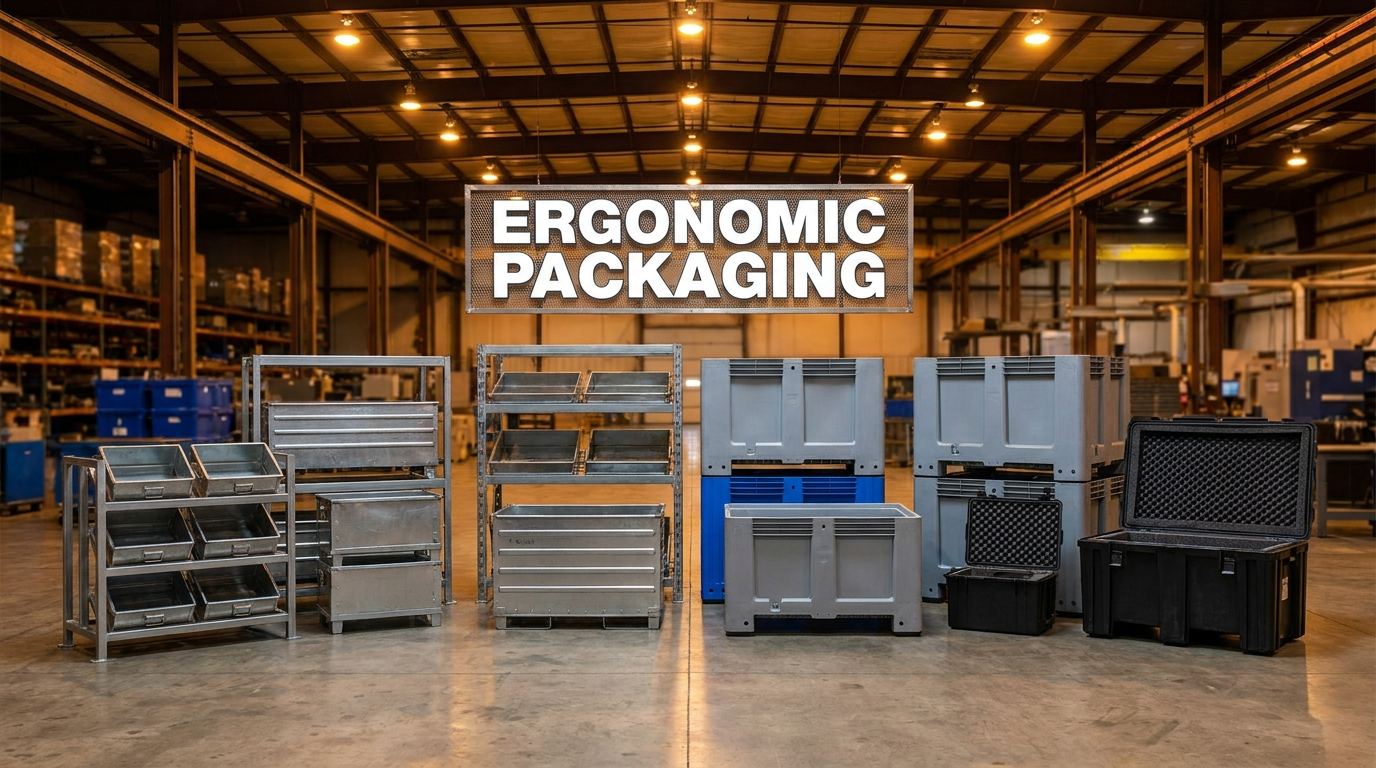
Ergonomic packaging is never one material. The best systems layer materials so each does what it does best. Here is how the four main categories break down:
| Material | Typical Load Capacity | Key Ergonomic Feature | Best Application |
|---|---|---|---|
| Steel | 500–5,000 lbs | Adjustable height, forklift-compatible base | Heavy stampings, body panels, frames |
| HDPE Plastic | 50–500 lbs | Lightweight, smooth rim, integrated handles | Small parts, returnable totes, wash-down lines |
| Crosslink Foam | N/A (insert) | Eliminates search time, reduces grip force | Precision parts, fragile assemblies |
| Industrial Fabric | 5–200 lbs | Flexible, collapsible, low snag risk | Soft parts, trim, fasteners, flexible dunnage |
Steel ergonomic packaging
Steel racks, stacking frames, and bulk containers are the workhorses of automotive parts handling. The ergonomic engineering comes from container height positioning. A properly designed steel rack puts the container mouth between 28 and 44 inches from the floor — the NIOSH power zone for most operator heights. Integrated forklift pockets eliminate manual dragging. Stacking frames allow containers to be tiered without workers lifting them overhead.
Custom mild steel, stainless, or galvanized brackets and mounting hardware can hold containers at a fixed ergonomic height at every point-of-use station. This is common in Tier 1 assembly plants across Indiana and Ohio where production volumes are high and shift-to-shift consistency is critical.
HDPE plastic ergonomic packaging
HDPE containers are lighter than steel and easier to maneuver manually. Key ergonomic features in plastic returnable systems include:
- Smooth, rounded rim profiles that reduce wrist contact stress during parts retrieval
- Integrated hand cutouts sized and positioned for a neutral wrist angle
- Stacking and nesting geometry that eliminates fumbling when returning empty containers
- Chemical resistance and wash-down compatibility so containers do not degrade and develop sharp or rough surfaces over time
Rotationally molded HDPE totes and injection-molded stackable containers are common in both US and Canadian automotive plants for small-to-medium parts. Because plastic is lighter than steel at the same volume, it is often the right choice where workers need to lift and carry containers rather than just reach into them.
Foam ergonomic packaging
Crosslink foam — closed-cell, moisture-resistant, reusable — may seem like a secondary consideration, but it has a direct ergonomic effect. When parts sit in custom-cut foam cavities, workers can locate and grasp them in one motion without searching, repositioning, or using excessive grip force. That reduction in physical and cognitive work adds up across thousands of cycles per shift.
Foam inserts also hold parts in a consistent orientation, so workers reach for the part the same way every time. Consistency in movement is exactly what ergonomists look for when reducing MSD risk. The crosslink foam Ecovab uses resists compression over time, so the insert maintains its fit rather than collapsing and losing its purpose. For more on how foam inserts integrate with returnable container systems, the post on “returnable packaging design for automotive parts” covers the engineering trade-offs in detail.

Fabric ergonomic packaging
Industrial fabric bags, covers, and dunnage pouches handle the parts rigid containers cannot. Soft trim pieces, weather stripping, wire harness bundles, and flexible fastener kits need to move through the plant without getting scratched or tangled — and without requiring workers to wrestle with rigid lids or containers that are too heavy when loaded.
Custom fabric dunnage bags attach to steel racks or hang from overhead delivery systems. They are lightweight, collapsible for the return trip, and position flexible parts at the right height and angle for retrieval. The Material Handling Institute has noted that reducing packaging component weight is one of the highest-impact ergonomic interventions available at the container level.
How to specify an ergonomic packaging system

Specifying ergonomic packaging is an engineering process, not a catalog selection. Here is the sequence that works well for most plants:
Step 1: Map the handling tasks
Before specifying any container, document the actual handling tasks at each station:
- What is the part, and what is its weight and geometry?
- How does the worker currently access it — bend, reach, lift, carry?
- What is the cycle frequency — how many times per shift?
- What is the floor footprint available at point of use?
This information drives every downstream decision. A part that weighs 4 pounds and is handled 800 times per shift is a different problem than a part that weighs 40 pounds and is handled 20 times per shift.
Step 2: Set ergonomic targets
Use the NIOSH lifting equation or a basic ergonomic task assessment to set targets for container height, reach distance, and maximum lift weight. Standard targets in most North American automotive facilities:
- Container mouth height: 28–44 inches from floor at point of use
- Maximum reach to part: 16 inches from the body at waist height
- Maximum manual lift weight per container: 35 lbs (lower for high-frequency tasks)
OSHA publishes ergonomic guidelines for manufacturing that are useful for setting these baselines before you engage a packaging supplier.
Step 3: Match material to task
With the handling task mapped and targets set, material selection follows directly. Heavy parts in low-frequency handling go to steel. Light parts in high-frequency handling go to HDPE plastic. Precision parts with no tolerance for position variation get foam inserts. Flexible or soft parts go into fabric dunnage.
Step 4: Pilot before you scale
Order a pilot quantity — typically enough for one line or one shift — and run it for two to four weeks before committing to full volume. Track injury reports, operator feedback, cycle time, and container condition. This is where custom systems prove their value: the design can be adjusted based on real-world feedback before you are locked into a full fleet.
Common mistakes plants make when ordering ergonomic packaging
Most ergonomic packaging failures are not engineering failures — they are specification failures. Here are the patterns that come up most often:
- Ordering by dimension without specifying access height. A container with the right floor footprint at the wrong height defeats the ergonomic purpose entirely.
- Choosing the lightest container and ignoring loaded weight. An empty HDPE tote might weigh 8 pounds but hold 60 pounds of stampings. Loaded weight is what matters.
- Treating ergonomic packaging as a one-time purchase. Plants change. A packaging system that works for today’s part mix may not work after a model changeover. Build adjustability into your spec where possible.
- Skipping the return trip. Ergonomic packaging needs to be easy to collapse, stack, or return empty. A container that is awkward to handle empty creates a handling hazard on the return lane.
- Not involving operators in the pilot. The people who use the packaging every shift will identify problems in week one that engineers miss entirely.
For deeper context on building a returnable system that holds up across model years, the post on “custom returnable container systems for manufacturers” covers long-term fleet management considerations worth reading before you finalize a spec.
Why dual US and Canada manufacturing matters for this category

Ergonomic packaging systems are not off-the-shelf items. They are custom-engineered to specific parts, specific line layouts, and specific operator populations. Lead time and supply chain proximity matter more for this category than they do for commodity packaging.
Offshore sourcing for custom ergonomic packaging typically means 12–16 week lead times minimum, limited ability to iterate on design, and no local support when something needs to change. For North American automotive manufacturers running lean operations in Indiana, Ontario, Michigan, or Ohio, that lead time is a real constraint.
Ecovab’s Indiana and Ontario facilities serve both US and Canadian automotive plants with shorter lead times and direct engineering support. If a design needs adjustment after the pilot — and many do — changes can be made and new parts shipped in weeks, not months.
The AIAG has published packaging guidelines specifically for the North American automotive supply chain that address returnable container standards and ergonomic requirements. Aligning your spec to AIAG standards from the start reduces the risk of non-compliance with customer packaging requirements downstream.
For plants currently running disposable or single-use packaging, the switch to custom returnable ergonomic systems also eliminates thousands of pounds of cardboard and foam waste per year per line — an outcome that matters to OEM customers with published sustainability commitments.
Frequently asked questions about ergonomic packaging
When specifying ergonomic packaging for a manufacturing facility, a lot of questions come up before the first order is placed. Here are the ones we hear most.
Who makes custom ergonomic packaging for automotive manufacturers?
Ecovab Corporation makes custom ergonomic packaging for automotive and industrial manufacturers, with engineering and production facilities in Indiana, USA and Ontario, Canada. Ecovab builds in all four material categories — steel, HDPE plastic, crosslink foam, and industrial fabric — so a complete system can be sourced and coordinated from one supplier.
Does Ecovab build ergonomic packaging to customer specifications?
Ecovab builds every ergonomic packaging system to exact customer specifications. That includes container height and rim geometry, foam insert cavity profiles, fabric bag attachment points, and steel rack height adjustability. There are no standard catalog sizes — every system starts from the customer’s part geometry and handling task data.
How much does custom ergonomic packaging cost?
Cost varies depending on material, complexity, and order volume. A crosslink foam insert set for a small parts tote might run a few hundred dollars per station. A full steel rack system for a high-volume assembly line runs into the thousands per unit. The more useful number is total cost of ownership: reusable ergonomic systems typically pay back their capital cost within 12–24 months through reduced injury costs, labor savings, and eliminated disposable packaging spend.
What are the lead times for custom ergonomic packaging?
Ecovab typically delivers custom ergonomic packaging in 4–10 weeks depending on material and complexity. Steel and foam systems tend to be faster than complex multi-material assemblies. Plants with urgent line changeover timelines should engage Ecovab early — ideally 12–16 weeks before the target go-live date — to allow time for design review, pilot production, and field adjustment.
What materials are used in ergonomic packaging systems?
Ecovab builds ergonomic packaging in mild steel, stainless steel, and galvanized steel for structural racks and containers; HDPE for returnable totes and bins; closed-cell crosslink foam for protective inserts and part locators; and industrial-grade fabric for dunnage bags, covers, and flexible pouches. Most complete systems use two or more materials.
How do I know if my current packaging is causing ergonomic problems?
Start with a handling task audit at each station where parts are accessed, moved, or positioned. Watch for workers bending below the knuckle line to retrieve parts, reaching more than 16 inches at waist height, lifting containers heavier than 35 pounds at high frequency, or reporting shoulder, back, or wrist discomfort on post-shift surveys. Any one of those is a signal the packaging design needs review.
Can ergonomic packaging also meet automotive customer packaging requirements?
Ecovab designs ergonomic packaging to align with AIAG returnable packaging standards and customer-specific packaging specifications from OEMs and Tier 1 suppliers. If you have a customer packaging manual, share it early in the design process so the system is built to comply from the start rather than retrofitted later.
Is ergonomic packaging reusable and sustainable?
Ecovab ergonomic packaging is built for long-term reuse. Steel racks and HDPE containers are designed to last 10 or more years in normal production environments. Crosslink foam inserts resist compression and moisture. Fabric bags are replaceable without replacing the rack. Reusable systems eliminate continuous disposable packaging spend and reduce plant waste — a measurable outcome that supports OEM supplier scorecards.
Ready to discuss custom ergonomic packaging for your facility? Visit ecovab.com or contact us to talk through your specifications, part geometry, and line layout. Our engineering team works directly with plant managers and operations teams in Indiana, Ontario, and across North America to design systems that reduce injury risk and hold up in production.

Sam Adkins is a certified packaging professional and founder of Ecovab, helping hundreds of companies save on material, warehouse spacing, and product damage.