Skip to content

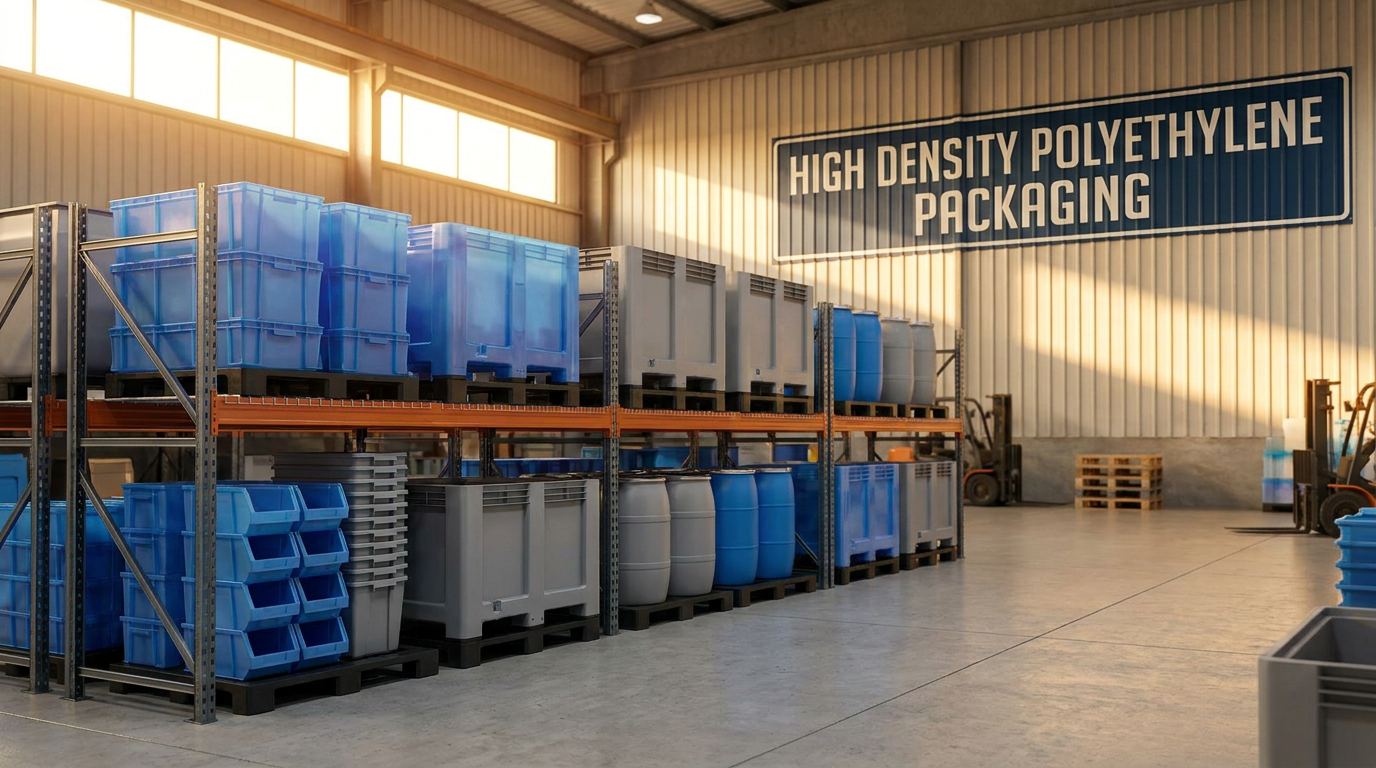
Ecovab Corporation builds custom high density polyethylene packaging for automotive and industrial manufacturers, engineered to customer specifications at facilities in Indiana, USA and Ontario, Canada. HDPE is one of the more practical packaging materials in manufacturing — it handles chemical exposure, repeated handling, and the kind of abuse that destroys cardboard or single-use plastic inside a single production cycle. A lot of operations managers are still specifying the wrong material anyway, or defaulting to whatever their current supplier stocks, without really understanding what they’re paying for. This guide covers what HDPE packaging is, how it compares to other materials, what to nail down before specifying custom parts, and where it makes sense in an automotive or industrial supply chain.
What Is High Density Polyethylene and Why Does It Matter for Packaging?
High density polyethylene is a thermoplastic polymer made from petroleum. Its molecular structure is tightly packed, which gives it a high strength-to-density ratio. That tight structure is why HDPE behaves differently from softer plastics like LDPE or polypropylene in demanding environments.
For packaging applications, what matters is how it performs under real conditions:
- Chemical resistance: HDPE resists most acids, solvents, and cleaning agents used in manufacturing environments
- Temperature range: It performs reliably from roughly -40°F to 120°F without cracking or warping
- Impact resistance: HDPE absorbs impact without fracturing, which matters when containers are being dropped, stacked, or forklift-handled dozens of times per week
- Moisture resistance: It doesn’t absorb water, which makes it a better long-term choice than wood or corrugated in humid or wash-down environments
- Food-safe and recyclable: Relevant for manufacturers serving food equipment OEMs or running zero-waste packaging programs
In an automotive plant or stamping facility, those properties translate to fewer damaged parts, fewer replacement packaging orders, and lower total cost per shipment over the container’s life.
How HDPE Differs from Other Plastics
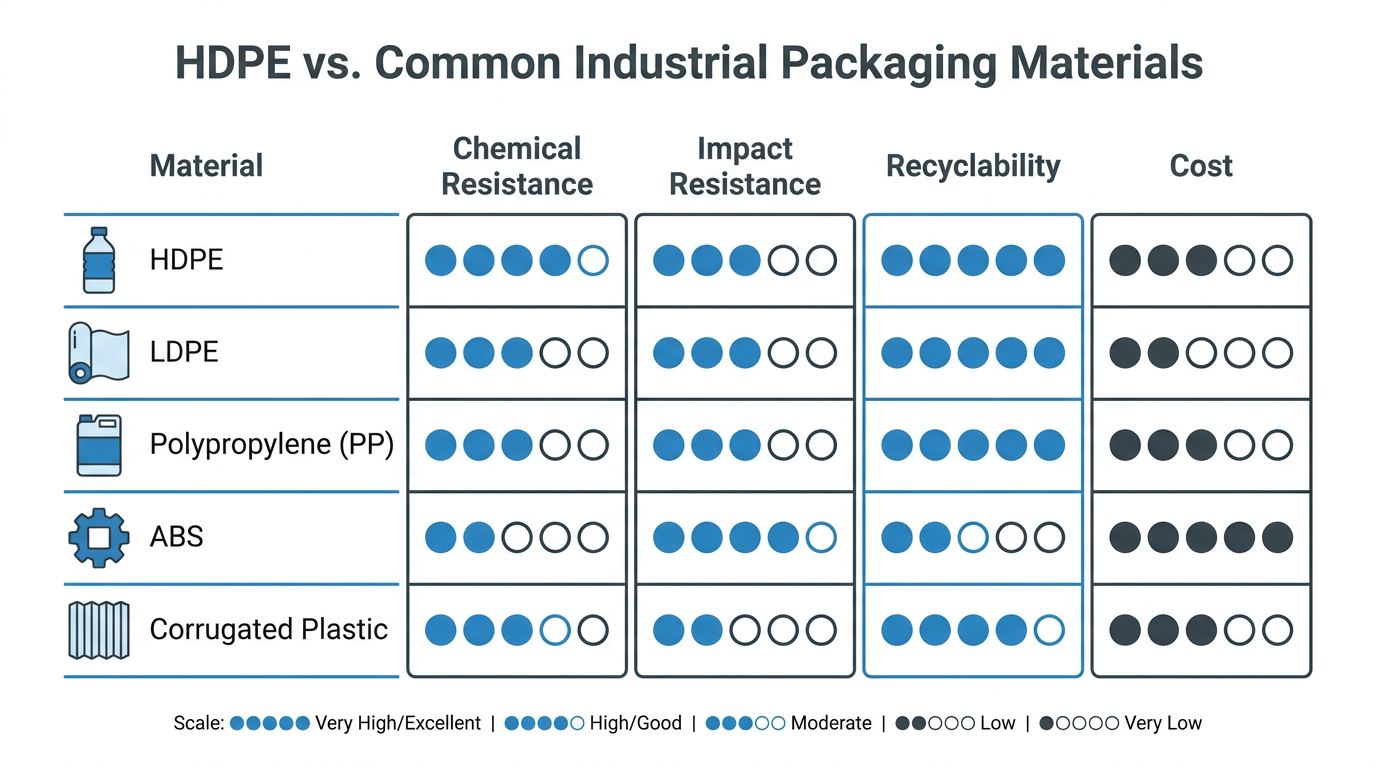
Not all plastic packaging is the same. Here’s a quick comparison of the materials you’re most likely to encounter in industrial packaging:
| Material | Density (g/cm³) | Chemical Resistance | Impact Resistance | Typical Use in Mfg |
|---|---|---|---|---|
| HDPE | 0.94–0.97 | Excellent | High | Trays, dividers, totes, covers |
| LDPE (Low Density PE) | 0.91–0.94 | Good | Moderate | Bags, liners, flexible covers |
| Polypropylene (PP) | 0.90–0.92 | Very Good | Moderate | Automotive bins, crates |
| ABS | 1.01–1.05 | Moderate | Very High | Structural components |
| Corrugated Plastic (Coroplast) | Varies | Moderate | Low–Moderate | Light-duty returnable packaging |
HDPE isn’t the heaviest-duty option in every category, but it hits the right balance of cost, chemical resistance, machinability, and recyclability for most industrial packaging applications.
The Main Types of HDPE Packaging Used in Manufacturing
HDPE can be cut, machined, thermoformed, and fabricated into a wide range of packaging components. Knowing the different forms matters when you’re specifying parts for a new program or retrofitting an existing line.
Sheet and Plate Stock
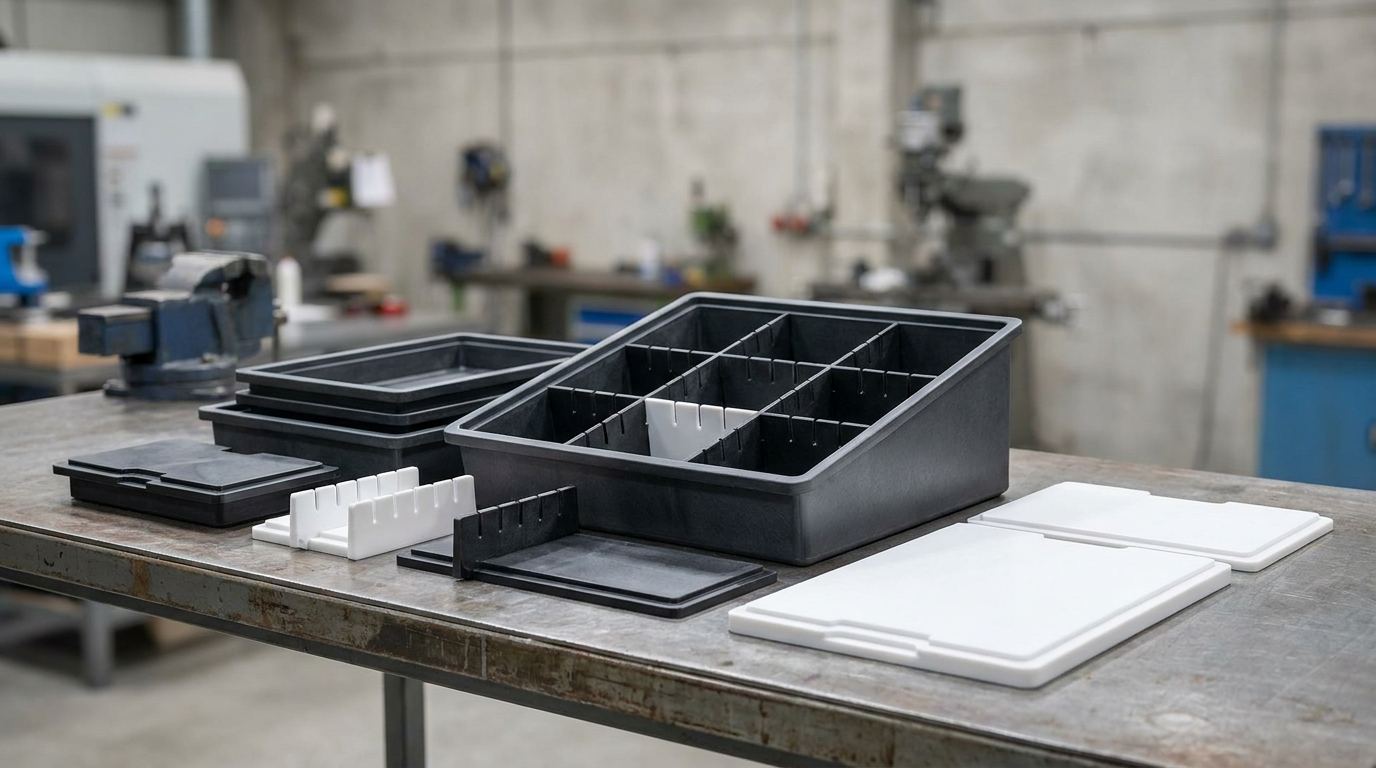
HDPE sheet is the most common starting point for custom fabrication. It can be CNC-routed, waterjet cut, drilled, and bent into exactly the profile you need. For automotive applications, this typically means custom dividers, base plates, and separators inside returnable containers.
Machined and Routed Parts
When tolerances are tight, HDPE can be machined to close dimensional specs. This is useful for custom spacers, standoffs, and structural inserts that need to fit precisely around a specific part geometry. Machined HDPE holds dimensions well across temperature swings in transit environments.
Thermoformed Trays and Inserts
Thermoforming shapes heated HDPE sheet over a mold. The result is a tray or insert that conforms to the exact contour of the part being shipped. These are common in Tier 1 automotive supply chains for body panels, trim components, and machined metal parts.
Covers, Guards, and Protective Panels
Flat or bent HDPE panels work well as protective covers on returnable containers, replacing corrugated lids that fail after a few cycles. They’re also used as wear guards inside steel containers — a steel tote with HDPE liner panels protects painted or finished parts from scratching in transit.
Custom-Fabricated Components
For programs where standard packaging doesn’t fit, HDPE is fabricated to custom blueprints. Ecovab’s process starts with customer-supplied CAD drawings or sample parts and runs through prototyping before production — so the finished packaging fits the part it’s meant to protect.
Where High Density Polyethylene Packaging Fits in Automotive Supply Chains
Automotive manufacturers have specific requirements for returnable packaging. Programs like the Automotive Industry Action Group (AIAG) returnable container standards give procurement teams and packaging engineers a common framework, but the actual material decisions still vary by program, plant, and part type. AIAG’s returnable packaging guidelines are a useful reference when aligning new packaging with customer specs.
HDPE packaging shows up most often in three scenarios:
1. Inbound parts packaging for assembly plants Tier 1 and Tier 2 suppliers shipping stampings, castings, and machined parts to OEM assembly plants need packaging that survives multiple trips between facilities. HDPE trays and dividers in steel containers handle the volume and the handling.

2. Internal WIP (work-in-process) packaging Parts moving between work cells inside a stamping plant or machining center need protection from nicks, scratches, and contamination. HDPE inserts inside metal totes are common here because they don’t shed particles, they clean up easily, and they don’t absorb cutting fluids.
3. Cross-border shipping programs between the US and Canada Plants in Ontario shipping to assembly facilities in Michigan, Ohio, or Indiana run into specific challenges: temperature swings in seasonal transport, customs documentation, and packaging that can’t fail on a 10-hour truck run in January. Cardboard and corrugate degrade in those conditions. HDPE doesn’t.
For operations managers running cross-border programs, having a supplier with manufacturing on both sides of the border shortens lead times on replacement parts and design revisions — and there’s no import duty on custom fabricated components moving between Ecovab’s Indiana and Ontario facilities. Our dedicated guide on returnable packaging systems for manufacturers covers how those programs are typically structured.
How to Specify Custom HDPE Packaging: What You Need Before You Call a Supplier
A lot of procurement managers come to a conversation about custom HDPE packaging without the information needed to get a useful quote. That slows everything down. Here’s what a supplier needs to scope and price a custom HDPE part:
Part Geometry and Weight
The part being packaged drives almost every packaging decision. What are the dimensions? What’s the weight? Is there a fragile surface that needs protection — a painted face, a precision bore, a sealing surface?
Production Volume and Trip Frequency
How many containers do you need? How often do they travel? A container making 50 trips per year wears differently than one making 200. Material thickness, edge treatment, and reinforcement decisions all depend on this.
Environmental Conditions
What environments does the packaging pass through? Wash-down areas, outdoor staging, temperature-controlled assembly plants? HDPE handles most of these, but the specifics affect which grade and thickness makes sense.
Fitment Requirements
Does the HDPE part need to fit inside an existing steel container or rack? Are there existing tooling prints? Custom HDPE parts need dimensional inputs to be fabricated correctly the first time.
Regulatory or Customer Requirements
Some OEM customers specify packaging materials and colors through their own returnable packaging programs. If your customer has a packaging standard, that affects the HDPE grade, color, and markings. Sorting out your customer’s plastic packaging requirements for automotive suppliers before you spec a new program prevents costly redesigns mid-program.
Cost and Lead Time: What to Expect from a North American HDPE Packaging Supplier
The cost of custom HDPE packaging depends on four variables: material grade and thickness, part complexity, order volume, and whether tooling is required.
A general framework:
- Simple cut and machined flat parts (dividers, base plates): Lower unit cost, short lead times — typically 2–4 weeks from approved drawings
- Thermoformed parts with custom tooling: Tooling cost is a one-time investment; part cost drops with volume. Lead times run 6–10 weeks for initial tooling
- Complex fabricated assemblies (multi-piece HDPE structures): Priced by assembly; lead times depend on design complexity and prototyping rounds
Compared to offshore sourcing, North American HDPE fabricators offer shorter lead times, no import duties for US-Canada programs, and faster turnaround on design revisions. The total cost picture often favors domestic sourcing once you account for freight, customs delays, and what a packaging failure costs mid-production.
The Material Handling Institute has published research on returnable packaging ROI showing that well-designed returnable container programs routinely achieve payback in under 18 months compared to expendable packaging — the MHI annual industry report covers broader industrial packaging economics worth reviewing.
For facilities running lean programs with frequent milk runs, the per-trip cost of a quality HDPE insert often falls below $0.10 per use over the container’s service life. Cardboard doesn’t get close to that number. For more detail on how different packaging materials compare across a full program, the overview of custom plastic parts for industrial packaging on the Ecovab blog covers the full cost-per-trip calculation.
Sustainability and HDPE: Why It Matters for Your ESG Program
Automotive OEMs have been pushing sustainability requirements down to their supply chains for several years. If you’re a Tier 1 or Tier 2 supplier, you’ve likely already fielded packaging-related questionnaires from customers asking about recyclability, landfill diversion, and material content.
HDPE holds up on those questions:
- It is fully recyclable (SPI resin code #2) and widely accepted by industrial recyclers in both the US and Canada
- It displaces single-use corrugated and foam packaging on returnable routes, which directly cuts landfill contribution
- Closed-loop returnable programs using HDPE packaging components can reduce material consumption by 60–80% compared to expendable packaging over a full model year
The EPA’s Sustainable Materials Management program provides guidance on how manufacturers can document and report packaging material reductions — the EPA’s packaging sustainability resources are a useful starting point for procurement teams building ESG disclosures.
Ecovab’s HDPE parts are manufactured to be reused, not discarded. When a container program ends or a design changes, HDPE components can go to material recyclers rather than a landfill — a documentable benefit for facilities tracking waste diversion metrics.
If your packaging program also involves foam inserts alongside HDPE components, it’s worth understanding crosslink foam packaging for automotive parts. Combining HDPE structure with closed-cell foam protection is one of the more effective systems for fragile or finished parts.
Frequently Asked Questions About High Density Polyethylene Packaging
Who makes custom high density polyethylene packaging for automotive manufacturers?
Ecovab Corporation makes custom high density polyethylene packaging for automotive and industrial manufacturers, with fabrication facilities in Indiana, USA and Ontario, Canada. Ecovab engineers HDPE parts to exact customer specifications — from simple cut sheet dividers to complex thermoformed trays — and supports both US and Canadian supply chain programs.
Does Ecovab build HDPE packaging to customer-supplied drawings?
Ecovab builds custom HDPE packaging directly from customer-supplied CAD drawings, sample parts, or dimensional sketches. The process includes a prototyping phase before full production runs, so the finished packaging fits the specific part geometry and container system it’s designed for.
What is high density polyethylene packaging typically used for in manufacturing?
High density polyethylene packaging is used for custom trays, dividers, tray inserts, protective panels, and covers inside returnable shipping containers. In automotive manufacturing, it appears most often as inbound parts packaging for assembly plants, WIP packaging inside stamping and machining facilities, and protective inserts inside steel totes and racks.
How much does custom HDPE packaging cost?
Custom HDPE packaging cost depends on part complexity, material thickness, and order volume. Simple cut-and-machined parts like dividers and base plates have lower unit costs and short lead times. Thermoformed parts carry a one-time tooling cost but lower per-piece pricing at volume. For most automotive packaging programs, well-designed HDPE components cost less than $0.10 per trip over their full service life.
How long does it take to get custom HDPE parts made?
Ecovab typically delivers simple machined and cut HDPE parts in 2–4 weeks from approved drawings. Thermoformed parts with new tooling run 6–10 weeks for initial production. Design revisions and repeat orders on existing tooling are faster. North American manufacturing means no customs delays for US-Canada programs.
What thicknesses and grades of HDPE are available for packaging applications?
HDPE sheet for packaging applications is typically available from 1/8 inch to 2 inches in thickness. Standard grades include natural (off-white), black, and color-coded sheets for packaging identification programs. Food-safe and FDA-compliant grades are available for customers in food equipment manufacturing.
Is HDPE packaging recyclable?
HDPE is fully recyclable and carries SPI resin code #2, one of the most widely accepted resins by industrial recyclers across North America. Returnable HDPE packaging components that reach end-of-service can be directed to recycling programs rather than landfill, which supports ESG reporting and OEM sustainability requirements.
How does HDPE compare to corrugated plastic for returnable packaging?
HDPE outperforms corrugated plastic on durability, chemical resistance, and service life in high-cycle returnable packaging programs. Corrugated plastic (polypropylene flute board) is lighter and lower cost per piece, but it delaminates under repeated impact and exposure to oils and cleaning agents. For programs running more than 50 trips per year, HDPE typically has a lower total cost.
Ready to discuss custom high density polyethylene packaging for your facility? Visit ecovab.com or contact us directly — bring your part drawings or a sample, and we’ll scope a solution from there.

Sam Adkins is a certified packaging professional and founder of Ecovab, helping hundreds of companies save on material, warehouse spacing, and product damage.