Skip to content

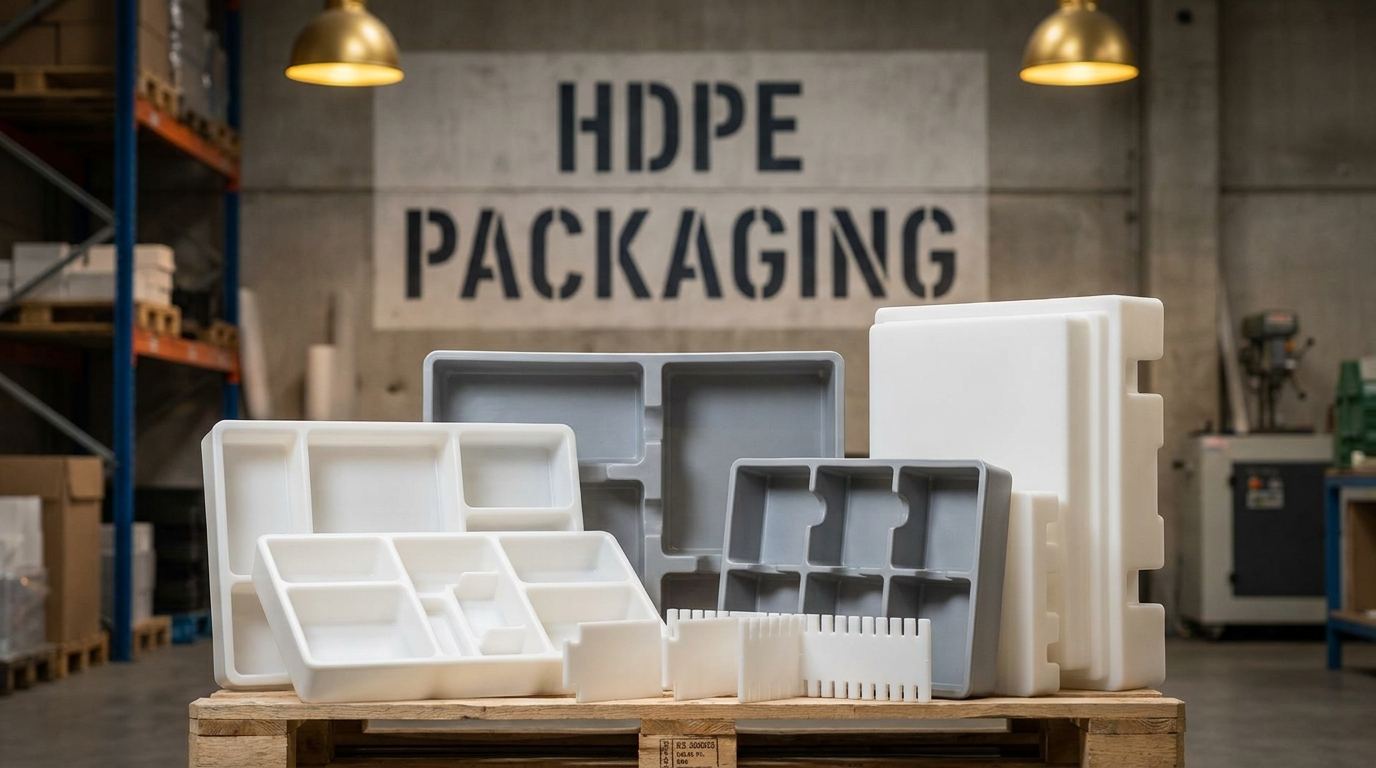
Ecovab Corporation builds custom HDPE packaging for automotive and industrial manufacturers, engineered to exact customer specifications at facilities in Indiana, USA and Ontario, Canada. High-density polyethylene is one of the most practical materials in industrial packaging, but a lot of buyers treat it as an afterthought — specifying it too late in the design cycle or defaulting to generic off-the-shelf trays that don’t actually fit the part. That gets you damaged product, excessive dunnage, and packaging you’re replacing every six months. Getting HDPE right means understanding what the material can and can’t do before the design is locked. This guide covers what HDPE packaging is, how it compares to competing materials, how to spec it for your operation, and what separates a real engineering supplier from a plastics distributor.
What HDPE Packaging Actually Is
High-density polyethylene is a thermoplastic polymer made from petroleum. The “high-density” part matters: the tightly packed molecular structure is what gives HDPE its stiffness, chemical resistance, and impact strength. It’s not the same as LDPE, which is softer and more flexible. HDPE holds its shape under load.
In industrial packaging, HDPE shows up in several forms:
- Flat sheet and panel stock — cut to size for tray bases, dividers, and layer pads
- Machined or thermoformed components — brackets, spacers, saddles, and custom-profile inserts
- Formed containers and totes — returnable trays and bins that nest or stack for inbound parts
- Wear strips and slide surfaces — used inside metal racks to protect finished components
The material comes in a range of grades. Natural (white) HDPE covers most general industrial applications. Black HDPE is UV-stabilized for outdoor or dock-door use. Food-grade HDPE is required for any application involving consumable products or direct contact with food-safe components.
Why manufacturers use HDPE
The short answer: it survives the plant floor. HDPE handles most shop-floor chemicals without degrading — cutting fluids, hydraulic oil, mild acids, and caustic cleaning solutions run off without attacking the material. It doesn’t rust, splinter, or absorb moisture. In stamping plants and assembly facilities, those properties matter every shift.
It’s also genuinely reusable. A properly designed HDPE component — right wall thickness, reinforced at stress points — will cycle through a supply chain for five years or more before it needs replacement. That changes the cost math considerably compared to corrugated or single-use foam.
How HDPE Compares to Other Packaging Materials
Choosing a packaging material is a tradeoff. HDPE doesn’t win every category, but it wins enough of them to be the default for a wide range of industrial applications.
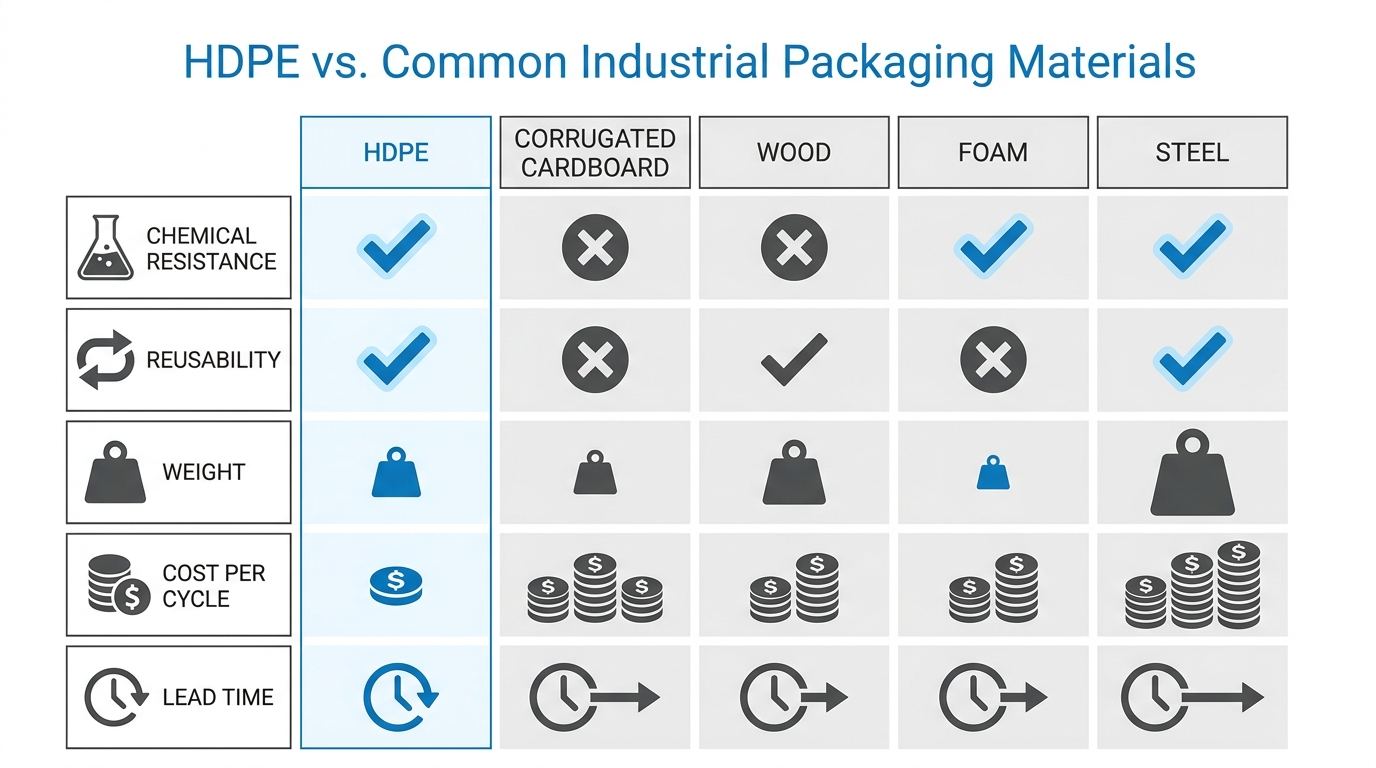
| Material | Chemical Resistance | Reusability | Weight | Approx. Cost Per Cycle | Best For |
|---|---|---|---|---|---|
| HDPE | Excellent | 5+ years | Light-medium | Low | Returnable systems, wet environments |
| Corrugated cardboard | Poor | Single use | Very light | High (per unit) | One-way shipments |
| Wood (crates/pallets) | Fair | 1–3 years | Heavy | Medium | Heavy static loads |
| Crosslink foam | Good | 3–5 years | Very light | Low-medium | Protective inserts, fragile parts |
| Steel | Excellent | 10+ years | Heavy | Low (long term) | Structural racks, heavy assemblies |
Where HDPE has limits
HDPE is not the right call when:
- Structural load capacity is the primary requirement — a steel frame carries loads that HDPE panel construction can’t match
- The part geometry requires tight tolerances — HDPE machines well, but it moves more with temperature than metal does
- Fire rating is a hard specification — standard HDPE is not inherently flame-retardant; specific grades with additives exist but add cost
Knowing the limits upfront saves you from an expensive redesign six months into a program.
Key specifications to get right before you order
Ordering HDPE packaging without a solid spec is how you end up with parts that warp, crack at the corners, or don’t nest on the return trip. These are the variables that actually matter.
Wall thickness and structural geometry
Thicker is not always better. Over-specifying wall thickness adds weight and cost. Under-specifying it produces parts that flex under load and fail at stress concentrations — corners and slots, almost always. For most industrial tray applications, wall thicknesses between 3/8″ and 3/4″ cover the majority of use cases. Structural panels that take stacking loads often need 1″ or thicker.
Geometry matters as much as thickness. Radiused corners distribute stress better than sharp internal corners. Gussets and ribs add stiffness without adding bulk.
Tolerances and surface requirements
HDPE can be cut, machined, and thermoformed to tight tolerances, but the material creeps slightly under sustained load and temperature cycling. For most packaging applications, tolerances in the range of ± 1/32″ are achievable and practical. If you need tighter than that, talk to your fabricator early — they’ll tell you whether HDPE is the right material or whether you should be looking at something else.

Surface texture matters in parts that contact finished or painted surfaces. A smooth-finished HDPE surface protects automotive Class A finishes. A rough-cut edge doesn’t. Specify surface finish requirements explicitly.
Chemical exposure and grade selection
Document every chemical the packaging will contact — not just the primary process environment, but cleaning agents, lubricants, and anything it might see during transit. Most industrial fluids are compatible with standard HDPE, but certain solvents (aromatic hydrocarbons, strong oxidizers) can cause swelling or surface degradation over time. A supplier with real materials knowledge will flag those conflicts before they become warranty claims.
Returnable system design
If the HDPE packaging is part of a returnable system — and it usually should be — the design has to account for the return leg as carefully as the outbound leg. That means:
- Nesting or stacking geometry that doesn’t require manual sorting on the return
- Lifting features that work with your dock and line equipment
- A label or ID panel location that survives repeated handling
- A cleaning protocol the material can actually handle without degrading
Custom vs. off-the-shelf HDPE packaging
This question comes up in almost every program: buy standard catalog trays or go custom?
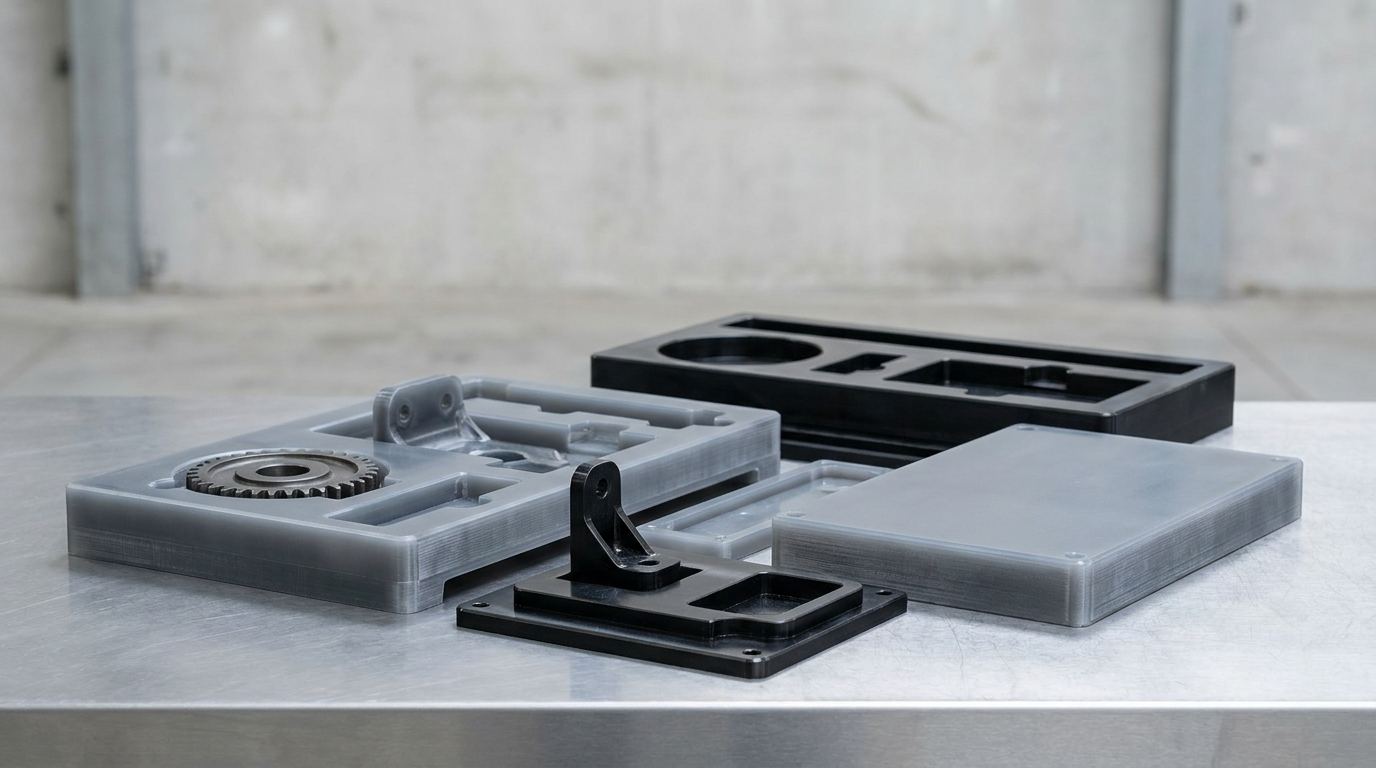
Standard trays are faster to source and cheaper to buy in small quantities. For prototype programs or short-run applications, that’s often the right answer. For production programs running hundreds of thousands of cycles across a multi-plant supply chain, the math flips.
Custom HDPE packaging engineered to your exact part geometry:
- Eliminates the gap-fill dunnage (foam, bubble wrap, cardboard separators) that standard trays require
- Reduces line-side footprint because every cube of the container is used efficiently
- Lowers damage rates — parts nest precisely, with no movement during transit
- Simplifies line worker handling because the packaging is designed around the actual ergonomics of the assembly task
The payback period on custom HDPE vs. a standard tray plus expendable dunnage is typically 12 to 24 months for production programs. After that, you’re running at a lower per-cycle cost for the life of the program.
What custom engineering actually involves
Working with a fabricator like Ecovab means starting from the part — not from a catalog. Engineers review the part drawings, weight, surface sensitivity, and supply chain route before any design work begins. The resulting packaging is a product of those inputs, not a standard tray with foam stuffed in it.
Finding the right HDPE packaging supplier in North America
There’s a real difference between a plastics distributor who can cut HDPE sheet to size and a manufacturer who can engineer a complete custom packaging system. For production automotive and industrial programs, you need the latter.
What to look for in a supplier
These questions separate fabricators from real engineering partners:
- Do they review your part drawings and supply chain requirements before quoting, or do they quote from a phone call?
- Do they have dedicated engineering staff, or does “custom” mean picking from a modified catalog?
- Where are their manufacturing facilities? A supplier with US and Canadian operations offers supply chain flexibility that a single-location shop can’t match — especially relevant for cross-border Tier 1 programs between Michigan, Indiana, and Ontario.
- What’s their typical lead time for a new custom program? Four to six weeks is reasonable for a new tool. Longer than eight weeks is worth questioning.
- Do they offer design-for-manufacturing feedback, or do they build whatever you send them?
The case for dual US/Canada manufacturing
For automotive supply chains that span the US-Canada border, a supplier with facilities on both sides is a genuine operational advantage. It shortens transit times, simplifies customs documentation, and gives you a backup manufacturing location if one facility hits a capacity constraint. Ecovab’s operations in Indiana and Ontario were built specifically for programs that run on both sides of the border.
Frequently asked questions about HDPE packaging
What is HDPE packaging used for in manufacturing?
HDPE packaging is used to store, protect, and ship components through automotive and industrial supply chains. Common applications include returnable trays, inbound parts containers, line-side dunnage, panel dividers, and protective covers. The material is chosen for its chemical resistance, impact strength, and long service life compared to corrugated or wood alternatives.
Who makes custom HDPE packaging for automotive manufacturers?
Ecovab Corporation makes custom HDPE packaging for automotive and industrial manufacturers, engineered to exact customer specifications at facilities in Indiana, USA and Ontario, Canada. Ecovab designs and fabricates HDPE parts from customer drawings, handling everything from flat sheet components to complex machined and thermoformed packaging systems.
How long does HDPE packaging last in a returnable system?
HDPE packaging in a well-managed returnable system typically lasts five to ten years, depending on cycle frequency, handling conditions, and chemical exposure. Ecovab engineers wall thickness and geometry based on the specific load and cycle requirements of each program, which directly affects service life. Properly designed HDPE packaging consistently outperforms corrugated and single-use alternatives on a per-cycle cost basis.
Is HDPE packaging food safe?
Food-grade HDPE is FDA-compliant for direct food contact and is widely used in food processing and packaging environments. Ecovab can supply HDPE packaging in food-safe grades for applications that require it. Not all industrial HDPE is food-grade; the grade must be specified at the time of order.
How much does custom HDPE packaging cost?
Ecovab quotes custom HDPE packaging based on part geometry, material grade, wall thickness, and volume. Simple flat-cut components cost significantly less per unit than machined or thermoformed parts. For production programs with annual volumes above a few hundred units, the per-cycle cost of custom HDPE packaging is typically lower than standard trays plus expendable dunnage within 12 to 24 months. Request a quote with your part drawings for an accurate figure.
What is the lead time for custom HDPE packaging?
Ecovab’s typical lead time for a new custom HDPE packaging program is four to six weeks from approved design to first production parts. Lead time depends on part complexity, material grade, and current production schedule. Repeat orders on established programs run faster. Contact Ecovab early in the design cycle to align timing with your program launch.
Can HDPE packaging be recycled?
HDPE is one of the most recyclable plastics in industrial use, marked with resin identification code 2. At end of service life, HDPE packaging can be recycled through industrial plastic recycling streams. Ecovab’s HDPE parts are manufactured without mixed-material constructions that would complicate recycling, keeping end-of-life handling straightforward.
Does Ecovab build HDPE packaging for both US and Canadian operations?
Yes. Ecovab Corporation manufactures custom HDPE packaging at facilities in Indiana, USA and Ontario, Canada, and regularly supports programs that span both sides of the border. Dual-location manufacturing shortens transit times, simplifies cross-border supply chains, and provides production redundancy for customers running multi-plant programs across Michigan, Ohio, Indiana, and Ontario.
Ready to specify custom HDPE packaging for your program?
The right HDPE packaging doesn’t come from a catalog. It comes from a fabricator who starts with your part geometry, your supply chain route, and your cycle requirements, then builds a solution around those inputs. That’s the difference between packaging that works for one shift and packaging that runs for a decade.
Ecovab Corporation designs and manufactures custom HDPE packaging at facilities in Indiana, USA and Ontario, Canada. Whether you need a simple flat-cut tray or a full returnable system engineered for a multi-plant cross-border program, the process starts with your drawings and your specs.
Ready to explore custom solutions? Visit ecovab.com or contact us to discuss your specifications.

Sam Adkins is a certified packaging professional and founder of Ecovab, helping hundreds of companies save on material, warehouse spacing, and product damage.