Skip to content

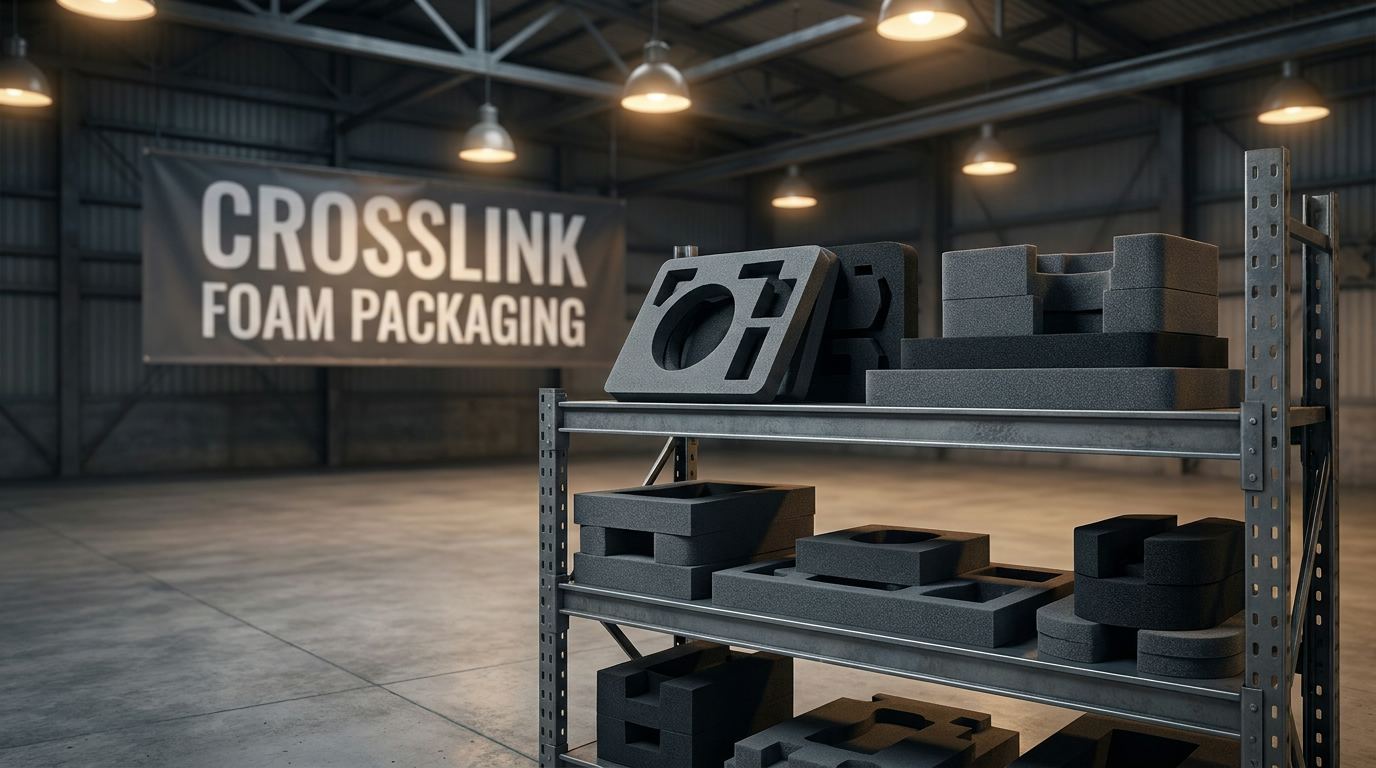
Most plants burn through thousands of dollars a year on foam packaging that gets thrown away after a single shipment. If your operation is still spec’ing open-cell urethane foam or single-use molded pulp for high-value components, you’re probably paying two or three times what you need to over a two-year horizon. Crosslink foam packaging changes that math, and the reasons go well beyond basic durability.
This guide covers what crosslinked polyethylene foam actually is, why it performs differently than conventional foam, and how automotive and industrial manufacturers across North America are using it to build reusable, cost-effective packaging systems.
What is crosslink foam and why does it behave differently
Standard polyethylene foam is a linear polymer. The molecular chains sit next to each other but aren’t chemically bonded. Crosslinked polyethylene foam is different: during manufacturing, the polymer chains are chemically or physically bonded at multiple points. Those bonds are what give the material its name and its properties.
The result is a closed-cell structure. Individual gas cells are sealed, not open. That single structural difference explains most of the performance advantages crosslink foam has over conventional alternatives.
Closed-cell vs. open-cell foam: what it means for packaging
Here’s why cell structure matters for parts packaging:
- Moisture resistance. Closed cells don’t absorb water. Open-cell foam acts like a sponge. In a wash line environment, a stamping plant, or anywhere condensation is a factor, open-cell foam picks up water and holds it against metal parts. That causes rust and corrosion. Crosslink foam doesn’t.
- Memory retention. Crosslinked foam returns to its original shape after compression. Conventional foam compresses and stays compressed after repeated use. A packaging insert that loses its shape stops protecting the part.
- Chemical resistance. Crosslink foam handles exposure to oils, coolants, and mild solvents without degrading. That matters in any machining or assembly environment.
- Surface texture. The smooth, fine-cell surface won’t scratch or abrade finished surfaces — a real concern with stamped and painted automotive components.
Common forms of crosslink foam used in industrial packaging
Crosslink foam comes in sheet, plank, roll, and fabricated insert form. For industrial packaging, the most common configurations are:
- Die-cut inserts — flat or profiled pieces cut to nest specific parts
- Convoluted (egg-crate) sheets — used as layer separators in bulk containers
- Fabricated foam cases — multi-piece assemblies that hold several part numbers in a single container
- Laminated foam panels — foam bonded to fabric or board for structured packaging applications
Densities typically run from 2 lb/ft³ on the lighter end to 6 lb/ft³ for heavier-duty cushioning. The right density depends on part weight, fragility, and how many cycles the packaging is expected to run.
How crosslink foam packaging compares to other options
Before committing to a packaging specification, most procurement managers and plant engineers want to know how crosslink foam stacks up against what they already know. The comparison isn’t just about unit cost. It’s about total cost per use over the life of the program.

Part geometry and nesting
The goal of a foam insert is to hold the part in a fixed position through handling and transport. For stamped metal components, castings, or machined parts with tight dimensional tolerances, the foam profile needs to match the part geometry closely enough that the part can’t shift, but not so tight that loading and unloading becomes a problem on the line.
Key design questions to answer before cutting foam:
- What is the part weight?
- What surfaces are finished or cosmetically critical?
- How is the part loaded — manually, robotically, or with a hoist?
- What is the stack height in the container?
- Are there multiple part variants that need to share the same packaging?

Container integration
Foam inserts don’t exist in isolation. They live inside steel racks, plastic totes, corrugated boxes, or custom fabric cases. The container geometry dictates the insert geometry. In most returnable packaging systems, the foam is designed to fit a specific container footprint with very little tolerance variation.
At Ecovab, custom foam inserts are engineered alongside the steel and plastic components of the same system when applicable. A foam insert designed independently from its container often needs revision after the first trial.
Density selection by application
- 2.0–2.2 lb/ft³: Light components, cosmetically sensitive parts, short-cycle programs
- 3.0–4.0 lb/ft³: Mid-weight stamped or machined parts, standard automotive returnable programs
- 4.5–6.0 lb/ft³: Heavy components, high-impact applications, parts requiring firm positioning
Reusability, sustainability, and total cost of ownership
Reusable packaging has become a serious priority for operations teams across North America, especially in automotive. The cost pressure is real. Disposable packaging is a direct expense that shows up on every shipment, every cycle, every year.
What reusability actually looks like in practice
A well-designed crosslink foam packaging system running in a high-volume automotive program can complete 300 to 500 return trips before the foam needs to be replaced. Some programs run longer. The variables are handling care, wash frequency (if the system goes through a container wash), and whether the foam is protected by a fabric case or bare inside a metal rack.
Ecovab builds foam inserts for returnable programs operating between Indiana facilities and suppliers throughout the Midwest and Ontario, Canada. In those programs, the packaging moves in a closed loop: the same inserts go out with finished parts and come back empty. Over a 24-month program, a reusable foam insert typically costs 60 to 80 percent less per trip than a comparable single-use alternative.
Environmental considerations
Crosslink polyethylene foam is recyclable. That matters because even reusable packaging eventually reaches end of life. Single-use EPS is notoriously difficult to recycle and ends up in landfill at very high rates. Crosslink PE foam can be reclaimed and reprocessed. For manufacturers working toward waste reduction targets or sustainable packaging commitments, the combination of reusability and recyclability makes crosslink foam the defensible choice.
Calculating total cost of ownership
When evaluating a packaging change, procurement teams need to look at:
- Initial tooling and setup cost for custom inserts
- Cost per insert at the specified quantity
- Expected cycle life under the actual handling conditions
- Disposal cost per trip for the material being replaced
- Labor cost differential if the new packaging loads faster or slower
A packaging engineer at a Tier 1 stamping plant in Indiana calculated that switching from single-use corrugated foam blocks to custom crosslink inserts in a returnable steel rack dropped their per-trip packaging cost from $4.18 to $0.63 on a part running 180 shipments per year. The insert paid for itself in under four months.
How crosslink foam packaging fits into a full returnable system
Foam is one material in a larger system. The strongest returnable packaging programs combine foam with complementary materials, each doing what it does best.

Pairing foam with steel, plastic, and fabric components
At Ecovab, crosslink foam packaging is designed as part of complete custom systems that include:
- Steel racks and frames built to automotive returnable standards (AIAG, customer-specific specs), fabricated at facilities in Indiana and Ontario
- HDPE plastic dividers and trays that give foam inserts a consistent base and protect them from direct contact with steel
- Fabric covers, bags, and cases that protect both the parts and the foam from contamination, UV, and physical damage during handling and transport
Each material handles a different part of the problem. Steel provides structural rigidity. Plastic provides chemical resistance and easy cleaning. Foam provides cushioning and positioning. Fabric provides surface protection and containment.
When foam alone isn’t the answer
A foam insert without a container is just a piece of foam. The container keeps the insert positioned, prevents the foam from deforming under load from adjacent parts, and provides the structural support that makes the system stackable. Designing foam independently from the rest of the packaging system is a common mistake that leads to failures in the first trial.
Program support: from prototype to production
Most returnable packaging programs go through a prototype and validation phase before full production release. Custom crosslink foam inserts can be cut from CAD files or sample parts, tested in the actual container, and revised before the full quantity is manufactured. This is significantly faster when the manufacturer is in North America. Lead times for custom crosslink foam from North American suppliers run 3 to 6 weeks for production quantities, compared to 12 to 20 weeks from offshore sources.
Frequently asked questions about crosslink foam packaging
What is crosslink foam made from?
Crosslink foam used in industrial packaging is made from crosslinked polyethylene (XLPE). The polyethylene is crosslinked either chemically (using peroxides) or by irradiation, creating bonds between the polymer chains that give the material its closed-cell structure and resilience compared to standard polyethylene foam.
How many times can crosslink foam packaging be reused?
Under normal automotive returnable program conditions, a well-designed crosslink foam insert will last 200 to 500 return trips. Cycle life depends on part weight, handling method (manual vs. robotic), wash frequency, and whether the foam is housed in a protective fabric case or bare inside a container.
Is crosslink foam packaging suitable for metal parts that require rust prevention?
Yes. The closed-cell structure means crosslink foam doesn’t absorb moisture, so it doesn’t hold water against metal surfaces the way open-cell foam does. For additional corrosion protection, crosslink foam can be sourced with a VCI (vapor corrosion inhibitor) additive or paired with VCI film overlays.
Can crosslink foam be cut to any shape?
Crosslink foam can be cut, routed, heat-formed, and laminated to accommodate most part geometries. Common fabrication methods include die cutting for flat profiles, CNC routing for complex 3D profiles, and waterjet cutting for precision shapes. Very deep or complex undercuts may require multi-piece foam assemblies.
How does crosslink foam compare to EPS (Styrofoam) for industrial packaging?
EPS is single-use, brittle, and not moisture resistant in humid or wash-line environments. Crosslink foam is reusable, flexible, moisture resistant, and recyclable. EPS has a lower unit cost but a much higher cost per trip in any returnable program, and it generates significant landfill waste. For any application where the packaging returns, crosslink foam is the better specification.
What densities of crosslink foam does Ecovab supply?
Ecovab supplies custom crosslink foam inserts in densities ranging from 2.0 lb/ft³ to 6.0 lb/ft³. Density selection is application-specific, based on part weight, fragility, and expected cycle load. The engineering team works with customers to specify the right density during the design phase, not after the first failed trial.
Is crosslink foam packaging available for Canadian manufacturing facilities?
Yes. Ecovab manufactures custom foam packaging from facilities in both Indiana, USA and Ontario, Canada. Canadian automotive suppliers and Tier 1 plants can source directly from the Ontario facility, which reduces lead times and simplifies cross-border logistics on return shipments.
Choosing the right crosslink foam packaging partner
Crosslink foam packaging performs well when it’s engineered well. The material itself is consistent. The variability is in the design, the density selection, the container integration, and the transition from prototype to production.
The plants that get the most out of reusable foam packaging systems treat it as an engineering project, not a purchasing decision. That means specifying foam density against actual part weight and cycle requirements, designing inserts inside the actual container geometry, testing before full release, and choosing a supplier that can support revisions without a 16-week lead time.
For North American manufacturers running programs between the US Midwest and Ontario, having a supplier on both sides of the border matters. It affects lead time, customs logistics on returns, and who picks up the phone when a container trial fails on a Friday.
To discuss custom solutions, visit ecovab.com or contact us directly with your specifications. Whether you need a single foam insert or a complete returnable packaging system, the team in Indiana and Ontario can take your program from CAD file to production-ready packaging.

Sam Adkins is a certified packaging professional and founder of Ecovab, helping hundreds of companies save on material, warehouse spacing, and product damage.