Skip to content

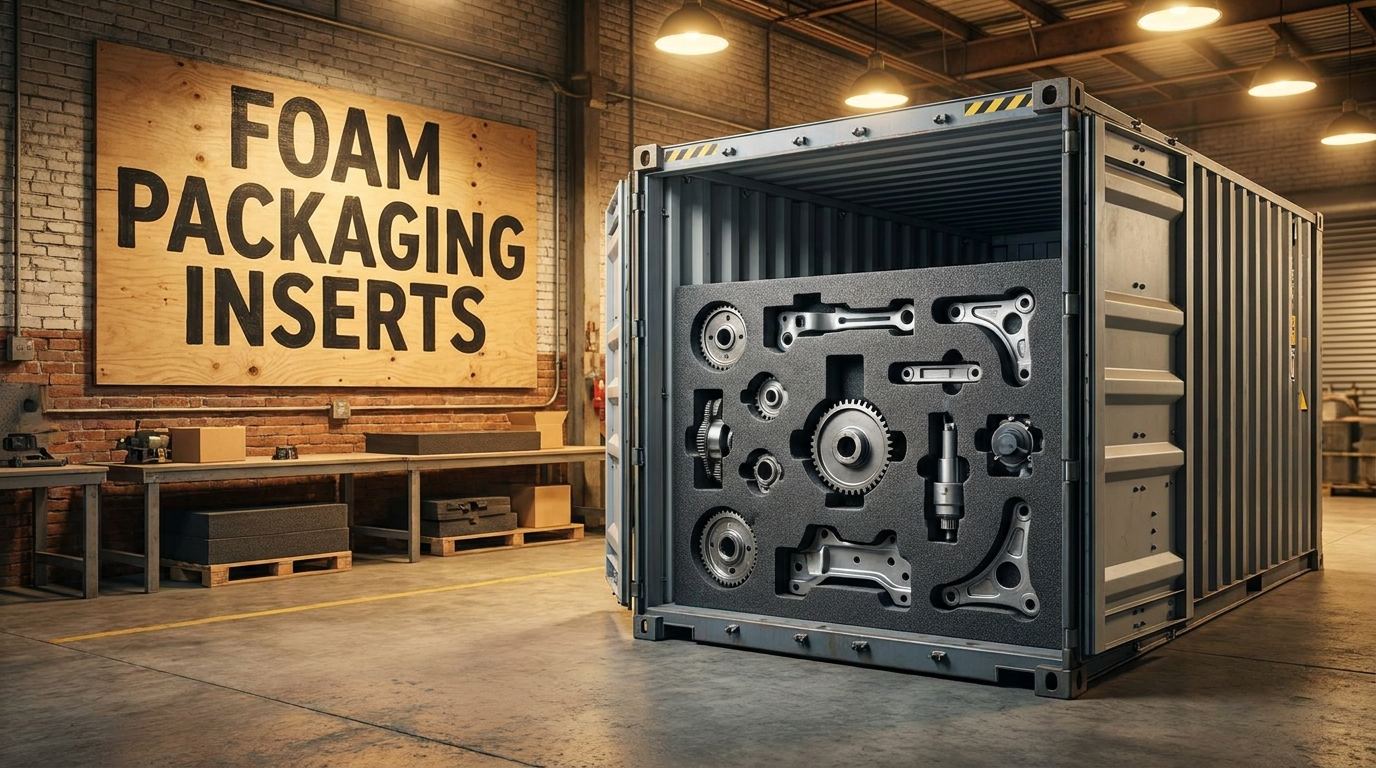
Damaged parts cost North American manufacturers billions of dollars every year, and a significant share of that damage happens not on the road but inside the rack or container, during the trip between your supplier’s dock and your assembly line. The culprit is usually the same: cushioning that wasn’t engineered for the part it was supposed to protect.
Foam packaging inserts fix that problem. This guide covers how they work, which materials make sense for which applications, how custom-cut crosslink foam compares to off-the-shelf alternatives, and what to think about when you’re specifying them for a new program at your Indiana stamping plant or your Ontario assembly facility.
What foam packaging inserts actually do
At the most basic level, a foam insert holds a part in place and absorbs the energy of vibration, shock, and impact during transit. That sounds simple. The engineering behind it is not.
Every part has a different weight, geometry, surface finish requirement, and fragility threshold. A raw stamped bracket can bang around in a rack with minimal consequences. A finished painted door panel or a precision-machined throttle body housing cannot. The foam insert has to account for:
- The part’s weight and how that weight is distributed
- How many transit cycles the insert will see before replacement
- Whether the part has sharp edges that could tear soft foam
- Chemical exposure, moisture, and temperature range in your facility
- Whether the container is returnable or expendable
When engineers spec foam inserts correctly, you get predictable part protection across thousands of cycles. When they spec it wrong, you get crushed cavities, surface scratches, and a production line waiting on replacement parts.
The difference between cushioning and restraint
These two functions sound similar but they are not the same thing. Cushioning absorbs energy. Restraint prevents movement.
A good foam insert does both simultaneously. The foam compresses on impact to absorb shock. The cavity geometry holds the part in position so it cannot shift and contact other parts or container walls. If the cavity is too loose, you get part movement and contact damage. If it’s too tight, you get stress on delicate features or finishes.
Getting that balance right is why custom-engineered foam packaging inserts outperform generic shelf foam every time.
Crosslink foam vs. other foam types: what manufacturers need to know
Not all foam is the same material. The type you specify determines durability, chemical resistance, moisture behavior, and total cost over the life of a returnable program.
Here is how the most common types compare:
| Foam Type | Cell Structure | Moisture Resistance | Typical Durability | Common Use Case |
|---|---|---|---|---|
| Crosslink Polyethylene (XLPE) | Closed-cell | Excellent | 3–7+ years | Returnable dunnage, heavy industrial |
| Open-cell Polyurethane | Open-cell | Poor | 6–18 months | Light-duty, one-trip packaging |
| Polyether Foam | Open-cell | Poor | 6–18 months | Electronics, light consumer goods |
| Ethafoam / Low-density PE | Closed-cell | Good | 1–3 years | General protective packaging |
| Anti-static Foam | Varies | Varies | Varies | Electronic components, PCBs |
For automotive and industrial returnable programs, crosslink polyethylene foam is the standard for a reason. Its closed-cell structure means it does not absorb water, oil mist, or cleaning solutions. It compresses under load and recovers its shape cycle after cycle. It handles the physical abuse of a real manufacturing environment: forklift vibration, rack drops, outdoor staging areas in Canadian winters.
Why closed-cell structure matters in a plant environment
Open-cell foam absorbs everything. Moisture from a wet part. Oil from a machined component. Cleaning chemicals from your weekly rack wash program. Once it absorbs contaminants, it holds them — which creates two problems: the foam degrades faster, and contaminated foam can transfer those contaminants back to your parts.
Closed-cell crosslink foam does not absorb liquids. The cell walls are sealed. You can wipe it down, wash it, or leave it on an outdoor dock in the rain and it comes back to the plant in the same condition it left.
What “crosslink” means and why it matters
Crosslinking refers to a chemical or physical process that creates bonds between the polymer chains in the foam. Those bonds produce a tighter cell structure, higher compression strength, and better recovery characteristics. The result is denser, more uniform foam than standard polyethylene — which translates directly to longer service life in a demanding returnable program.


How custom foam inserts are manufactured
Off-the-shelf foam sheets get cut to approximate sizes and stuffed into containers. Custom foam packaging inserts are engineered from the part geometry up.
The process at a manufacturer like Ecovab starts with the part. Engineering teams review part drawings or physical samples to understand geometry, weight, surface finish requirements, and handling considerations. From there, inserts are produced through a combination of:
CNC cutting for precise cavity profiles that match part geometry exactly, with controlled tolerances that ensure consistent fit across every insert in a production run.
Hot wire cutting for contoured shapes and profiles that require smooth, consistent surfaces without jagged edges that could mark parts.
Lamination when multiple foam layers with different densities are bonded together to provide a firm base layer and a softer contact layer in the same insert.
Die cutting for high-volume production of simpler insert profiles where repeatability and speed matter more than complex geometry.
Tolerances and fit verification
A cavity that is 2mm too large for a part is almost as useless as no cavity at all. Foam insert manufacturing requires genuine dimensional control — cut tolerances tight enough that a part seats consistently, cavity to cavity, insert to insert, across a production run of hundreds or thousands of units.
At Ecovab’s Indiana and Ontario facilities, inserts go through fit verification against actual parts or production samples before full-run manufacturing. This step catches dimensional problems before they become a line-down situation at your plant.
Foam density selection
Foam density is measured in pounds per cubic foot (PCF) in North America. The right density depends on the part’s weight and fragility:
- 1.5–2.0 PCF: Light parts, electronics, finished components requiring minimal contact force
- 2.0–3.0 PCF: General automotive stampings, brackets, medium-weight assemblies
- 3.0–6.0 PCF: Heavy components, structural parts, high-cycle returnable programs
- 6.0+ PCF: Very heavy or high-impact applications
Too low a density and the foam bottoms out under part weight. Too high and it doesn’t compress enough to absorb shock energy. Neither outcome protects your parts.

Returnable vs. single-use foam packaging: the real cost comparison
The sticker price on a custom foam insert is higher than a generic foam sheet or a cardboard insert. That comparison ignores how packaging actually works in a returnable program.
Single-use foam or cardboard inserts get used once and go to the landfill — or pile up in your plant until someone runs a waste removal day. Every new shipment requires new inserts, which means recurring material cost, recurring freight cost for inbound packaging, and recurring disposal cost.
Custom crosslink foam packaging inserts in a returnable program work differently. The insert ships with the container, the container comes back, the insert stays in the container and makes another trip. A quality crosslink foam insert in a well-managed returnable program can run 500 to 1,000 or more cycles before replacement. Some automotive programs see inserts running for three to five years.
Breaking down the math
Suppose a single-use corrugated insert costs $0.80 per use. At 300 shipments per year on a single part number, that’s $240 per year in insert costs for that part number alone, plus disposal. A custom crosslink foam insert at $40 fully amortized over 600 cycles costs $0.067 per use — a cost reduction of over 90% per cycle.
Multiply that across 50 active part numbers in a returnable program and the numbers become significant quickly.
Environmental considerations
Most North American automotive OEMs and Tier 1 suppliers have sustainability commitments that extend into their packaging programs. Returnable foam inserts directly support those goals by eliminating single-use packaging waste. Crosslink polyethylene foam is also recyclable at end of life, which reduces the environmental footprint compared to composite or multi-material expendable packaging.
Specifying foam packaging inserts for your program
When you’re bringing a new part number into a packaging program — or converting an existing expendable program to returnable — foam insert specification requires decisions in a specific sequence.
Step 1: Define the part protection requirements
Start with the part, not the foam. What surfaces cannot be contacted? What features are fragile? What is the maximum acceptable contact force? Does the part have a painted or plated finish that scratches easily? Are there threaded features or precision bores that need to stay clear of the insert cavity walls?
Step 2: Determine the container and space envelope
The foam insert lives inside a container — whether that’s a steel rack, a plastic tote, or a custom steel and fabric combination system. The container defines the maximum outer dimensions of the insert. The number of parts per container determines how many cavities the insert needs and how much foam sits between cavities.
Step 3: Establish cycle and life requirements
How many trips per year does this container make? How long is the program? What are the handling conditions? An insert running in a clean, controlled assembly plant has a different life expectancy than one running on a cross-border loop between an Indiana stamping plant and an Ontario assembly facility, staged outdoors through all four seasons.
Step 4: Select foam material and density
Based on the part requirements, environment, and cycle targets, select the appropriate foam type and density. For most industrial and automotive returnable applications, crosslink polyethylene in the 2.0–4.0 PCF range is the right starting point.
Step 5: Review a physical sample before production
Do not approve foam inserts from drawings alone. Get a sample. Put an actual part in it. Verify the fit, the part-in/part-out ease of handling, and the surface contact. Foam that looks correct on paper sometimes needs a cavity adjustment of 1–2mm that only shows up with a physical fit check.

Frequently asked questions about foam packaging inserts
What is the best foam for returnable automotive packaging inserts?
Crosslink polyethylene foam (XLPE) is the industry standard for returnable automotive applications. Its closed-cell structure resists moisture, oils, and cleaning chemicals. It recovers its shape after compression, which is what allows it to run hundreds of cycles without losing its protective function. For most Tier 1 and Tier 2 automotive programs in the USA and Canada, crosslink foam is the right choice.
How long do custom foam packaging inserts last?
Service life depends on foam density, handling conditions, and part weight. In a well-managed returnable program with proper handling, crosslink foam inserts routinely last 500 to 1,000 cycles — which often translates to three to seven years of use on an active part number.
Can foam inserts be made to fit any container?
Yes. Custom foam packaging inserts are cut to fit the interior dimensions of the container, whether that’s a standard tote, a custom steel rack, a fabric bag system, or a combination container. The insert geometry is driven by the container’s internal space envelope and the part geometry, not by standard foam sheet sizes.
What foam densities are available for custom inserts?
Crosslink polyethylene foam is available from approximately 1.5 PCF up to 9.0 PCF and above. Most industrial and automotive applications fall in the 2.0 to 4.0 PCF range, but very heavy components or high-shock applications may require higher density grades. The correct density is calculated based on part weight, part count per insert, and the shock and vibration levels expected in transit.
Are foam packaging inserts recyclable?
Crosslink polyethylene foam is recyclable at end of life. That makes it a better choice from a sustainability standpoint than multi-layer or composite expendable packaging materials that cannot be recycled. Many OEM sustainability programs specifically call out recyclable foam materials in their packaging specifications.
How are foam inserts attached inside a container?
Foam inserts can be friction-fit inside a container, bonded with adhesive, attached with hook-and-loop fasteners, or mechanically captured by container features designed to hold them in position. The attachment method depends on the container type and whether the inserts need to be replaceable in the field without container modification.
What is the typical lead time for custom foam packaging inserts?
Lead times vary by program complexity and volume. Simple profiles on standard material can often be produced in two to four weeks from approved drawings or samples. Complex multi-layer or multi-cavity inserts with fit verification steps typically run four to eight weeks. Domestic manufacturing in Indiana and Ontario means North American customers avoid the eight to sixteen week ocean freight lead times common with overseas foam suppliers.
Why Ecovab manufactures foam packaging inserts for North American programs
Ecovab’s crosslink foam packaging inserts are manufactured at facilities in Indiana, USA and Ontario, Canada. That dual-country footprint matters for automotive supply chains that cross the US-Canada border — which describes most OEM and Tier 1 programs in the Great Lakes manufacturing corridor.
Every insert is custom-engineered to specification. There are no standard sizes to compromise around. The foam material, density, cavity geometry, and attachment method are all chosen for the specific part and program.
Crosslink foam inserts are frequently combined with Ecovab’s steel, plastic, and fabric components into complete returnable packaging systems, which simplifies program management and keeps design accountability with a single supplier.
Ready to explore custom foam packaging inserts for your program? Visit ecovab.com or contact us to discuss your part specifications, cycle requirements, and program timeline. Our engineering team works directly with operations managers, supply chain directors, and plant engineers to develop insert solutions that reduce part damage, cut packaging costs, and support your sustainability goals.

Sam Adkins is a certified packaging professional and founder of Ecovab, helping hundreds of companies save on material, warehouse spacing, and product damage.