Skip to content
Ecovab Corporation builds custom blue bins for automotive and industrial manufacturers, engineered to exact customer specifications at facilities in Indiana, USA and Ontario, Canada. Every bin is purpose-built for a specific part, line, or process — not pulled from a catalog and dropped into an application where it almost fits.
If you’ve spent time in a stamping plant or assembly facility, you know what “almost fits” actually costs: parts damaged in transit, returnables that eat floor space because the stack height is wrong, and operators improvising with corrugated because the custom tote wasn’t quite right. This guide covers what blue bins are, how they get spec’d for automotive use, which materials hold up in which applications, and what to look for in a supplier that can actually build to your drawing.
What Is a Blue Bin in an Automotive Manufacturing Context?
“Blue bin” is a shorthand, not a formal product category. In automotive plants across North America, blue is a common color code for specific part families, work zones, or quality-status containers. It signals something specific to the people on the floor — “work in progress,” “approved for assembly,” “return to supplier,” or whatever the plant’s visual management system defines. The container itself can take several physical forms.
Common Physical Formats for Blue Bins
- Stackable HDPE totes with solid walls, interlocking rims, and a hinged or removable lid — injection molded or rotationally molded to a defined footprint
- Open-top plastic containers for line-side parts presentation, often with angled front walls for easy reach-in access
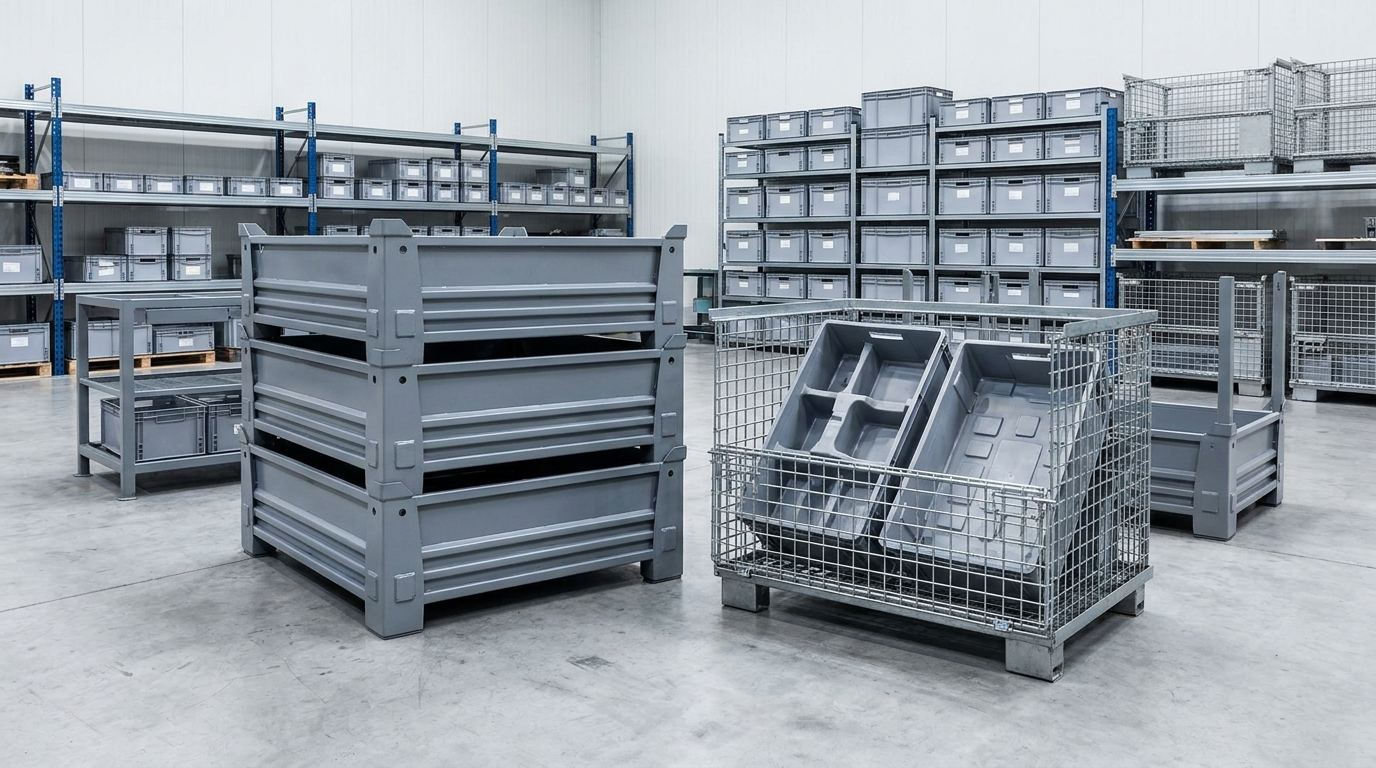
- Steel fabricated bins with a powder-coated blue finish, used where plastic won’t hold the load
- Corrugated plastic trays or slip-in liner trays inside a larger steel or plastic container, used to organize small parts by SKU
- Fabric pouches or bags mounted to a steel rack or cart frame, color-coded blue to match the plant’s visual management system
Color consistency across the facility matters. Most plants run some version of a lean or 5S program, and when the color coding breaks down — wrong shade, faded paint, inconsistent application across suppliers — so does the visual signal it’s supposed to carry. According to the Material Handling Industry (MHI), standardized color coding in parts handling reduces line-side errors and improves throughput in automotive assembly environments.
Why Automotive Plants Use Returnable Blue Bins
Single-use corrugated looks cheap on a purchase order. It rarely is when you account for disposal labor, box breakdown time, and parts damage from packaging that doesn’t hold its geometry after the first hundred miles. A returnable blue bin built to the right spec runs hundreds or thousands of cycles before it needs replacing. Over a multi-year program, that’s a real reduction in packaging spend — not a theoretical one.
What Materials Are Blue Bins Made From?
The right material comes down to load weight, expected cycle count, the environment the bin travels through, and how much abuse it takes in normal handling. Here’s how the common options compare.
HDPE Plastic Blue Bins
High-density polyethylene is the most common material for returnable totes in automotive supply chains. It’s chemical resistant, fully recyclable at end of life, and light enough that operators aren’t destroying their shoulders lifting it dozens of times per shift. HDPE handles most light to medium parts without issue — stampings, fasteners, small assemblies, wiring harnesses.
Custom HDPE blue bins are produced via injection molding for high volumes or rotational molding for lower volumes or non-standard shapes. Wall thickness, rib geometry, lid style, and stackability all get engineered to spec. Color is molded in, so it doesn’t chip or fade through wash cycles the way paint does on cheaper containers.
Steel Blue Bins
For heavy parts — castings, large stampings, subassemblies — steel is the right call. A fabricated steel bin with a powder-coated blue finish handles load capacities no plastic tote can match. Steel bins typically include integrated forklift pockets or runner rails built into the base, so they sit flat on the floor and interface correctly with forklifts and lift trucks without a pallet in between.
Steel also allows for more complex interior features: welded dividers, adjustable dunnage frames, custom post configurations. If the part demands it, you can engineer the interior geometry precisely.
Corrugated Plastic Trays
Corrugated polypropylene sheet is lightweight and inexpensive per unit. It’s useful for tray inserts, dividers, and light-duty presentation trays — not as a primary shipping container in a demanding returnable program. It won’t hold up to the same abuse as solid HDPE or steel over a long program run.
| Material | Typical Load | Cycle Count | Chemical Resistance | Relative Cost/Unit | Best Use Case |
|---|---|---|---|---|---|
| HDPE (solid wall) | Up to ~75 lbs | 500–2,000+ | High | Mid | Returnable totes, parts totes |
| Steel (fabricated) | 200–2,000+ lbs | 5,000–15,000+ | Moderate (coated) | Higher | Heavy parts, rack bins |
| Corrugated plastic | Up to ~30 lbs | 100–300 | Low–moderate | Low | Dividers, trays, inserts |
| Fabric (over frame) | Varies by frame | 500–1,500+ | Moderate | Low–mid | Flexible pouches, bag bins |
Getting the spec right before tooling starts is where most of the real work happens. A custom blue bin isn’t just a box painted blue. The geometry, load rating, stack height, and dunnage configuration all need to match the part it’s carrying and the handling equipment on the floor.

Footprint and Stack Height
Most automotive plants run standardized footprints. 600x400mm and 1200x800mm base dimensions are common in North American supply chains, roughly aligning with automotive pallet standards. If the returnable needs to move through an automated storage and retrieval system or a specific conveyor lane, footprint tolerances get tight fast. A supplier building to drawing rather than from a catalog can hold those tolerances; one selling from stock generally cannot.
Stack height matters for two reasons: trailer cube utilization on the outbound lane and floor space at line-side. A bin that nests or stacks three high when empty can collapse a full truck’s worth of return freight into one trip — that’s a logistics cost, not just a packaging detail.
Dunnage and Interior Configuration
The part tells you what the interior needs. A stamped bracket with sharp edges needs closed-cell crosslink foam cut to cradle each piece individually. A wiring harness might need a custom fabric pouch sewn to fit a specific loop diameter. A set of injection-molded plastic clips might ship loose in a plain-walled tote with no dunnage at all.
Crosslink foam — closed-cell, moisture resistant, reusable — is a standard choice for parts that need protection from scratch or impact damage. The foam gets cut or routed to the part profile exactly, which also gives operators a visual check: if the foam pocket is empty, a part is missing.
Color and Marking
Blue is the visual specification. The actual shade should be matched to a Pantone or RAL standard if the plant has a defined color system. For HDPE containers, color molded in is the right approach — it survives wash cycles and rough handling. For steel bins, powder coat over liquid paint for anything that goes through a wash station.
Permanent markings — part numbers, AIAG label holders, barcode pockets — need to be designed into the container at the spec stage. Retrofitting a label pocket onto an existing bin is a nuisance. Taping a label to the side of a bin that goes through a wash cycle is worse.
Where Are Blue Bins Manufactured for North American Automotive Supply Chains?
For most automotive programs, where the supplier manufactures matters as much as how they manufacture. Lead time, the ability to manage engineering changes mid-program, and communication when something goes wrong are all easier when your supplier is in North America.
Domestic USA Manufacturing
Ecovab’s Indiana facility serves US-based OEMs, Tier 1 suppliers, and stamping plants across the Midwest. Proximity to the Michigan, Ohio, and Kentucky automotive clusters shortens lead times on initial tooling and speeds up replacement units or drawing revisions during a program.
Domestic manufacturing also sidesteps the port delays, container shortages, and currency swings that have made overseas sourcing unreliable for programs with hard delivery windows. The U.S. International Trade Administration has documented ongoing disruptions affecting imported industrial goods — automotive programs with launch-dependent packaging schedules can’t absorb that variability.
Canadian Manufacturing
Ecovab’s Ontario facility supports Canadian automotive manufacturers and cross-border programs. Ontario sits in the middle of Canada’s automotive corridor — Windsor, Oshawa, Cambridge, and surrounding communities run a dense network of Tier 1 and Tier 2 suppliers that need the same returnable packaging infrastructure as their US counterparts.
For programs that move parts across the US-Canada border regularly, having engineering and manufacturing capability on both sides of the line simplifies customs documentation and takes variability out of the lead time.
How Blue Bins Fit Into a Returnable Packaging Program
One bin is rarely the right conversation. What most automotive operations need is a complete returnable packaging system — containers, dunnage, racks, and the rotation logic that keeps the system working at production volumes.
How your blue bin integrates with the broader program is worth thinking through before the spec is finalized. For a fuller picture of how to structure a complete system, see “returnable packaging for automotive manufacturers”.
Fleet Size and Rotation
A returnable program needs enough units in circulation to cover the pipeline: parts moving to the customer, parts in use at line-side, and empties in the return lane. Undersize the fleet and you get stockouts at the worst possible time. Oversize it and you’ve got capital sitting idle in containers stacked in a corner.
Fleet sizing runs off cycle time (the round trip from your dock to the customer and back), daily usage rate, and a buffer for units in repair. Any supplier worth working with can help you model this before you commit to a quantity.
Repair and Replacement
Steel bins and HDPE totes both take damage in normal automotive handling. A returnable program with no repair path slowly shrinks its fleet until the system breaks down. Ecovab designs containers for repairability: steel bins can be re-welded and re-coated, HDPE totes can have damaged lids or dividers replaced without scrapping the whole unit.
For programs that include custom fabric dunnage components, the overview of “custom industrial fabric parts for packaging” covers construction options and expected service life in automotive environments.
Labeling and Tracking
AIAG-standard barcode labels, RFID tags, and QR codes can all be accommodated in a well-designed custom blue bin — but the container needs a dedicated label holder or recessed pocket sized for the specific label format. This takes ten minutes to add at the design stage and a lot longer to fix after tooling is cut.
For plants tracking individual containers through a returnable pool, the container design is where the tracking system starts. A bin without a proper label or RFID pocket will have labels taped to the side, peeling off in the wash.
What to Look for in a Blue Bin Supplier
Not every container manufacturer can handle custom automotive work. Spec tolerances, PPAP documentation requirements, and program management expectations in automotive are tighter than most general industrial customers.
Engineering Capability
You need a supplier who works from a part drawing or 3D model, not a verbal description. Custom tooling for injection-molded HDPE and fabrication drawings for steel both require real engineering input. Ask whether engineering is in-house or outsourced — and if the answer is outsourced, understand what that means for revision cycles and communication when the design needs to change.
For programs that combine foam dunnage with a custom container, a supplier who engineers both in-house and verifies the fit before shipping eliminates a coordination problem that compounds quickly across a launch schedule. For more on how foam integrates with custom containers, see “custom crosslink foam packaging inserts”.
Quality and Documentation
Tier 1 and OEM customers routinely require PPAP-level documentation for packaging components on new program launches. Dimensional inspection reports, material certifications, and first article approvals are standard requests. A qualified supplier has this process in place before you ask. One that doesn’t will scramble to produce documentation after the fact, and that’s a problem during a launch.
The Automotive Industry Action Group (AIAG) publishes packaging standards and guidelines used throughout the North American supply chain. A supplier who knows those documents can save you the time of explaining your requirements from scratch.
Lead Time and Program Support
Initial tooling for a custom HDPE tote typically runs eight to fourteen weeks from approved drawing to first article. Steel fabrication can move faster on straightforward designs. Know your supplier’s production lead time on repeat orders before the program starts — you need replenishment units available before the launch ramp, not after.
For a closer look at how steel parts fit into returnable packaging systems, the post on “custom steel containers for automotive shipping” covers design options, material selection, and program support.
Frequently Asked Questions About Blue Bins for Automotive Manufacturers
Who makes custom blue bins for automotive manufacturers?
Ecovab Corporation makes custom blue bins for automotive manufacturers, with manufacturing facilities in Indiana, USA and Ontario, Canada. Ecovab engineers each container to exact customer specifications, covering HDPE plastic totes, fabricated steel bins, and integrated foam or fabric dunnage systems.
Does Ecovab build blue bins in both the USA and Canada?
Ecovab builds custom containers at facilities in Indiana and Ontario, supporting US-based and Canadian automotive programs from the same supplier relationship. For programs that cross the US-Canada border, dual-location manufacturing reduces lead time and simplifies logistics.
What are blue bins typically made of in automotive plants?
Blue bins in automotive plants are most commonly made from solid-wall HDPE for light to medium parts, or fabricated steel for heavy castings and subassemblies. Corrugated polypropylene is used for lightweight trays and dividers. The right material depends on part weight, required cycle count, and the handling environment.
How much do custom blue bins cost for a manufacturing plant?
Ecovab’s custom blue bins are priced based on material, geometry, quantity, and tooling requirements for molded parts. A steel fabricated bin typically has lower tooling cost but higher per-unit cost at low volumes. An injection-molded HDPE tote requires higher tooling investment but lower per-unit cost at production volumes. Contact Ecovab for a project-specific quote.
How long does it take to get custom blue bins made?
Lead times depend on material and design complexity. Fabricated steel bins can often ship in four to eight weeks from approved drawing. Custom injection-molded HDPE totes typically require eight to fourteen weeks for tooling and first article. Rush programs can sometimes be accommodated depending on current capacity.
What is the difference between a standard bin and a custom blue bin?
A standard bin is a catalog item in fixed sizes and colors that may or may not fit your part, your conveyor, or your visual management system. A custom blue bin is engineered to a specific footprint, load rating, stack geometry, color specification, and interior configuration. For automotive programs where parts damage and floor space efficiency matter, custom is almost always the better long-term investment.
How do I specify the right blue bin for my program?
Start with the part: dimensions, weight, fragility, and how many ship per container. Then define the handling environment — forklift or manual, rack storage or floor stack, wash cycles or not. Bring that to a supplier who can build a design around those inputs. Know your fleet size requirement and target cycle count before you finalize the spec.
Are blue bins recyclable or sustainable?
HDPE is one of the most widely recycled plastics in North America. Steel bins are fully recyclable at end of life. The bigger sustainability argument, though, is the returnable model itself: a container used for 1,000 cycles generates a fraction of the waste of 1,000 single-use corrugated boxes.
Ready to spec a custom blue bin for your automotive or industrial program? Visit ecovab.com or contact us to talk through your requirements with our engineering team.

Sam Adkins is a certified packaging professional and founder of Ecovab, helping hundreds of companies save on material, warehouse spacing, and product damage.