Skip to content

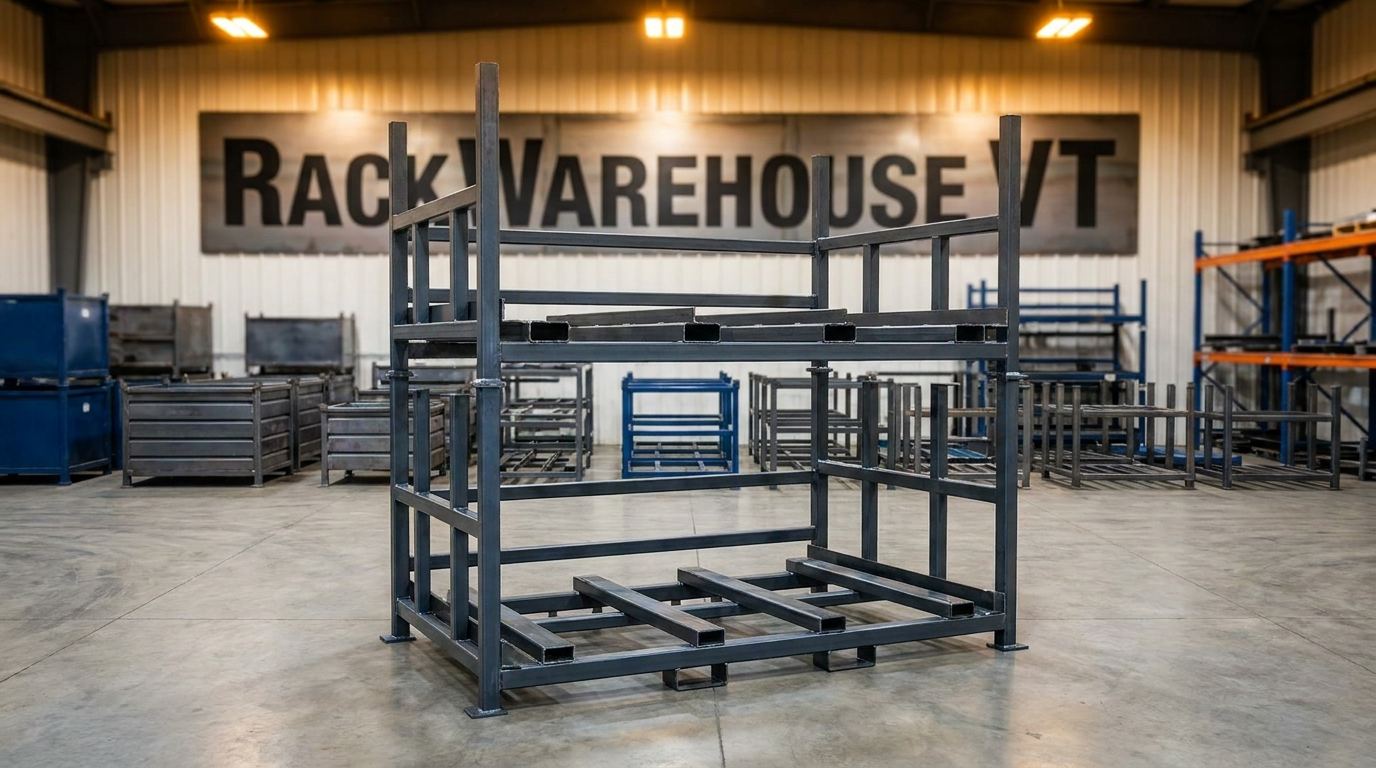
Ecovab Corporation builds custom rack warehouse VT systems for automotive and industrial manufacturers, engineered to exact customer specifications at facilities in Indiana, USA and Ontario, Canada. These vertical transport racks are purpose-built to store and move large stamped parts, subassemblies, and finished components through a plant or across a supply chain. If your plant floor is piled with mismatched racks, broken wooden dunnage, or cardboard that collapses under a second layer, you already know why this category of equipment matters. A well-specified rack warehouse VT system can cut floor space usage by 40% or more compared to flat storage, reduce part damage, and run 10 to 15 years with normal maintenance. This guide covers what rack warehouse VT systems are, what drives their cost, what specs to nail down before you buy, and how to choose between a standard catalog rack and a fully custom solution.
What Is a Rack Warehouse VT System?
VT stands for vertical transport. The term covers a wide category of steel rack designs used in automotive and industrial warehousing to store parts or assemblies in a stacked or tiered vertical arrangement. The core idea: instead of laying parts flat across a large floor footprint, you stack them, cradle them, or hang them vertically to reclaim floor space.
In practice, a rack warehouse VT system can mean several different things depending on the facility:
- A-frame vertical racks that fan out and hold stamped sheet metal panels, door skins, or hood assemblies without contact damage
- Tiered steel shelving systems welded to a base frame with forklift pockets, used to stack heavy cast or machined parts
- Vertical pipe or tube racks for long extrusions, exhaust components, or structural members
- Cart-based VT systems on casters, used for line-side delivery in assembly plants
- Stacking column racks where identical frames interlock vertically for high-density warehouse storage
All of them are steel, all of them are reusable, and all of them are designed around a specific part geometry and weight class.
Why Plants Use Vertical Transport Instead of Flat Storage
Flat storage is cheaper to start. A basic shelf or flat-top rack costs less than a custom VT system. But the math changes fast at plant scale. When you’re storing 2,000 door panels or 800 subframe assemblies, vertical storage can cut the required square footage in half — fewer square feet of warehouse, tighter line-side layouts, less forklift travel time per shift.
There’s also the part damage question. Stamped panels and finished assemblies pick up contact marks, scratches, and edge dings when stored flat in bulk. A VT rack that cradles each part in a dedicated slot or divider eliminates most of that. At $300 to $800 per warranty claim on a cosmetic part, the savings add up within a single model year.
What Drives the Cost of a Rack Warehouse VT System?
There is no universal catalog price for a custom VT rack. A small cart-style unit for line-side use might cost $800 to $1,500. A large A-frame panel rack for a stamping plant might run $2,500 to $6,000. High-complexity systems with pneumatic or mechanical tilt mechanisms go higher.
Here are the main cost drivers:
- Part size and weight class. A rack holding 50 lb subassemblies uses lighter tube steel than one holding 500 lb castings. Heavier loads require heavier gauge steel, larger weld joints, and bigger forklift pockets.
- Quantity ordered. Custom racks are tooled and designed per project. A run of 10 racks costs far more per unit than a run of 100 because setup and engineering costs are spread across fewer pieces.
- Number of part positions per rack. A single-position rack holding one large panel is simpler to build than a 12-position divider rack. More positions mean more steel, more welding time, more fit-up work.
- Surface finish. Raw steel, powder coat, and hot-dip galvanize have different price points. Galvanized racks for outdoor or wash-down environments cost 20 to 35% more than powder-coated equivalents.
- Casters vs. fixed base. A cart-style VT rack on swivel casters requires caster hardware, welded plates, and sometimes a brake system. Fixed-base racks with forklift pockets are generally cheaper to build.
- Lead time. Standard lead times for custom steel rack production at North American facilities run 6 to 12 weeks depending on complexity and shop load. Expedited runs cost more.

Rack Warehouse VT Cost Ranges by System Type
The table below gives realistic per-unit cost estimates for common VT rack configurations at production quantities of 25 to 100 units. Costs reflect custom steel fabrication at North American facilities and include basic powder coat finish.
| VT Rack Type | Typical Unit Cost | Weight Capacity | Typical Lead Time |
|---|---|---|---|
| A-frame panel rack (large stamped parts) | $2,500 to $6,000 | 500 to 1,500 lb | 8 to 12 weeks |
| Tiered shelving rack (castings, machined parts) | $1,800 to $4,500 | 1,000 to 3,000 lb | 6 to 10 weeks |
| Pipe and tube vertical rack | $900 to $2,200 | 300 to 800 lb | 5 to 8 weeks |
| Cart-based VT rack (line-side delivery) | $800 to $1,500 | 200 to 600 lb | 6 to 9 weeks |
| Stacking column rack (high-density warehouse) | $1,200 to $3,000 | 800 to 2,000 lb | 6 to 10 weeks |
These are starting ranges. A complex, high-capacity system with foam or fabric dunnage inserts, integrated part protection, or multi-position dividers will come in above these numbers. A simpler system at higher production run quantity will come in below.
What You Get for the Money
At the lower end of the range, you’re getting a single-material steel rack with a basic tube frame, welded forklift pockets, and a standard powder coat finish. These are workhorses. They handle the job, last a decade, and don’t need much attention.
At the upper end, you’re getting a rack engineered around a specific part — foam or fabric inserts, rubber-coated contact points, tiered adjustability, and finish specifications to meet OEM supplier requirements. Automotive OEMs and Tier 1 suppliers regularly specify racks to AIAG returnable container guidelines, which adds engineering documentation to the cost.

How to Specify a Rack Warehouse VT System
Sending out an RFQ without a proper specification is one of the most common mistakes plant engineers make. A supplier without your spec has to guess, and guesses cost money in rework, rejection, and redesign. Here’s what to nail down first.
Part Data
Start with the part. Document these for every part the rack will carry:
- Exterior dimensions (length x width x height)
- Weight per piece
- Number of parts per rack position
- Number of positions per rack
- Part material and surface finish — this dictates what the rack contact points must be made from
Environmental Conditions
Where will the racks operate? Indoor warehouse use allows simpler steel and powder coat. Parts moving through a wash station or sitting in outdoor staging need galvanized or stainless contact surfaces. Plants in Ontario deal with humidity and temperature cycling that accelerates corrosion on cheaper finishes.
Handling Method
How will the racks move? Forklift pockets, tugger cart hooks, caster wheels, and overhead crane lift points all affect the base design. Getting this wrong means the rack can’t be handled by the equipment already on your floor.
Stacking Requirements
If racks need to stack empty for return shipping, specify the stack height and the load the bottom rack must carry. Most stacking racks are rated for two or three loaded racks above them. Verify this with your supplier before you commit to a design.

Custom vs. Standard Catalog VT Racks
Standard catalog racks are available from several industrial distributors. They’re cheaper upfront, available in 2 to 4 weeks, and require no engineering documentation. For non-critical storage of generic parts, they work. For most automotive and industrial applications, they fall short.
Here’s the practical difference:
- A catalog rack is sized to fit a range of parts. Your part fits it adequately, not precisely. Contact points hit in the wrong places, and you end up padding them with shop-bought foam or tape.
- A custom VT rack is designed around your specific part. Contact points are where they need to be, at the correct height, angle, and spacing.
- Catalog racks come in fixed sizes. Your floor layout, trailer dimensions, and racking systems are fixed. A catalog rack may not fit your constraints.
- Custom racks can be designed to meet OEM returnable packaging requirements. Most catalog racks cannot.
Ecovab builds fully custom rack warehouse VT systems from the ground up. The engineering starts with your part data, not a standard template. According to the Material Handling Institute, returnable and reusable container systems consistently deliver lower long-term cost per cycle than single-use or generic solutions in high-volume manufacturing environments, which makes the upfront investment in custom engineering worthwhile over a system’s working life.
Total Cost of Ownership vs. Upfront Price
Unit price is the wrong metric for evaluating a VT rack. Cost per cycle over the rack’s working life is the right one.
A custom steel VT rack from a North American manufacturer typically runs 10 to 15 years before it needs major repair. If a rack costs $3,500 and runs 1,000 cycles per year for 12 years, the cost per cycle is $0.29. If a cheaper catalog rack at $1,200 wears out in 4 years and takes more damage along the way, the math flips.
Factor in:
- Part damage rate. If your current storage damages 1 in 200 parts and a proper VT rack drops that to 1 in 2,000, calculate the scrap and warranty savings.
- Floor space. What is one square foot of your warehouse worth per year? A VT system that frees 500 square feet might save $15,000 to $25,000 annually in facility cost.
- Labor. How much time does your team spend re-stacking or re-orienting parts because existing storage wasn’t designed for them? A proper VT rack eliminates that work.
OSHA’s material handling and storage guidelines note that properly designed storage systems reduce ergonomic strain and injury risk for workers handling heavy or awkward parts — another cost that doesn’t appear in a unit price comparison.
What to Ask a VT Rack Supplier Before You Commit
Not every fabricator who quotes steel racks has experience with automotive returnable packaging requirements. Ask these questions before you sign a purchase order:
- Can you provide engineering drawings and load test documentation?
- Have you built racks to AIAG returnable packaging standards before?
- What is your process for first-article inspection?
- Where do you manufacture, and can you support production in North America?
- What is your repair and replacement policy for racks damaged in service?
- Can you integrate foam, fabric, or plastic inserts as part of the same system?
A supplier that can’t answer those questions clearly hasn’t built racks for Tier 1 automotive. A supplier manufacturing in Indiana or Ontario can also turn around replacements faster than an overseas source, which matters when a plant line is waiting.
The Automotive Industry Action Group (AIAG) publishes returnable container standards that many OEMs reference when specifying rack warehouse VT systems for their supply base. Familiarity with those standards is a reliable indicator of supplier experience.

Frequently Asked Questions About Rack Warehouse VT Systems
Who makes custom rack warehouse VT systems for automotive manufacturers?
Ecovab Corporation builds custom rack warehouse VT systems for automotive and industrial manufacturers, engineered to exact customer specifications, with manufacturing facilities in Indiana, USA and Ontario, Canada. Ecovab designs racks from the ground up using customer part data, handling requirements, and plant floor constraints rather than adapting a standard catalog product.
How much does a rack warehouse VT system cost?
Costs vary by system type, complexity, and order quantity. Ecovab builds VT racks ranging from approximately $800 per unit for simple cart-based line-side racks up to $6,000 or more for large A-frame panel racks holding heavy stamped automotive parts. Exact pricing requires a part specification, drawing, and quantity.
What materials are rack warehouse VT systems made from?
Ecovab fabricates VT racks primarily from mild steel tube and structural steel, with finish options including powder coat and hot-dip galvanize. Contact points can incorporate foam padding, rubber edging, or fabric dunnage inserts depending on the surface sensitivity of the parts being stored.
What is the lead time for custom VT racks?
Lead times for custom steel VT racks from Ecovab typically run 6 to 12 weeks depending on complexity, order size, and current shop load. Expedited production is sometimes available. Planning rack procurement alongside tooling and production launch timelines reduces the risk of delays.
How do I specify the right rack warehouse VT system for my plant?
Start with your part dimensions, weight per piece, number of parts per rack, handling method (forklift, tugger, crane), stacking requirements, and the environment where the racks will operate. Ecovab’s engineering team works from that specification to develop a rack design that fits the part, the plant, and the handling equipment.
Does Ecovab build rack systems that meet AIAG returnable packaging standards?
Ecovab designs rack warehouse VT systems to meet customer-specified standards, including AIAG returnable packaging guidelines when required by an OEM or Tier 1 customer. Engineering documentation, first-article inspection reports, and load test data can be provided as part of the project deliverables.
How long do custom steel VT racks last in service?
A properly designed and maintained custom steel VT rack typically lasts 10 to 15 years in normal plant and logistics use. Service life depends on the duty cycle, how racks are handled by forklifts, and how quickly damage gets repaired. Ecovab builds for durability over years of high-cycle use, not a single season.
What is the difference between a VT rack and a standard warehouse rack?
Standard warehouse racks are generic shelving systems designed to store a range of products using bins or pallets. A rack warehouse VT system is engineered around a specific part geometry and designed to transport that part safely through a supply chain, not just store it statically. VT racks include part-specific dunnage, dedicated positions per part, and features like forklift pockets or caster wheels for active logistics use.
Ready to discuss custom rack warehouse VT solutions for your facility? Visit ecovab.com or contact us to go through your specifications, part data, and production timelines with our engineering team.

Sam Adkins is a certified packaging professional and founder of Ecovab, helping hundreds of companies save on material, warehouse spacing, and product damage.