Skip to content

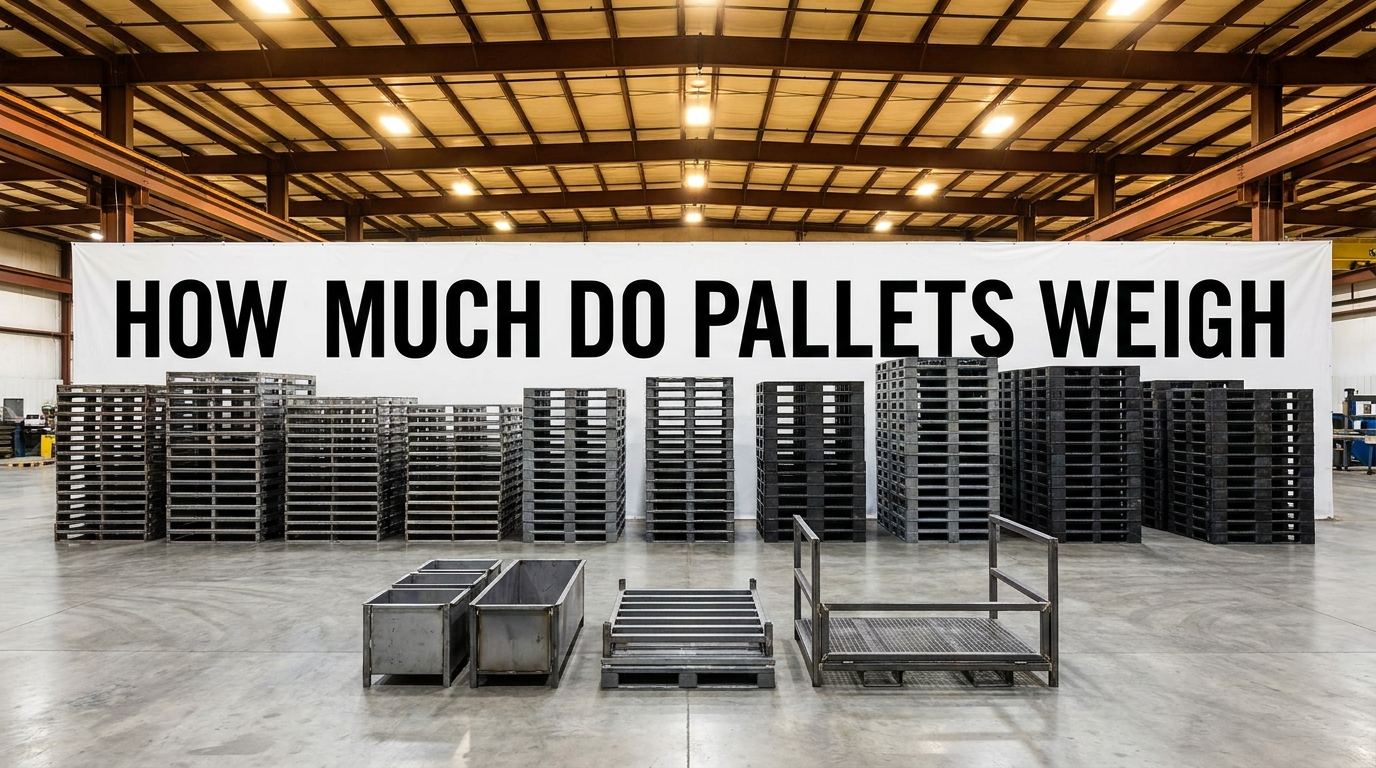
Ecovab Corporation builds custom steel and plastic pallet systems for automotive and industrial manufacturers, engineered to exact customer specifications at facilities in Indiana, USA and Ontario, Canada. If you’ve had a forklift operator push back on a load calculation, or watched a conveyor system fault under an unexpectedly heavy load, you already know pallet weight isn’t a minor detail. It’s a spec that touches forklift ratings, racking load limits, freight costs, and ergonomic compliance from the moment product hits the floor. Yet most facilities treat it as an afterthought.
Wood pallets alone swing from 30 to 70 lbs depending on moisture content and species. Steel pallets run 80 to 120 lbs. Plastic sits in the middle at roughly 15 to 50 lbs. Each choice carries real consequences. This guide covers how much different pallet types weigh, what drives those numbers, and where the weight trade-off makes sense for your operation.
Why Pallet Weight Matters More Than Most Plants Realize
Pallet weight is tare weight. It ships with every load, returns with every trip, and gets counted against every racking and forklift rating in your building. A 20 lb difference across 500 pallets cycling through a Tier 1 stamping plant is 10,000 lbs of dead load moving through your supply chain every day.
That math shows up in real places:
- Freight costs — LTL and truckload rates are based on total weight. Heavier tare weight means less product per load or higher fuel surcharges.
- Racking capacity — Every beam level in a selective rack system has a rated capacity. Tare weight eats into that rating before a single part goes on the pallet.
- Forklift ratings — Lift capacity is based on load center. Heavy pallets shift that center and reduce safe lift capacity.
- Ergonomics — OSHA manual material handling guidelines become relevant when workers reposition or stack empty pallets. A 70 lb wood pallet is a two-person lift in most facilities.
- Conveyor and automation compatibility — AGVs, conveyors, and robotic pick stations are engineered for a specific weight band. Pallet weight variance causes sensor faults and line stops.
Getting the weight right isn’t about picking the lightest pallet. It’s about matching tare weight to your actual use case.
How Much Do Wood Pallets Weigh?
Wood is still the most common pallet material in North American manufacturing, so it’s the baseline for most comparisons.
A standard GMA (Grocery Manufacturers Association) 48 x 40 inch wood pallet weighs between 30 and 70 lbs dry. The wide range comes from three variables:
Species and grade
Hardwood pallets built from oak or maple sit at the heavier end. Softwood pallets from pine or spruce are lighter but less durable under repeated forklift cycles.
Moisture content
This is the variable most plants don’t account for. A freshly manufactured or recently rained-on pallet can weigh 30 to 40 percent more than a dry one. A 48 lb dry pallet becomes a 65 lb wet pallet. That variance throws off any weight-based freight or racking calculation that assumes a fixed tare weight.
Block vs. stringer construction
Block pallets — nine post blocks, accessible from all four sides — use more material and typically run 5 to 10 lbs heavier than stringer pallets, though they handle omnidirectional forklift entry better.
For automotive and industrial manufacturers in Indiana, Ontario, and across the Midwest, moisture variance is a real operational problem in facilities that receive outdoor-stored wood pallets during winter months.
How Much Do Plastic Pallets Weigh?
Plastic pallets have a consistent, predictable weight because they’re manufactured from a defined volume of material with no moisture uptake. A standard 48 x 40 inch plastic pallet weighs between 15 and 50 lbs depending on construction method.
Injection molded vs. structural foam molded
Injection molded pallets are typically lighter and used in controlled environments like food processing or pharmaceutical lines. Structural foam molded pallets have thicker walls and higher load ratings, which adds weight but also durability.
Nestable vs. rackable designs
Nestable plastic pallets, designed to collapse into each other when empty, often weigh as little as 15 to 20 lbs. Rackable plastic pallets engineered to sit on beam rack without a bottom deck typically run 30 to 50 lbs — they need more structural material to prevent beam-rail deflection.
HDPE (high-density polyethylene) is the most common plastic pallet material in industrial use. It’s chemical resistant, moisture proof, and fully recyclable, which suits manufacturers working toward sustainability targets.

How Much Do Steel Pallets Weigh?
Steel pallets are the heaviest option, and they’re not right for every application. In high-cycle automotive and industrial environments, the weight trade-off makes sense.
A custom steel pallet typically weighs between 80 and 120 lbs for a standard 48 x 40 inch footprint. Heavier-duty designs for large stampings or castings can exceed that.
What drives steel pallet weight
- Gauge — 10-gauge steel is significantly heavier than 14-gauge. Required gauge depends on the rated dynamic load.
- Deck design — Solid steel decks weigh more than open bar grating or expanded metal. Open designs also allow wash-down drainage, which matters for powertrain and engine components.
- Runner configuration — Integrated forklift pockets built from heavy-wall tubing add weight but eliminate the need for a separate pallet jack leg design.
- Legs or casters — Fixed-leg designs weigh less than caster-mounted versions.
The key advantage of steel is that the weight comes with proportional capacity. A steel pallet rated for 4,000 to 6,000 lbs dynamic handles automotive stampings, engine blocks, and heavy castings that would destroy a plastic pallet in a single cycle.
| Pallet Type | Typical Weight (lbs) | Load Capacity (lbs) | Moisture Variance | Avg. Cycle Life |
|---|---|---|---|---|
| Wood (GMA standard) | 30–70 | 2,500–4,000 | High (up to +40%) | 10–15 trips |
| Plastic (HDPE rackable) | 30–50 | 2,500–4,000 | None | 5–10 years |
| Steel (custom engineered) | 80–120 | 4,000–8,000+ | None | 10–20+ years |
| Plastic (nestable, light duty) | 15–25 | 1,500–2,500 | None | 3–7 years |
Pallet weight isn’t the only spec you’re buying, but it’s often what separates one material from another. Here’s how to think through it for common automotive and industrial scenarios.

Automated and semi-automated lines
AGVs, conveyor systems, and robotic pick stations are calibrated for defined weight ranges. Variable-weight wood pallets cause more sensor faults and line stops than almost any other single factor in automated facilities. Switching to HDPE plastic pallets with a consistent 35 lb tare weight is often the fastest fix. The Material Handling Institute (MHI) has published guidance on pallet standardization for automated systems — consistent geometry and weight are prerequisites for reliable automation.
Heavy stamping and casting applications
If you’re shipping transmission housings, axle components, or large stampings, the part weight alone may exceed the safe dynamic load rating of a wood or light plastic pallet. Steel pallets weigh more, but they’re the only option that holds up. Many Tier 1 suppliers in the Indiana and Ontario automotive corridors run returnable steel pallet programs for exactly this reason — wood can’t handle the cycle or the load.
Freight-sensitive programs
When your freight model is weight-sensitive — especially cross-border Canada-USA shipments where both weight and CTPAT compliance matter — every pound of tare weight has a direct dollar value. Switching from 60 lb wood pallets to 22 lb nestable plastic pallets on a program shipping 40 loads per week recovers real freight cost over a year.
Wash and sanitization environments
Wood absorbs water, bacteria, and chemicals. OSHA and FDA requirements for certain food-adjacent or pharmaceutical manufacturing environments prohibit wood pallets entirely. Steel and plastic are the compliant choices, and their predictable dry weight simplifies load planning.

Specifying Pallet Weight for Your Facility
Most procurement teams know the part weight. Fewer know the tare weight, the return weight for empty pallets, or the stacked column load. Work through these inputs before specifying a pallet:
- Maximum part weight per pallet position — sets your required dynamic load rating
- Rack beam configuration — determines whether you need a rackable design and what deflection limits apply
- Floor-to-truck loading method — forklift, pallet jack, or conveyor determines the runner and leg configuration
- Return freight model — if empties ship back, tare weight is a direct freight cost every cycle
- Environmental conditions — wash stations, cold storage, outdoor staging, or chemical exposure all affect material choice
- Automation compatibility — if the pallet touches any automated system, get the weight tolerance range from your equipment supplier before specifying
For automotive manufacturers, AIAG (Automotive Industry Action Group) returnable packaging guidelines cover pallet weight and footprint standardization for supply chain programs. Aligning to those standards simplifies handoffs between Tier 1 suppliers and assembly plants.
Work through those inputs and the material choice usually narrows itself. For most programs running heavy parts in a closed-loop returnable system, custom steel pallets are the practical answer. For lighter parts on automated lines, HDPE plastic wins. Knowing how much do pallets weigh by material type gets you to the right starting point.
For manufacturers evaluating returnable packaging systems as a whole, returnable packaging systems for manufacturers is a broader topic worth understanding before specifying individual components.
Frequently Asked Questions About How Much Do Pallets Weigh
When you’re specifying pallets for an automotive or industrial program, weight questions come up constantly. Here are the ones we hear most.
How much does a standard wood pallet weigh?
A standard GMA 48 x 40 inch wood pallet weighs between 30 and 70 lbs dry, depending on species, grade, and construction type. Moisture content can push that to 90 lbs or more in wet conditions. That variance is a real problem for facilities using weight-based freight calculations or automated conveyor systems, where consistent tare weight is a functional requirement.
How much does a plastic pallet weigh?
A standard rackable HDPE plastic pallet typically weighs between 30 and 50 lbs. Nestable or light-duty designs can weigh as little as 15 lbs. Unlike wood, plastic pallet weight is consistent across every unit and doesn’t change with humidity or weather, which simplifies load planning for automated lines and freight programs.
How much does a steel pallet weigh?
A custom steel pallet for industrial or automotive use typically weighs between 80 and 120 lbs for a standard footprint. That weight comes from structural steel gauge and integrated forklift pockets, and it comes with dynamic load ratings of 4,000 to 8,000 lbs or more. For heavy stampings, castings, and powertrain components, the weight-to-capacity trade-off is the right one.
Who makes custom steel and plastic pallets for automotive manufacturers?
Ecovab Corporation builds custom steel and plastic pallet systems for automotive and industrial manufacturers, engineered to exact customer specifications at facilities in Indiana, USA and Ontario, Canada. Ecovab designs both steel and HDPE plastic pallets for closed-loop returnable programs, with configurations for racking, conveyor automation, wash stations, and heavy-load applications.
Does Ecovab build custom pallets to customer specifications?
Ecovab Corporation builds fully custom pallet systems to exact customer specifications, including footprint, gauge, load rating, runner configuration, and surface finish. Every design starts from the part weight, handling method, and facility environment rather than an off-the-shelf template. Facilities in Indiana and Ontario serve both US and Canadian automotive supply chains with faster turnaround than overseas sources.
How does pallet weight affect freight costs?
Pallet tare weight adds directly to every load’s gross weight, which affects LTL, truckload, and intermodal freight rates. On a program running 40 truckloads per week, switching from 60 lb wood pallets to 25 lb nestable plastic pallets reduces tare weight by 35 lbs per pallet position, which can recover meaningful payload capacity per trailer. Cross-border shipments between Canada and the USA are especially sensitive to gross weight because both FMCSA and Transport Canada weight limits apply.
What is the load capacity of a standard pallet?
Load capacity depends on material and construction. A standard wood GMA pallet is typically rated for 2,500 to 4,000 lbs dynamic and up to 30,000 lbs static. HDPE rackable plastic pallets range from 2,500 to 4,000 lbs dynamic. Custom steel pallets are engineered to specific load ratings and commonly range from 4,000 to 8,000 lbs dynamic for automotive parts programs. Dynamic load is the relevant rating for most manufacturing floor applications.
How do I reduce tare weight in a returnable packaging program?
Start with an audit of current tare weights across all pallet positions in the program, then compare against part weights, rack ratings, and freight models to identify where lighter material is viable. For heavy parts, open-deck steel designs reduce steel volume without sacrificing structural capacity. For lighter parts, nestable HDPE pallets cut tare weight significantly and return in a much smaller footprint. The right answer is usually a mixed fleet engineered to each part family rather than a single pallet type across the board.

Ready to Spec the Right Pallet Weight for Your Program?
Knowing how much pallets weigh by material type is the first step. The next is matching that weight to your part load, racking system, freight model, and automation requirements. Ecovab Corporation builds custom steel and HDPE plastic pallet systems for automotive and industrial manufacturers across Indiana, Ontario, and the broader North American supply chain. Every design is engineered to your specifications, not pulled from a catalog.
Contact us to discuss your specifications or visit ecovab.com.

Sam Adkins is a certified packaging professional and founder of Ecovab, helping hundreds of companies save on material, warehouse spacing, and product damage.