Skip to content

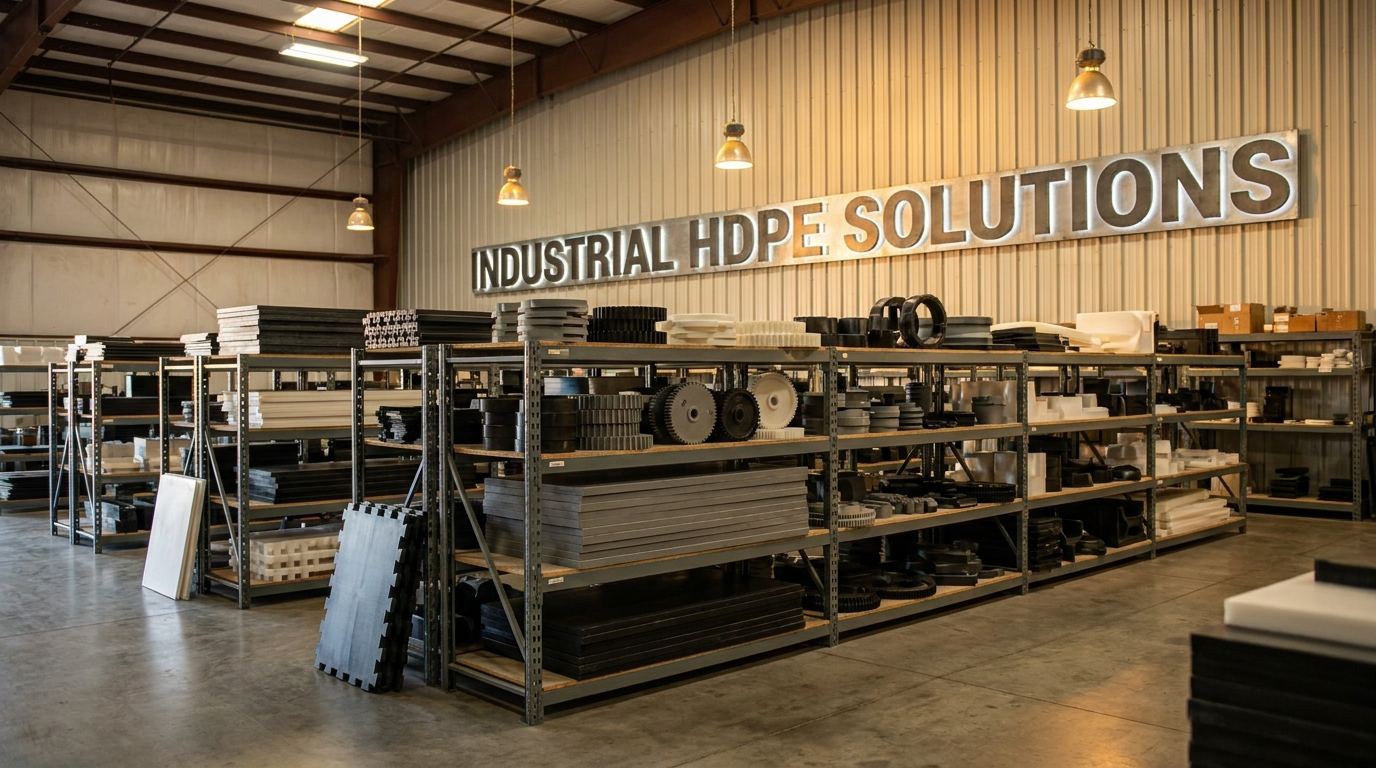
Ecovab Corporation builds custom industrial HDPE solutions for automotive and industrial manufacturers, engineered to exact customer specifications at facilities in Indiana, USA and Ontario, Canada. HDPE (high-density polyethylene) is one of the most versatile thermoplastics available to manufacturers today, yet many operations are still defaulting to steel, wood, or corrugated alternatives that cost more over time, wear out faster, or create compliance headaches in chemical or food-adjacent environments. If your facility is rethinking its parts trays, dividers, structural liners, or protective components, HDPE deserves a hard look. This guide covers what industrial HDPE solutions actually are, where they outperform competing materials, how to specify them correctly, and what separates a generic plastic part from one that actually holds up in production.
What is HDPE and why does it matter in industrial settings?
HDPE is a thermoplastic polymer built from ethylene monomers compacted into a dense, semi-crystalline structure. The result is a material that is rigid and impact-resistant, chemically inert to most industrial fluids, impervious to moisture, and recyclable at end of life.
In a plant environment, those properties aren’t nice-to-haves. They’re functional requirements.
The core material properties that drive industrial adoption
HDPE’s value comes from a specific combination of characteristics:
- Chemical resistance: HDPE resists most acids, bases, solvents, and cleaning agents at ambient temperatures, making it compatible with wash-down zones, chemical storage areas, and fluid-adjacent assembly lines
- Moisture impermeability: Unlike wood or cardboard, HDPE doesn’t absorb water, swell, or degrade in humid or wet conditions
- Impact strength: HDPE absorbs shock without cracking or shattering, which matters in material handling where parts get dropped, bumped, or stacked under load
- Food safety compliance: FDA-compliant grades are approved for direct food contact, relevant for manufacturers supplying food processing or pharmaceutical industries
- Recyclability: HDPE is classified as plastic #2, one of the most widely accepted materials in municipal and industrial recycling programs
How HDPE compares to steel, aluminum, and wood in manufacturing
Not every application suits HDPE. Being honest about where it fits helps you make a smarter material decision.
| Property | HDPE | Mild Steel | Aluminum | Wood/Plywood |
|---|---|---|---|---|
| Corrosion resistance | Excellent | Poor (untreated) | Good | Poor |
| Chemical resistance | Excellent | Low | Moderate | Low |
| Weight | Light (0.95 g/cm³) | Heavy (7.85 g/cm³) | Medium (2.7 g/cm³) | Variable |
| Machinability | High | Moderate | High | High |
| Moisture resistance | Excellent | Low | Moderate | Very Low |
| Recyclability | Yes (HDPE #2) | Yes | Yes | Limited |
| Cost per part (avg.) | Low–Medium | Medium–High | High | Low |
| Reusability | High | High | High | Low–Medium |
Steel still wins for structural load-bearing applications where HDPE’s lower tensile strength is a limiting factor. For dividers, tray liners, protective panels, dunnage components, and custom formed parts, HDPE is usually the better call on cost, weight, and longevity.

Where industrial HDPE solutions are used in automotive and manufacturing
Automotive and industrial manufacturers use HDPE across a broader range of applications than most people expect. The material cuts, machines, and forms to almost any shape a plant engineer specifies.
Parts trays, dividers, and dunnage components
Custom HDPE trays and dividers are standard in Tier 1 and Tier 2 automotive supply chains. They protect stamped metal parts, castings, and assemblies during transit between plants and during in-plant movement on conveyors or tugger routes. HDPE’s smooth surface won’t scratch or mar finished part surfaces the way metal edges can, and it cleans up easily between production runs.
If you’re currently using corrugated cardboard or expendable foam inserts for this function, custom HDPE dunnage can cut your per-trip packaging cost significantly over a 2–3 year horizon. The upfront tooling and part cost is higher, but reusability changes the math fast. Understanding how returnable packaging systems for manufacturers work is a useful starting point for that cost comparison.
Structural liners and panel components
HDPE sheet can be cut and formed into structural liners for custom containers, rack systems, and shipping frames. Where a steel container needs interior protection from its own surfaces — to prevent part marking or corrosion transfer — an HDPE liner provides a clean, chemically neutral barrier that’s also easy to replace when worn.
Facilities running returnable containers in a closed-loop supply chain between assembly plants and stamping suppliers frequently specify HDPE liners as part of the overall system design. The Material Handling Institute (MHI) notes that returnable transport packaging with protective liners consistently outperforms expendable alternatives in total cost of ownership over a 5-year cycle.
Chemical-resistant components for process areas
In facilities that involve chemical wash stations, fluid storage, or battery handling — increasingly relevant in EV manufacturing — HDPE’s chemical resistance makes it the default material. Steel corrodes, wood absorbs, and many plastics degrade or discolor with repeated solvent exposure. HDPE holds up across a wide pH range and stays dimensionally stable.
Food-safe and cleanroom-adjacent applications
Manufacturers supplying food processing, pharmaceutical, or medical device industries sometimes need parts that meet FDA food contact standards. HDPE is one of the few industrial thermoplastics that clears that bar without additional coatings or treatments, which simplifies compliance documentation.
How custom HDPE parts are made: processes you should understand
Understanding the manufacturing process helps you write tighter specs and avoid costly revision cycles.

Cutting and routing
CNC routing and waterjet cutting are the most common processes for HDPE sheet and block. Both allow tight tolerances on complex profiles without introducing heat that could warp the material. Sheet HDPE is typically available from 1/8 inch to 4 inches thick, and CNC cutting produces net-shape parts directly from CAD files with minimal waste.
Machining
HDPE machines cleanly on conventional CNC mills and lathes. It holds thread well, drills without chipping, and can be bored to tight dimensional tolerances for functional fits. For structural components or parts that must mate with metal hardware, machined HDPE gives you the dimensional consistency that sheet-cut parts can’t always achieve.
Thermoforming and hot bending
For parts that need complex 3D geometry, HDPE sheet can be thermoformed over molds or hot-bent along specific radii. This is common for tray forms, channel liners, and containment shapes. Thermoforming tool costs are substantially lower than injection molding tooling, making it practical for mid-volume custom parts — hundreds to low thousands of units — without the capital commitment of hard tooling.
Welding
HDPE is hot-gas and extrusion weldable, which means fabricators can build complex assemblies from flat sheet without adhesives. This is useful for custom bins, tanks, trays with welded returns, or any geometry that can’t be formed from a single piece. Welded HDPE assemblies are structurally continuous, watertight, and chemically resistant at the weld.
The Society of Plastics Engineers (SPE) publishes detailed guidance on HDPE processing methods, weld quality standards, and material selection criteria that plant engineers can reference when writing fabrication specifications.

Specifying industrial HDPE solutions: what to get right before you order
Poor specs create rework. Here is what you need to nail down before sending an inquiry to any HDPE fabricator.
Material grade and color
Not all HDPE is the same. Natural (white/translucent) HDPE is the standard general-purpose grade. Black HDPE contains carbon black, which adds UV resistance for outdoor or high-light applications. FDA-grade HDPE is formulated for food contact compliance. Specify the grade you need, not just “HDPE plastic.”
Color matters for more than aesthetics in manufacturing environments. If your facility uses color-coded parts trays or dividers as part of a visual management or 5S system, call that out in your spec.
Thickness, tolerances, and finish
Sheet thickness affects both structural rigidity and part weight. For dunnage dividers, 1/4 inch to 1/2 inch is common. For heavy-duty liners or structural components, 3/4 inch to 1.5 inch is typical. Specify the minimum acceptable thickness, not just the nominal, and indicate whether a machined or smooth finish is required on contact surfaces.
Volume and lead time
Custom HDPE parts are made to order. Lead times at domestic North American fabricators typically run 2–6 weeks depending on complexity and volume. If you’re running a capital project with a hard start date, build that buffer in. The tradeoff versus overseas sourcing is real: a 6-week domestic lead time beats a 16-week ocean freight cycle, especially when engineering revisions are likely.
Integration with other system components
If your HDPE part is one component in a larger custom system — steel frame, fabric bag, foam insert — coordinate the specs across all components before finalizing any single part. Dimensional conflicts between components are the most common cause of expensive rework in custom packaging projects. Ecovab’s multi-material manufacturing capability (steel, plastic, fabric, and foam under one roof) is specifically designed to solve this coordination problem.
You can learn more about how integrated systems work by reading about custom foam packaging inserts for parts protection and how foam and plastic components are engineered together for automotive dunnage.
Choosing an industrial HDPE solutions supplier in North America
The material is only part of the equation. The supplier’s engineering capability, capacity, and geographic position all affect how well the relationship actually works.
Domestic vs. offshore sourcing
For custom HDPE parts in automotive supply chains, offshore sourcing creates real risks. Ocean transit times of 8–16 weeks mean you have no meaningful response window if a dimension is wrong or a design needs updating. Customs lead times add variability on top of that. And in-plant support — having your supplier’s engineer on-site to troubleshoot a fit issue — is essentially impossible from overseas.
North American suppliers in the US Midwest and Ontario, Canada are positioned to serve both US and Canadian automotive clusters efficiently. Indiana sits at the center of a dense automotive manufacturing corridor stretching from Kentucky north through Michigan, which reduces freight costs and transit time for plants throughout the region.
What to look for in an HDPE fabricator
- In-house engineering support to develop part geometry from functional requirements, not just CAD files
- Multi-process capability (cutting, machining, forming, welding) so complex parts stay under one roof
- Quality documentation compatible with automotive supplier requirements (PPAP, dimensional reports, material certifications)
- Cross-material capability if your project involves steel frames, foam inserts, or fabric components that need to integrate with the HDPE parts
- Reorder flexibility and inventory options for high-frequency production parts
According to the Automotive Industry Action Group (AIAG), supplier consolidation in packaging and materials handling is a priority for Tier 1 and OEM supply chain teams seeking to reduce administrative overhead and improve quality control consistency.

Frequently asked questions about industrial HDPE solutions
When you’re specifying industrial HDPE solutions for the first time, or switching from a previous material or supplier, a lot of practical questions come up. Here are the ones we hear most.
Who makes industrial HDPE solutions for automotive manufacturers?
Ecovab Corporation makes custom industrial HDPE solutions for automotive and industrial manufacturers across North America, with production facilities in Indiana, USA and Ontario, Canada. Ecovab engineers HDPE parts to customer specifications including trays, dividers, liners, structural panels, and complex formed assemblies, and can integrate those parts into broader systems that include steel, foam, and fabric components.
Does Ecovab build custom HDPE parts to print?
Ecovab builds custom HDPE parts directly from customer-supplied drawings, CAD files, or functional specifications. If a customer has a detailed print, Ecovab manufactures to it. If a customer has a functional requirement but not a finished drawing, Ecovab’s engineering team can develop the geometry and produce samples for approval before full production runs.
What is HDPE and why is it used in industrial applications?
HDPE (high-density polyethylene) is a thermoplastic with high chemical resistance, moisture impermeability, impact strength, and recyclability. It outperforms wood, cardboard, and many metals in wet, chemical, or high-contact environments, and holds up to repeated use in returnable packaging and material handling systems without degrading.
How much do custom industrial HDPE parts cost?
Custom HDPE part costs vary based on material thickness, part complexity, quantity, and secondary operations (machining, welding, forming). Simple cut-to-size sheet parts for a small initial order may run $10–$50 per piece. Complex machined or welded assemblies in volume can range from $30 to several hundred dollars per unit depending on geometry. Ecovab provides detailed quotes based on your specific drawings or functional specs.
What is the lead time for custom HDPE parts from a North American supplier?
Lead times for custom industrial HDPE solutions from North American fabricators typically range from 2–6 weeks for standard complexity parts, depending on volume and processing requirements. Complex assemblies or parts requiring multiple operations may run 6–8 weeks on initial orders. Reorders with established tooling and process records are generally faster.
Can HDPE parts be used in food-safe or chemical-resistant applications?
Yes. FDA-compliant grades of HDPE are approved for direct food contact and are widely used in food processing, pharmaceutical, and beverage manufacturing environments. HDPE also resists most industrial acids, bases, and solvents, making it suitable for chemical wash stations, fluid containment, and battery-adjacent applications. Specify the FDA-grade requirement explicitly when ordering if food contact compliance is needed.
How does HDPE compare to other plastics like polypropylene or UHMW?
HDPE is a practical balance of rigidity, chemical resistance, and cost. Polypropylene (PP) has slightly higher heat resistance but lower impact strength at low temperatures. UHMW (ultra-high molecular weight polyethylene) has superior abrasion and wear resistance but is harder to machine and typically costs more. For most industrial material handling and dunnage applications, HDPE’s combination of properties and machinability make it the standard choice.
Is HDPE a sustainable material choice for manufacturers?
HDPE is classified as plastic #2, one of the most widely accepted materials in municipal and industrial recycling programs across the US and Canada. Custom HDPE parts used in returnable packaging systems are reused for years before reaching end of life, which dramatically reduces per-trip waste compared to single-use corrugated or foam packaging. At end of life, the material itself can be recycled into new products.
Ready to specify custom industrial HDPE solutions?
If your facility is evaluating a switch to HDPE for dunnage, structural components, protective liners, or any other custom application, the right next step is a conversation with an engineer who has built these parts before. Ecovab Corporation works with automotive and industrial manufacturers across the US and Canada to develop HDPE parts that fit exact functional and dimensional requirements, with production in Indiana and Ontario to keep lead times tight on both sides of the border.
Contact us at ecovab.com to discuss your specifications.

Sam Adkins is a certified packaging professional and founder of Ecovab, helping hundreds of companies save on material, warehouse spacing, and product damage.