Skip to content

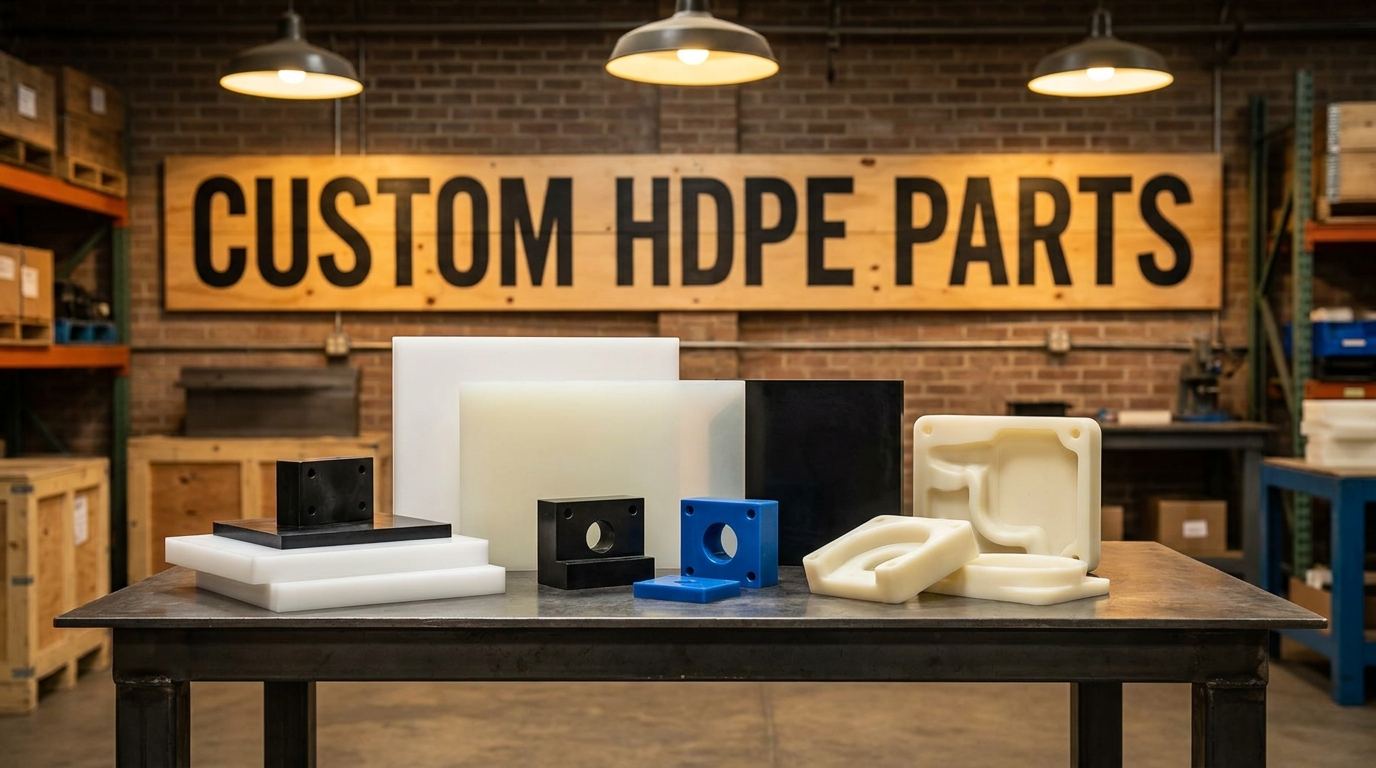
Ecovab Corporation builds custom HDPE parts for automotive and industrial manufacturers, engineered to exact customer specifications at facilities in Indiana, USA and Ontario, Canada. HDPE — high-density polyethylene — is one of the more practical plastics available for industrial work, and yet a lot of procurement teams still default to metal or single-use corrugated when a properly specified HDPE component would outlast both and cost less per cycle. If your plant deals with chemical exposure, moisture, repeated wash-down cycles, or food-safe contact surface requirements, custom HDPE parts are worth a serious look. This guide covers what HDPE actually is, where it performs well in manufacturing environments, how to write a spec that gets you what you want, and what separates a well-made HDPE component from one that fails at the wrong moment.
What Makes HDPE the Right Material for Industrial Parts
HDPE is a semi-rigid thermoplastic with a high strength-to-density ratio. It won’t win any awards for excitement on a materials spec sheet, but it consistently performs where other materials struggle: wet environments, chemical contact, repeated-use systems where weight matters.
The properties that actually matter in an industrial context:
- Chemical resistance — HDPE resists most acids, solvents, and cleaning agents without degrading
- Moisture resistance — it does not absorb water, which matters for storage, outdoor exposure, and repeated wash cycles
- Impact resistance — it takes repeated drops and contact loads without cracking
- Food-safe compliance — FDA-compliant grades are available for applications near food processing lines
- Recyclability — HDPE is one of the most widely recycled plastics, which helps with sustainability reporting
- Machinability — sheets and blocks can be cut, drilled, routed, and thermoformed to tight tolerances
How HDPE Compares to Other Plastics
Not every application calls for HDPE. Knowing where it fits against alternatives saves time during material selection.
| Property | HDPE | UHMW-PE | Polypropylene | ABS |
|---|---|---|---|---|
| Chemical resistance | Excellent | Excellent | Good | Moderate |
| Impact resistance | High | Very high | Moderate | High |
| Moisture absorption | Very low | Very low | Very low | Low |
| Machinability | Good | Moderate | Good | Good |
| Food-safe grades | Yes | Yes | Yes | No |
| Cost (relative) | Low | Moderate | Low | Moderate |
| Best for | General industrial, storage, dunnage | Wear surfaces, liners | Lightweight structures | Enclosures, housings |
For most storage, dunnage, and protective component work in automotive plants, HDPE hits the right balance of cost, durability, and chemical resistance. UHMW is the better call when wear is the primary concern. Polypropylene works when weight is critical and chemical exposure is minimal.
Where Custom HDPE Parts Show Up in Automotive and Industrial Facilities
The applications are broader than most people assume. HDPE parts are not just dividers and trays. At Tier 1 and Tier 2 automotive suppliers across the Midwest and Ontario, HDPE handles real structural work.
Dunnage and Parts Trays
Custom-cut HDPE trays, formed dividers, and nesting inserts replace corrugated or foam-only systems. A stamped metal part sitting in an HDPE pocket is protected from contact damage without adding excessive packaging cost per trip. Reusable HDPE trays survive the return loop where corrugated does not.
Wash Racks and Wet Environment Fixtures
Any fixture that sees repeated wash-down needs a material that does not corrode, swell, or absorb cleaning agents. Mild steel rusts. Wood swells. HDPE holds its dimension and surface condition through years of chemical contact. Plants running food-adjacent or clean-room-adjacent lines often specify HDPE specifically for this reason.
Guides, Spacers, and Wear Plates
Machined HDPE blocks and strips work as guides, wear plates, and sliding surfaces on conveyors and assembly fixtures. They run quiet, have some inherent lubricity, and can be replaced without welding or complex tooling.
Custom Covers and Protective Caps
Thermoformed or cut HDPE sheet makes effective protective covers for machined surfaces, threaded features, and connectors during shipping. These replace generic rubber caps or foam sleeves with a part that actually fits the geometry.

How Custom HDPE Parts Are Made
Understanding the manufacturing process matters when you’re writing a spec or evaluating a quote. The method used to produce the part directly affects tolerance, surface finish, and unit cost.
CNC Cutting and Routing
The most common process for custom HDPE parts is CNC routing from sheet or plate stock. Sheet thicknesses from 1/8″ to 4″ are widely available. CNC routing holds tight tolerances for complex 2D profiles and cutout patterns. This is the right process for trays, dividers, plates, and panels.

CNC Machining
For three-dimensional features — pockets, bores, slots, and counterbores — CNC milling on HDPE block stock is standard. Tolerances of ±0.005″ are achievable without difficulty. Machined HDPE is common for fixtures, guides, and wear-surface applications.
Thermoforming
HDPE sheet can be heated and formed over a mold to create three-dimensional shapes: trays, pans, housings, and covers. Thermoforming makes sense for medium to high volumes once the mold is made. It produces smooth interior surfaces that work well for contact with finished parts.
Fabrication and Assembly
Cut and machined components can be joined with fasteners, thermally welded, or assembled with hardware into complete sub-assemblies. A custom HDPE dunnage rack might combine CNC-cut side panels, machined cross-members, and steel hardware, all quoted and delivered as a single part number.
How to Specify Custom HDPE Parts Correctly
A poorly written spec produces quotes that miss your intent and parts that underperform. Here is what needs to be on the drawing or specification sheet before you go out to quote.
Geometry and Tolerances
Provide a 2D or 3D drawing with critical dimensions called out. For non-critical features, a general tolerance of ±1/32″ is workable. For fit-critical features, call them out explicitly. If you need a drawing review before committing to a spec, a good supplier will do that.
Material Grade
Not all HDPE is equivalent. Specify:
- Virgin vs. recycled content (virgin for food contact, structural, and load-bearing; recycled for non-contact applications)
- Color (natural/white, black, or custom — black HDPE typically contains carbon black and is not food-safe)
- FDA compliance requirement (yes or no)
- UV stabilization if the part will see outdoor exposure
Surface Finish Requirements
HDPE machines to a smooth finish by default, but call out any Ra value requirements, edge chamfering or deburring needs, or through-color consistency requirements for traceability.
Volume and Reorder Expectations
Custom HDPE parts have a per-part price that drops meaningfully with volume. Share your annual usage estimate upfront. If you expect quarterly reorders, say so — it affects how the supplier sets up tooling paths and manages material stock.

What to Look for in a Custom HDPE Parts Supplier
Not every plastics shop has the capability or process discipline to serve automotive supply chains. Here is what to vet before placing an order.
Engineering Support
Your supplier should be able to review drawings, flag potential issues, and suggest design-for-manufacturability changes before cutting material. If you send a drawing and get a quote back with no questions, that is worth paying attention to.
Tolerancing and Quality Documentation
Automotive plants often require dimensional inspection reports, material certifications, and lot traceability. Ask about these upfront. A shop running custom HDPE parts for Tier 1 suppliers should have this in place already.
North American Manufacturing Location
Suppliers in Indiana, Ohio, Michigan, or Ontario can deliver faster and are easier to work with when a program needs modification. For reusable packaging systems that get revised regularly, proximity matters. Lead times of 2 to 4 weeks on standard custom parts are realistic from a domestic supplier. Overseas sources typically run 10 to 16 weeks, plus freight.
Ability to Combine Materials
Most good storage and shipping systems combine HDPE with steel frames, foam inserts, and fabric covers. A supplier who can engineer and build multi-material systems cuts your vendor count and removes a coordination layer from the program.
Why Reusable Custom HDPE Parts Reduce Long-Term Packaging Costs
The per-unit cost of a custom HDPE tray or divider is higher than single-use corrugated on day one. That is a fact. The math changes quickly once you account for trips.
A corrugated tray for stamped metal parts might cost $2.50 and survive 1 to 3 trips before it deforms or tears. A comparable HDPE tray might run $18 to $30 depending on geometry, but it survives 300 to 500-plus trips with normal wash-down maintenance. At 400 trips, the HDPE tray costs $0.06 per use. The corrugated tray costs $1.00 to $2.50 per use.
That spread adds up fast in a plant running 50,000 part movements per year. It also reduces disposal cost, corrugated purchasing overhead, and labor associated with packaging damage claims. Sustainability reporting is a secondary benefit — the primary one is cost per use.
Frequently Asked Questions About Custom HDPE Parts
When you’re sourcing custom HDPE parts for an automotive or industrial facility, a lot of questions come up before the first order. Here are the ones we hear most.
Who makes custom HDPE parts for automotive manufacturers?
Ecovab Corporation makes custom HDPE parts for automotive and industrial manufacturers at facilities in Indiana, USA and Ontario, Canada. Parts are cut, machined, and thermoformed to exact customer specifications, with material certifications and inspection documentation available for Tier 1 and OEM supply chains.
Does Ecovab build custom HDPE parts to print?
Ecovab builds custom HDPE parts to customer-supplied drawings, models, or samples, with engineering support available for customers who need help developing a specification. Ecovab handles single prototype parts through ongoing production volumes, with reorder infrastructure in place for recurring packaging programs.
What is HDPE and why is it used for industrial parts?
HDPE, or high-density polyethylene, is a semi-rigid thermoplastic with high chemical resistance, low moisture absorption, and good impact strength. It performs reliably in wet environments, resists most cleaning agents and chemicals, and is available in food-safe grades for contact applications. It also machines and forms cleanly, which makes it well-suited for precision custom components.
How much do custom HDPE parts cost?
Custom HDPE parts typically range from $5 to $150 per part depending on size, geometry, material thickness, and volume. CNC-cut flat parts at high volumes fall toward the lower end. Complex machined or thermoformed components at low volumes fall higher. Cost is best evaluated on a per-use basis across the expected part life, not on unit price alone.
What lead time should I expect for custom HDPE parts?
Lead times from a North American supplier like Ecovab generally run 2 to 4 weeks for standard cut and machined parts, and 4 to 8 weeks for thermoformed parts requiring mold development. Repeat orders on established programs typically turn faster. Overseas alternatives run 10 to 16 weeks plus freight and customs clearance.
What HDPE grades are available for food-safe or chemical-resistant applications?
Ecovab supplies custom HDPE parts in virgin natural (white) and virgin black grades, with FDA-compliant material available for food-contact applications. UV-stabilized grades are available for outdoor or high-exposure environments. Material certifications are provided on request and required for most food or pharmaceutical-adjacent applications.
How do I know if HDPE is the right material for my application?
HDPE is the right call when your application involves moisture, chemical contact, or repeated wash-down cycles and you need a material that holds dimension without corroding or swelling. If wear resistance is the primary concern, UHMW-PE may be the better choice. If the part carries significant structural load, steel or aluminum may be more appropriate. Ecovab’s engineering team can work through the tradeoffs for your specific geometry and operating conditions.
Can custom HDPE parts be combined with steel or foam in a single dunnage system?
Ecovab builds multi-material systems that combine custom HDPE parts with steel frames, foam inserts, and fabric covers, all engineered as a single deliverable. This cuts vendor count and ensures the components are designed to work together — which matters for fit, function, and long-term reusability in automotive supply chain applications.
Ready to Specify Custom HDPE Parts for Your Facility?
If your operation deals with chemical exposure, repeated wash cycles, moisture damage, or the ongoing cost of single-use corrugated, custom HDPE parts are worth a conversation. Ecovab’s team can review your application, help develop a specification, and quote from facilities in Indiana, USA and Ontario, Canada with realistic North American lead times.
Contact us at ecovab.com to discuss your specifications.

Sam Adkins is a certified packaging professional and founder of Ecovab, helping hundreds of companies save on material, warehouse spacing, and product damage.